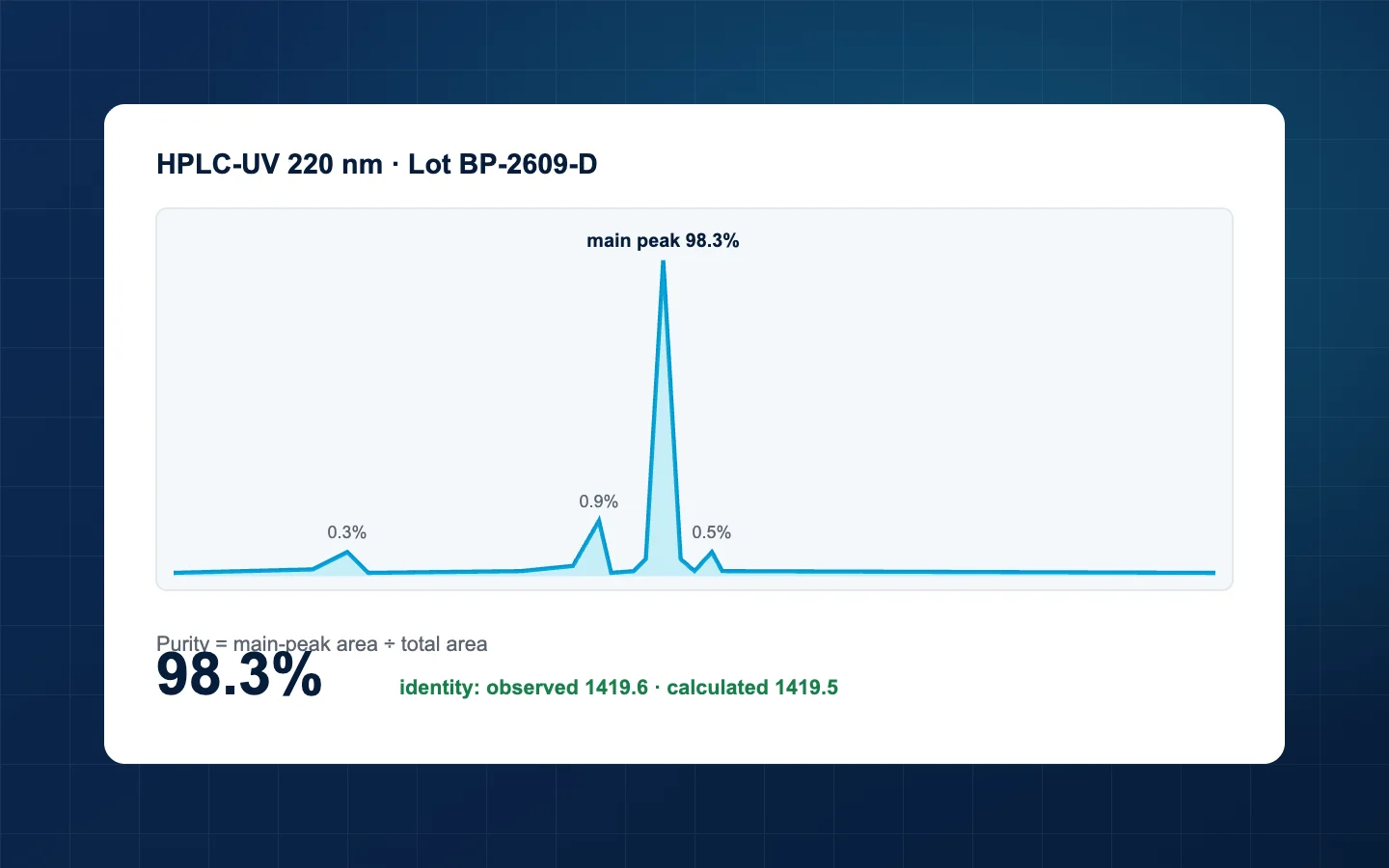
98% purity by HPLC is a good number for a research peptide. It clears the threshold most synthesis houses set for cell-based assays and animal work, and the difference between 98% and 99% rarely changes an experimental result. What matters more than the last percent is what the missing fraction is, and whether the identity test confirms that the main peak is the compound on the label.
This post gives the thresholds by application, explains what sits in the other 2%, walks through a chromatogram, and lists the current purity figure for every lot in the catalog.
What does a purity percentage measure?
Purity on a certificate is the area of the main peak on an HPLC chromatogram divided by the total area of all peaks. Bachem's quality guide describes the standard method: UV detection at 210 to 220 nm, where the peptide bond absorbs, with the main-peak area taken as a fraction of the total. A 98% figure means 98% of the UV-absorbing material that came off the column eluted as one compound.
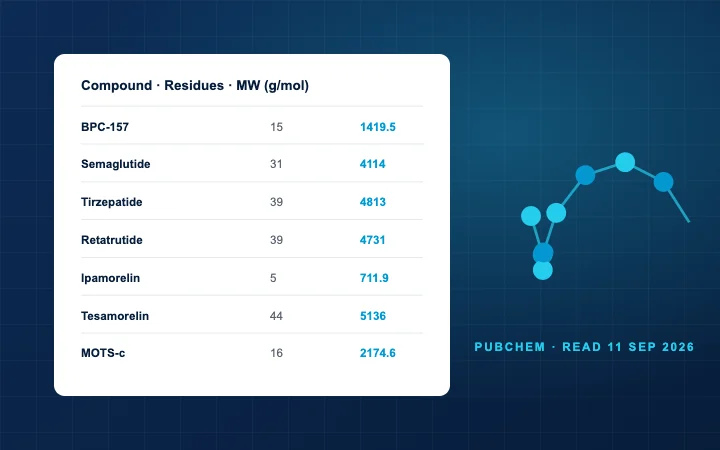
It does not say what that compound is, which is why a certificate also needs an observed mass from LC-MS. The certificate guide covers both lines, and the reference table gives the mass to compare against for every compound we sell.
What purity does each kind of experiment need?
Synthesis houses publish purity tiers by application, and they agree closely. GenScript's guideline, which is representative, sets these levels:
| Purity | Grade | Typical applications |
|---|---|---|
| Over 75% | Immuno grade | ELISA, peptide arrays, antigens for antibody production |
| Over 85% | Biochemistry grade | Non-quantitative in-vitro bioassays, epitope mapping, blocking studies |
| Over 95% | High purity | Quantitative in-vitro bioassays, receptor-ligand studies, NMR |
| Over 98% | Industrial and clinical grade | Crystallography, SAR studies, GMP and clinical material, animal studies |
The tiers say two things. First, 98% is the top tier, not a compromise. Second, the applications a research peptide buyer usually has in mind, quantitative in-vitro work and animal models, sit at 95% and 98% respectively. A 95% vial is fine for a receptor binding curve and not fine for an in-vivo model where the impurities go in with the compound.
What is in the other 2%?
For a synthetic peptide the impurities are mostly relatives of the target. D'Hondt and colleagues grouped them in their 2014 review: deletion sequences where one coupling failed, truncated chains that stopped early, variants where a protecting group stayed attached, and residues that oxidised or racemised. Because they are chemically close to the target they elute near it and often have similar activity, which is why a 97% vial and a 99% vial of the same compound behave alike in most assays.
The exception is any experiment where a specific impurity is active on its own, or where the readout is sensitive enough to see a 2% shift in dose. Those are the experiments that justify paying for the last percent. The synthesis post maps each impurity class to the step that makes it.
How do you read the chromatogram?
A certificate should show the trace, not just the number. Reading one takes four steps:
- Find the main peak. It is the tallest, and its retention time should match the supplier's reference for the compound.
- Look at the shoulders. Small peaks just before and after the main peak are the deletion and protecting-group variants. A shoulder that is not baseline-separated may have been integrated into the main peak, which flatters the number.
- Check the early region. Peaks near the solvent front are truncated fragments and small molecules. They are easy to see and easy to integrate honestly.
- Read the integration table. Each peak's area percentage should be listed. Add the non-main peaks; they should sum to 100 minus the purity figure.
A worked illustration: a trace shows a main peak at 14.2 minutes with 98.3% of area, a shoulder at 13.9 minutes with 0.9%, a peak at 14.6 minutes with 0.5%, and early peaks totalling 0.3%. That is a 98.3% lot with one deletion sequence, one protecting-group variant and trace fragments. It is a normal, good result. The same trace with the shoulder merged into the main peak would read 99.2% and be a worse report of the same vial.
Does 99% beat 98% in practice?
Only when three things hold: the identity is confirmed for both, the impurity profile is known, and the assay can resolve a 1% difference in delivered compound. In most research settings the third condition fails. The variance introduced by weighing, reconstitution and pipetting is larger than 1%, so the extra purity disappears into noise.
Net peptide content, which can differ by 10% or more between suppliers, moves the effective dose far more than a point of purity does. The post on price differences works through that arithmetic.
Which threshold applies to each product in this catalog?
| Compound | Typical research use | Purity that use needs |
|---|---|---|
| BPC-157, TB-500 | Cell migration and wound models, some in vivo | 98% |
| Semaglutide, tirzepatide, retatrutide | Receptor pharmacology, metabolic models in vivo | 98% |
| Ipamorelin, tesamorelin | Receptor assays, secretion models | 95% in vitro, 98% in vivo |
| GHK-Cu | Cell culture, gene expression | 95% |
| MOTS-c | Cell metabolism assays, some in vivo | 98% |
| NAD+ | Enzyme and cell assays | 95% (not a peptide; HPLC still applies) |
Every lot in the catalog is tested against the 98% tier regardless, so that the in-vivo case is covered for all of them.
What does the current certificate show for each lot?
The figures below are read from the current certificates and update when a lot changes.
| Compound | Lot | Purity (HPLC-UV) | Identity | Certificate |
|---|---|---|---|---|
| Retatrutide 10 mg | RT-2609-A | 99.4% | LC-MS | View |
| Tirzepatide 10 mg | TZ-2608-C | 99.2% | LC-MS | View |
| Semaglutide 5 mg | SM-2608-B | 99.6% | LC-MS | View |
| BPC-157 5 mg | BP-2609-D | 99.7% | LC-MS | View |
| TB-500 5 mg | TB-2608-A | 99.3% | LC-MS | View |
| BPC-157 + TB-500 10 mg blend | BL-2609-B | 99.1% | LC-MS | View |
| CJC-1295 + Ipamorelin 5/5 mg | BL-2608-E | 99.0% | LC-MS | View |
| Ipamorelin 5 mg | IP-2609-C | 99.5% | LC-MS | View |
| Tesamorelin 10 mg | TS-2608-D | 99.2% | LC-MS | View |
| GHK-Cu 50 mg | GK-2609-A | 99.8% | LC-MS | View |
| NAD+ 500 mg | ND-2608-B | 99.3% | LC-MS | View |
| MOTS-c 10 mg | MC-2609-E | 99.1% | LC-MS | View |
| Cagrilintide 10 mg | CAG-2609-X | 99.0% | LC-MS | View |
| Retatrutide + Cagrilintide 12.5 mg / 2.5 mg | RET-2609-X | 99.0% | LC-MS | View |
| AOD-9604 5 mg | AOD-2609-X | 99.0% | LC-MS | View |
| 5-Amino-1MQ 50 mg | 5AM-2609-X | 99.0% | LC-MS | View |
| KPV 10 mg | KPV-2609-X | 99.0% | LC-MS | View |
| ARA-290 10 mg | ARA-2609-X | 99.0% | LC-MS | View |
| SS-31 10 mg | SS3-2609-X | 99.0% | LC-MS | View |
| Thymosin Alpha-1 10 mg | THY-2609-X | 99.0% | LC-MS | View |
| Thymalin 20 mg | THY-2609-Y | 99.0% | LC-MS | View |
| CJC-1295 (no DAC) 10 mg | CJC-2609-X | 99.0% | LC-MS | View |
| Sermorelin 5 mg | SER-2609-X | 99.0% | LC-MS | View |
| IGF-1 LR3 1 mg | IGF-2609-X | 99.0% | LC-MS | View |
| Kisspeptin-10 10 mg | KIS-2609-X | 99.0% | LC-MS | View |
| KLOW blend 80 mg blend | KLO-2609-X | 99.0% | LC-MS | View |
| GLOW mix 70 mg blend | GLO-2609-X | 99.0% | LC-MS | View |
| Selank + Semax 5 mg / 5 mg | SEL-2609-X | 99.0% | LC-MS | View |
| CJC-1295 (no DAC) + GHRP-6 5/5 mg | CJC-2609-Y | 99.0% | LC-MS | View |
| Tesamorelin + Ipamorelin 10 mg / 5 mg | TES-2609-X | 99.0% | LC-MS | View |
| Melanotan-1 10 mg | MEL-2609-X | 99.0% | LC-MS | View |
| Melanotan-2 10 mg | MEL-2609-Y | 99.0% | LC-MS | View |
| SNAP-8 10 mg | SNA-2609-X | 99.0% | LC-MS | View |
| L-Glutathione 600 mg | LGL-2609-X | 99.0% | LC-MS | View |
| Humanin 10 mg | HUM-2609-X | 99.0% | LC-MS | View |
| PT-141 10 mg | PT1-2609-X | 99.0% | LC-MS | View |
| Semax 10 mg | SEM-2609-X | 99.0% | LC-MS | View |
| Selank 10 mg | SEL-2609-Y | 99.0% | LC-MS | View |
| P-21 5 mg | P21-2609-X | 99.0% | LC-MS | View |
| PE-22-28 10 mg | PE2-2609-X | 99.0% | LC-MS | View |
| Dihexa 5 mg | DIH-2609-X | 99.0% | LC-MS | View |
| Adamax 10 mg | ADA-2609-X | 99.0% | LC-MS | View |
| DSIP 5 mg | DSI-2609-X | 99.0% | LC-MS | View |
| Epithalon 10 mg | EPI-2609-X | 99.0% | LC-MS | View |
| Pinealon 20 mg | PIN-2609-X | 99.0% | LC-MS | View |
| Prostamax 20 mg | PRO-2609-X | 99.0% | LC-MS | View |
| Testagen 20 mg | TES-2609-Y | 99.0% | LC-MS | View |
| Vesugen 20 mg | VES-2609-X | 99.0% | LC-MS | View |
| Vilon 20 mg | VIL-2609-X | 99.0% | LC-MS | View |
Blends report purity per component, with both peaks integrated on the same chromatogram. The lot report collects the month's certificates in one place.
How should you read a purity claim on another site?
Ask three questions. Is the number attached to a lot, or is it a site-wide badge? Is there an observed mass next to it? Is the method named, with a wavelength or at least "HPLC-UV"? A lot-matched 98% with a mass and a method is a measurement. A site-wide "99%+" with none of those is a claim. The supplier vetting checklist covers the rest.
Frequently asked questions
Is 95% purity acceptable for cell culture?
For non-quantitative and semi-quantitative in-vitro work, yes. For quantitative cell assays and anything in vivo, the published guidelines put the threshold at 98%, so 95% material is a compromise you would need to justify.
Can purity be higher than 99%?
Yes. Preparative HPLC can take most sequences above 99%, at the cost of yield. Whether the extra purity is worth paying for depends on whether the assay can see it, and for most research it cannot.
Why do two certificates for the same lot show different purity?
Different columns, gradients and detection wavelengths integrate the same sample differently, and a second lab may resolve a shoulder peak the first merged into the main peak. Differences of a point or so between labs are normal. Larger gaps mean one of the two reports is wrong.
Does purity change in storage?
Slowly, if the vial stays sealed, dry and cold. Once reconstituted, hydrolysis and oxidation reduce it week by week. The storage guide gives the windows by compound class.
References
- GenScript. Recommended Peptide Purity Guidelines. Read 11 September 2026. www.genscript.com/recommended_peptide_purity.html
- Bachem. Quality Control of Amino Acids and Peptides: A Guide. Purity assessed by UV at 210 to 220 nm as main-peak area over total area; identity by mass spectrometry. www.bachem.com/knowledge-center/quality-control-of-amino-acids-peptides-a-guide
- D'Hondt M, Bracke N, Taevernier L, et al. Related impurities in peptide medicines. Journal of Pharmaceutical and Biomedical Analysis 2014;101:2-30. doi.org/10.1016/j.jpba.2014.06.012
Every product mentioned is sold for laboratory research use only and is not for human or animal use. Nothing on this page describes or recommends use of the material sold here in humans or animals.