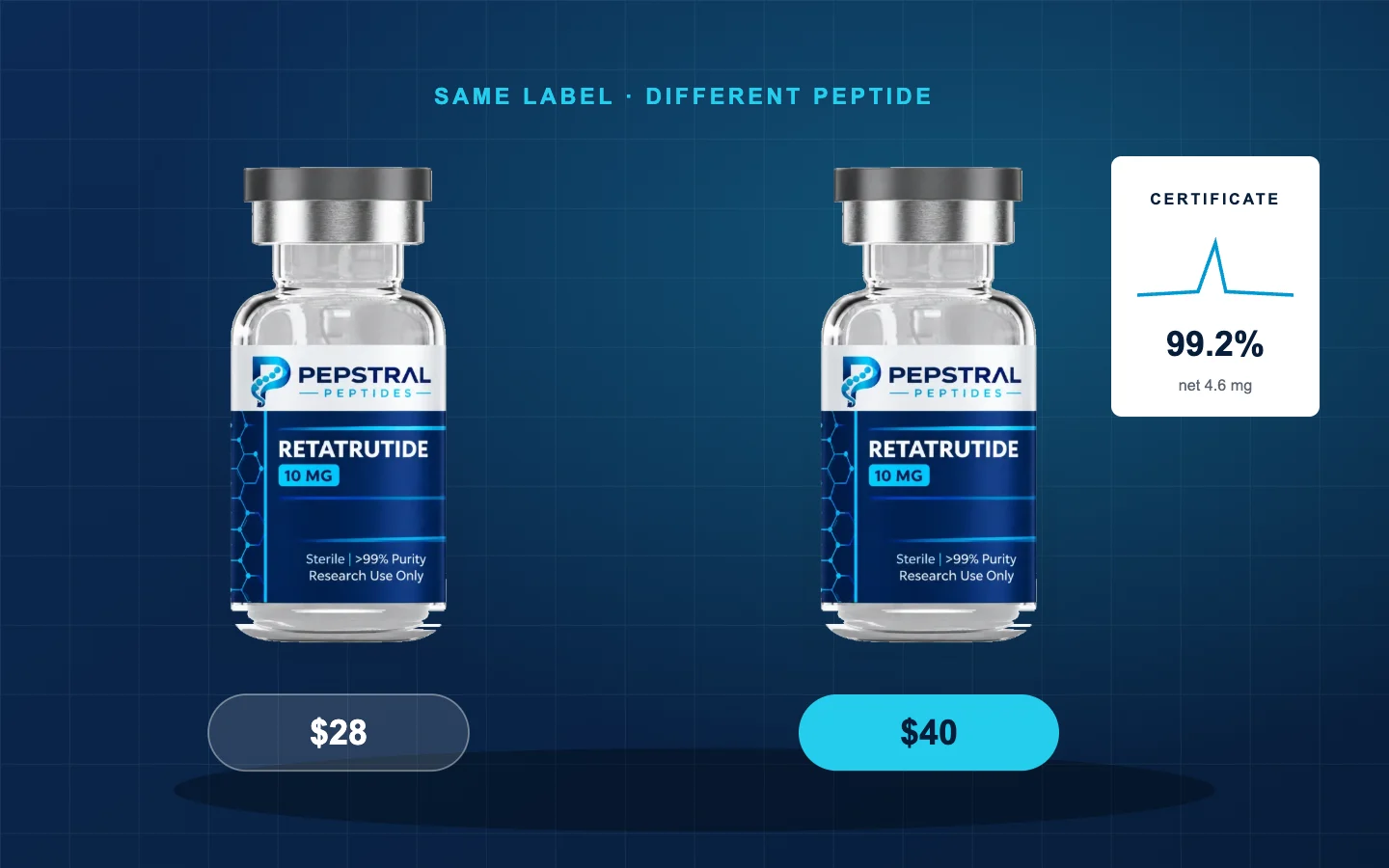
Most of the price difference between two vials with the same label comes from four things: how hard the sequence is to make, how many purification passes it went through, whether the milligrams on the label are net peptide or gross powder, and whether the lot was tested by an outside laboratory. A cheap vial is usually cheap because one or more of those was skipped. The certificate is where you find out which, and this post ends with a worked comparison that shows how to read price against it.
How does the sequence itself set the floor?
Peptides are built one amino acid at a time on a solid support. Each coupling step has a yield below 100%, so the longer the sequence, the more product is lost along the way and the more crude material has to be made to end up with the same finished quantity.
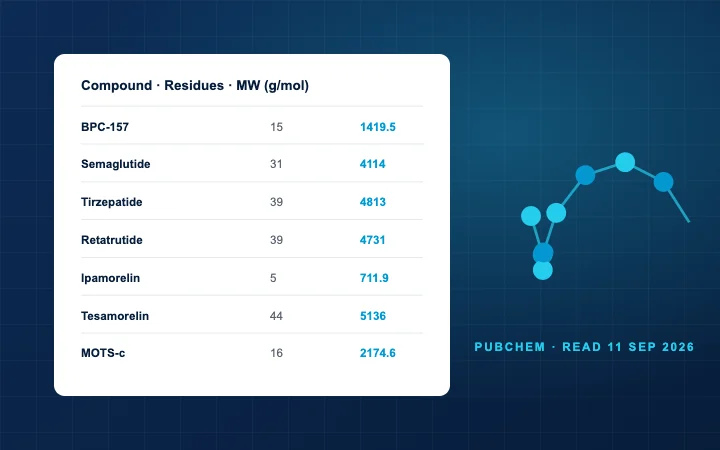
BPC-157 is 15 residues. Semaglutide is 31 residues with a fatty-acid side chain attached to a lysine, and tirzepatide is 39 residues with a similar modification. The synthesis post shows the arithmetic: at 99% per step, a 15-residue chain comes off the resin about 87% full-length and a 39-residue chain about 68%. The GLP-1 class compounds cost more per milligram partly because of that, and a supplier pricing them near a short peptide is either buying from a very large producer or cutting a corner further down this list.
What do purification passes add?
Crude synthetic peptide comes off the support as a mixture: the full sequence plus shorter chains where a coupling failed and variants where a protecting group stayed on. D'Hondt and colleagues catalogued these related impurities in their 2014 review, and they are the same classes for research material as for medicines.
Preparative HPLC separates them, and each pass trades yield for purity. Taking a lot from 90% to 98% discards a meaningful fraction of the material, and going from 98% to above 99% discards more. That lost material is a real cost. A 99% vial and a 95% vial are not the same product at different prices; they are different quantities of the same product plus different amounts of something else. GenScript's published guideline puts cell assays and animal work at the 98% tier, which is why that grade costs what it does.
Is the label weight net peptide or gross powder?
This is the one that changes the effective price the most. A lyophilized vial contains the peptide, residual water, and counter-ions, usually trifluoroacetate or acetate, left over from purification. Bachem's quality guide defines net peptide content as the percentage of peptide relative to that non-peptidic material and notes that sequences with many basic residues, or hygroscopic sequences, carry more of it even when they are extremely pure. Synthesis houses put the typical range at 60% to 90% of the powder weight.
So a supplier who fills 5 mg of gross powder is delivering somewhere between 3 mg and 4.5 mg of peptide. A supplier who fills 5 mg of net peptide is delivering 5 mg. Comparing sticker prices without knowing which one you are looking at is comparing different amounts. The certificate guide explains where net content appears on a report.
What does per-lot testing cost?
Running HPLC purity, LC-MS identity and an endotoxin assay on each lot at an independent laboratory is a fixed cost per lot. Spread over a large lot it is small per vial; spread over a small lot it is not. Suppliers who skip it, or who test once and reuse the certificate, save that cost and pass some of it on.
That is the saving you are buying when a vial is unusually cheap, and the COA library is where you check whether the saving was made. The independent testing post gives the current price of a single-compound test at an outside lab, which is a useful scale for what a supplier saves by skipping it.
Why do fill accuracy and packaging matter?
Filling a vial with a few milligrams of powder to a tight tolerance requires either gravimetric filling of each vial or filling as a solution and then lyophilizing in the vial. Both are slower than scooping. Add a stoppered, crimped, labelled vial in a carton with a desiccant and cold-chain packing, and the per-unit cost rises again.
None of this shows on the certificate, but it shows in whether the vial you receive has an intact cake, a clean crimp and a lot label that matches the label fields you expect.
A worked comparison
The figures below are invented to show the method, not to describe any real supplier. Two vials of a 5 mg peptide:
| Line | Supplier A | Supplier B |
|---|---|---|
| Sticker price | $28 | $40 |
| Label weight | 5 mg | 5 mg |
| Net peptide content on certificate | Not stated | 92% |
| Assumed net peptide | 3.5 mg (70% of gross, mid-range) | 4.6 mg |
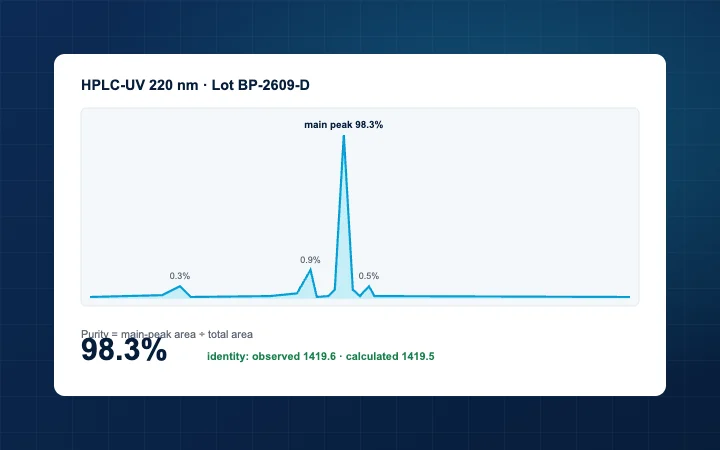
| Purity by HPLC | 97% (template certificate, no lot) | 99.2% (lot-matched) |
| Identity | Not shown | Observed mass matches |
| Price per net milligram | $8.00 | $8.70 |
| Price per net milligram of confirmed compound | Unknown: identity not tested | $8.70 |
Supplier B is 43% more expensive on the sticker and about 9% more expensive per net milligram, and only Supplier B has proved what the milligrams are. If Supplier A's net content is at the low end of the typical range, 60%, its price per net milligram becomes $9.33 and the cheap vial is now the expensive one. Run this table with real certificate figures and the cheap option usually stops looking cheap.
Which questions to ask before comparing prices
- Is the lot number on the product page, and is there a certificate for it?
- Does the certificate state net peptide content, or quantify against a standard?
- Is there an observed mass?
- Is the laboratory named?
- What is the price per net milligram?
Ask them in that order. A supplier who fails the first two cannot be compared on price at all, because you do not know what you are buying.
Frequently asked questions
Does a higher price guarantee a better product?
No. Price only sets a floor below which the work cannot have been done properly. Above that floor the certificate, not the price, tells you what you are getting.
Why are blends priced below the two singles combined?
A blend is filled once, tested once and shipped as one vial, so the fixed per-vial costs are shared. The trade-off is a fixed ratio, which the post on blends versus single compounds covers.
Are bulk discounts a warning sign?
Not by themselves. Larger lots lower the per-vial testing cost, so genuine bulk pricing exists. It becomes a warning sign when the discount is paired with a certificate that has no lot number or no laboratory name.
Where do Pepstral's prices sit?
Each product page shows the price, the lot and the purity on the same line, and the certificate for that lot is in the library. Ipamorelin at $40 with a matching certificate and stated net content can be compared per net milligram with any other supplier's vial, which is the comparison we would rather be judged on.
References
- Bachem. Quality Control of Amino Acids and Peptides: A Guide. Net peptide content defined as peptide relative to non-peptidic material, mostly counter-ions and moisture. www.bachem.com/knowledge-center/quality-control-of-amino-acids-peptides-a-guide
- AmbioPharm. What is Net Peptide Content? Typical range 60% to 90% of total weight. www.ambiopharm.com/faq/what-is-net-peptide-content
- D'Hondt M, Bracke N, Taevernier L, et al. Related impurities in peptide medicines. Journal of Pharmaceutical and Biomedical Analysis 2014;101:2-30. doi.org/10.1016/j.jpba.2014.06.012
- GenScript. Recommended Peptide Purity Guidelines. www.genscript.com/recommended_peptide_purity.html
Every product mentioned is sold for laboratory research use only and is not for human or animal use. Nothing on this page describes or recommends use of the material sold here in humans or animals.