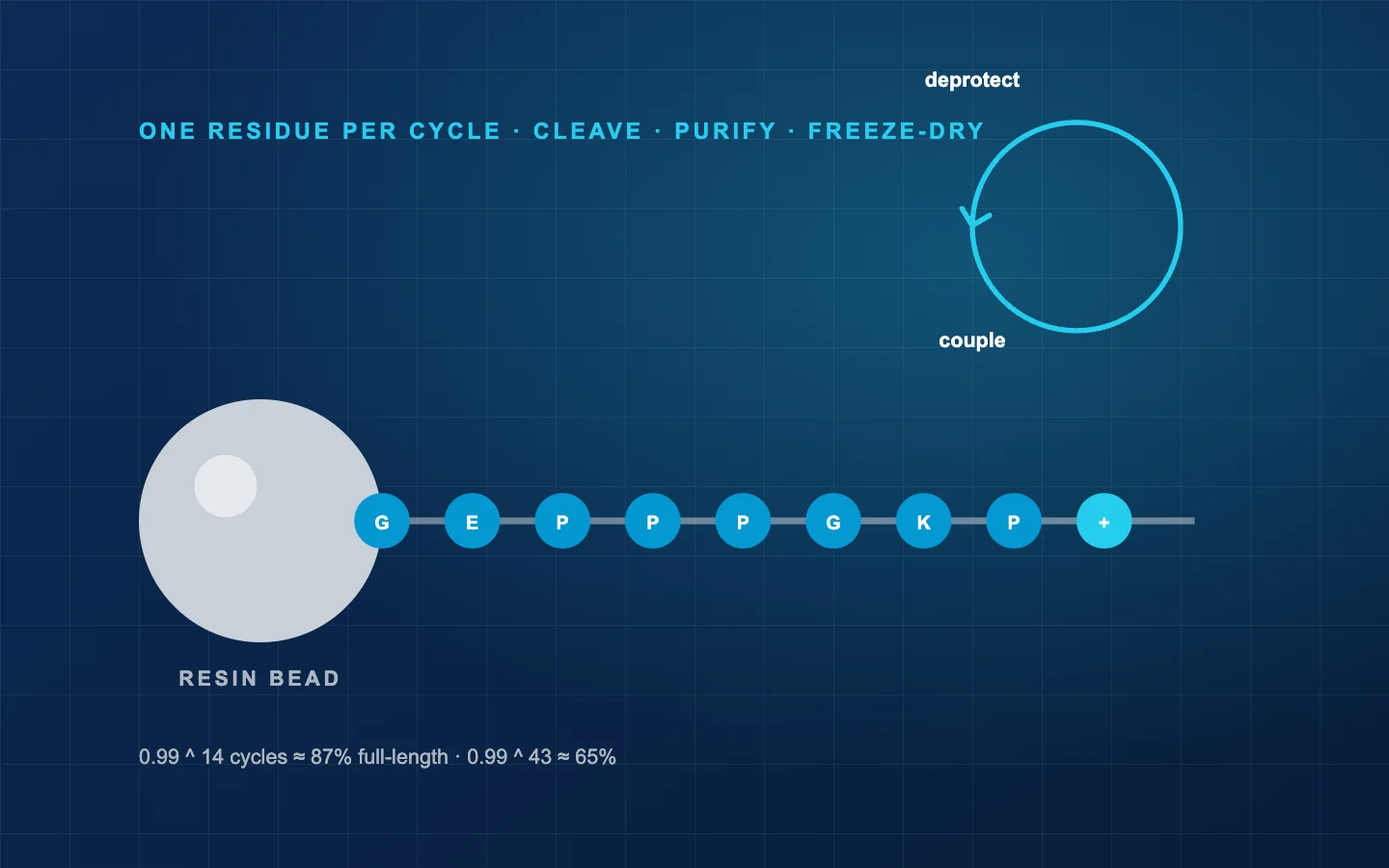
Nearly every research peptide on the market is made the same way: built one amino acid at a time on a solid resin, cleaved off, purified by preparative HPLC, and freeze-dried into the powder in the vial. The method was introduced by Bruce Merrifield in 1963 and made practical for routine work by the Fmoc protecting group that Carpino and Han described in 1972.
Understanding the six steps explains where the impurities on a certificate come from, why longer peptides cost more, and why "purity" and "net peptide content" are separate numbers.
What are the six steps of solid-phase synthesis?
- Anchor. The first amino acid, with its amine blocked by an Fmoc group and any reactive side chain blocked by a second protecting group, is attached to a resin bead through its carboxyl end.
- Deprotect. A mild base removes the Fmoc group from the amine, exposing it for the next coupling. The side-chain protecting groups stay on.
- Couple. The next Fmoc-protected amino acid is activated and added; its carboxyl group forms a peptide bond with the exposed amine. Excess reagent is washed away.
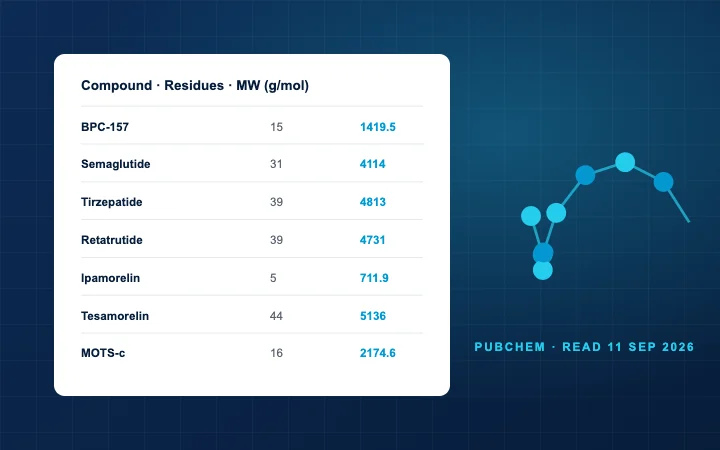
- Repeat. Steps 2 and 3 run once per residue. A 31-residue peptide such as semaglutide needs 30 cycles; a 44-residue peptide such as tesamorelin needs 43.
- Cleave. A strong acid, usually trifluoroacetic acid with scavengers, cuts the finished chain off the resin and strips the side-chain protecting groups in one step. The crude peptide is precipitated in cold ether.
- Purify and dry. Preparative reverse-phase HPLC separates the full-length peptide from everything else; the collected fractions are freeze-dried to the lyophilized powder that goes into the vial.
Why the resin? Because everything except the growing chain can be washed away between steps. Merrifield's insight was that anchoring the peptide to an insoluble bead turns a series of difficult purifications into a series of filtrations, which is what makes a 40-cycle synthesis practical at all.
How are the GLP-1 class side chains added?
Semaglutide, tirzepatide and retatrutide carry a fatty-acid chain on a lysine side chain, attached through a short linker. That group is what extends their half-life by binding albumin. In synthesis it is added either on the resin, by using an orthogonal protecting group on that one lysine so it can be exposed and modified while the rest of the chain stays protected, or after cleavage in solution. Either route adds cycles, a second purification, and a further set of possible impurities, which is part of why these compounds cost more than their length alone predicts.
Why does length set the yield?
Every coupling and every deprotection runs below 100%. Suppose each cycle is 99% complete, which is good practice. The fraction of chains that are full-length at the end is 0.99 raised to the number of cycles:
| Peptide | Residues | Full-length chains at 99% per cycle | At 98% per cycle |
|---|---|---|---|
| Ipamorelin | 5 | about 96% | about 92% |
| BPC-157 | 15 | about 87% | about 75% |
| Semaglutide | 31 | about 74% | about 55% |
| Tirzepatide, retatrutide | 39 | about 68% | about 46% |
| Tesamorelin | 44 | about 65% | about 42% |
This is arithmetic, not measurement, but it shows why crude purity drops with length, why more purification is needed to reach the same final purity, and why the price per milligram rises with residue count. It also shows why a one-point drop in per-cycle efficiency matters far more for a long peptide than a short one.
What does the crude chromatogram look like?
Before purification, an HPLC trace of the crude product shows the target as the tallest peak with a cluster of smaller peaks packed close around it and a scatter of early peaks near the solvent front. The close cluster is the deletion and protecting-group variants, which differ from the target by one residue or one small group and so elute nearby. The early peaks are truncated fragments and reagent residues.
After preparative HPLC, the same sample shows one dominant peak with small, well-separated shoulders and a clean early region. The purity post shows how to read that final trace and the integration table under it.
Where does each impurity come from?
D'Hondt and colleagues reviewed the impurities found in peptide medicines and grouped them by origin. The same classes apply to research material.
| Impurity | Which step makes it | What it looks like on the certificate |
|---|---|---|
| Deletion sequence | A coupling that failed for one residue; the chain continued without it | A peak close to the main peak on HPLC, one residue lighter on LC-MS |
| Truncated sequence | A chain capped after a failed coupling so it stops growing | An earlier-eluting HPLC peak, well below the target mass |
| Incomplete deprotection | A side-chain protecting group that survived cleavage | A peak slightly heavier than the target |
| Oxidised residue | Methionine, cysteine or tryptophan oxidised during cleavage or storage | Target mass plus 16 |
| Racemised residue | A stereocentre inverted during activation | Same mass, slightly different HPLC retention |
| Trifluoroacetate | Left over from cleavage and from the HPLC mobile phase; the peptide is delivered as its TFA salt | Not on the chromatogram; it is the gap between gross weight and net peptide content |
| Water | Absorbed during and after freeze-drying | Also in the gap between gross weight and net content |
The first five are "related impurities": they are the peptide's own near-relatives, which is why they elute near it and why a 98% purity figure still means the vial is almost entirely one compound and its close variants. The last two are not on the chromatogram at all. Bachem's guide is explicit that net peptide content and purity are different measurements, which is why they have to be reported separately.
How does purification decide the final number?
Preparative HPLC runs the crude mixture through a column and collects the fraction that elutes as the target. Cutting the fraction narrowly raises purity and throws away product; cutting it wide keeps yield and lets shoulder peaks through. Taking a lot from 95% to 98% and from 98% to above 99% each discards a meaningful share of the material, which is the direct cost behind higher purity grades. A second pass through the column can remove a specific impurity that co-eluted the first time.
Why are blends co-lyophilized rather than co-synthesized?
Two different sequences cannot be built on the same bead, and a mixed synthesis would give a mixture of chains with no control over the ratio. A blend is made by synthesizing and purifying each peptide separately, combining the purified solutions at the target ratio, and freeze-drying them together. That is why a blend certificate has two identity lines and two purity figures, as the blends post describes.
What does the certificate check at each stage?
- HPLC purity integrates the main peak against everything else and catches the related impurities.
- LC-MS identity confirms the main peak has the target mass, which catches a deletion sequence being sold as the full peptide. The reference table gives the mass to expect.
- Net peptide content, by amino acid analysis or by quantifying against a reference standard, catches the counter-ion and water.
- Endotoxin and sterility test for what the process should never have introduced.
A vial with all four lines on a lot-matched certificate has been checked at every point where the synthesis could have gone wrong. The certificate guide shows what each line looks like on a real report.
Frequently asked questions
Are research peptides made differently from pharmaceutical ones?
The chemistry is the same. The difference is the quality system around it: pharmaceutical synthesis runs under GMP with validated methods and full impurity qualification, research synthesis does not. That is why a research certificate matters so much; it is the only quality record there is.
Why is the peptide a TFA salt?
Because trifluoroacetic acid is used for cleavage and as the HPLC mobile-phase modifier, and it pairs with basic residues on the peptide. Freeze-drying removes the free acid but not the counter-ion. Acetate exchange is possible and is sometimes done for cell work where TFA is a concern.
Can a deletion sequence be biologically active?
Sometimes, which is why it matters for quantitative work. Most deletion sequences of a receptor ligand bind less well or not at all, but a few retain activity, and the purity figure does not distinguish them. A high-resolution chromatogram and a low impurity total are the practical protection.
Does longer synthesis time affect stability?
Not directly. Stability is set by the sequence and by how the lyophilized powder is stored. The storage guide covers it by compound class.
References
- Merrifield RB. Solid Phase Peptide Synthesis. I. The Synthesis of a Tetrapeptide. Journal of the American Chemical Society 1963;85(14):2149-2154. pubs.acs.org/doi/10.1021/ja00897a025
- Carpino LA, Han GY. 9-Fluorenylmethoxycarbonyl amino-protecting group. Journal of Organic Chemistry 1972;37(22):3404-3409. pubs.acs.org/doi/10.1021/jo00795a005
- D'Hondt M, Bracke N, Taevernier L, et al. Related impurities in peptide medicines. Journal of Pharmaceutical and Biomedical Analysis 2014;101:2-30. doi.org/10.1016/j.jpba.2014.06.012
- Bachem. Quality Control of Amino Acids and Peptides: A Guide. Purity by HPLC at 210 to 220 nm; net peptide content; identity by mass spectrometry. www.bachem.com/knowledge-center/quality-control-of-amino-acids-peptides-a-guide
Every product mentioned is sold for laboratory research use only and is not for human or animal use. Nothing on this page describes or recommends use of the material sold here in humans or animals.