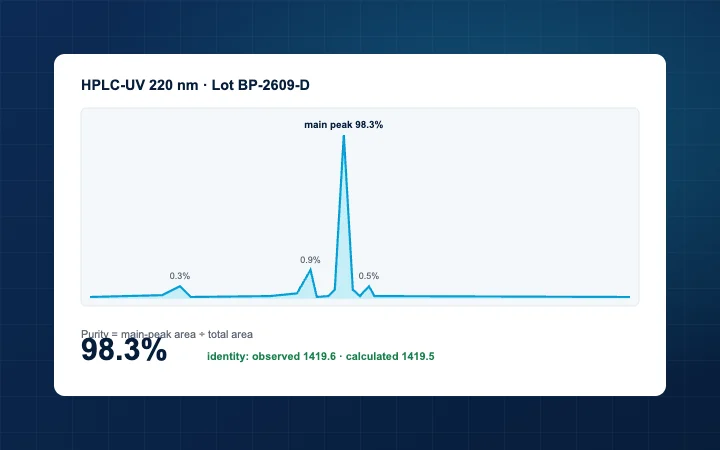
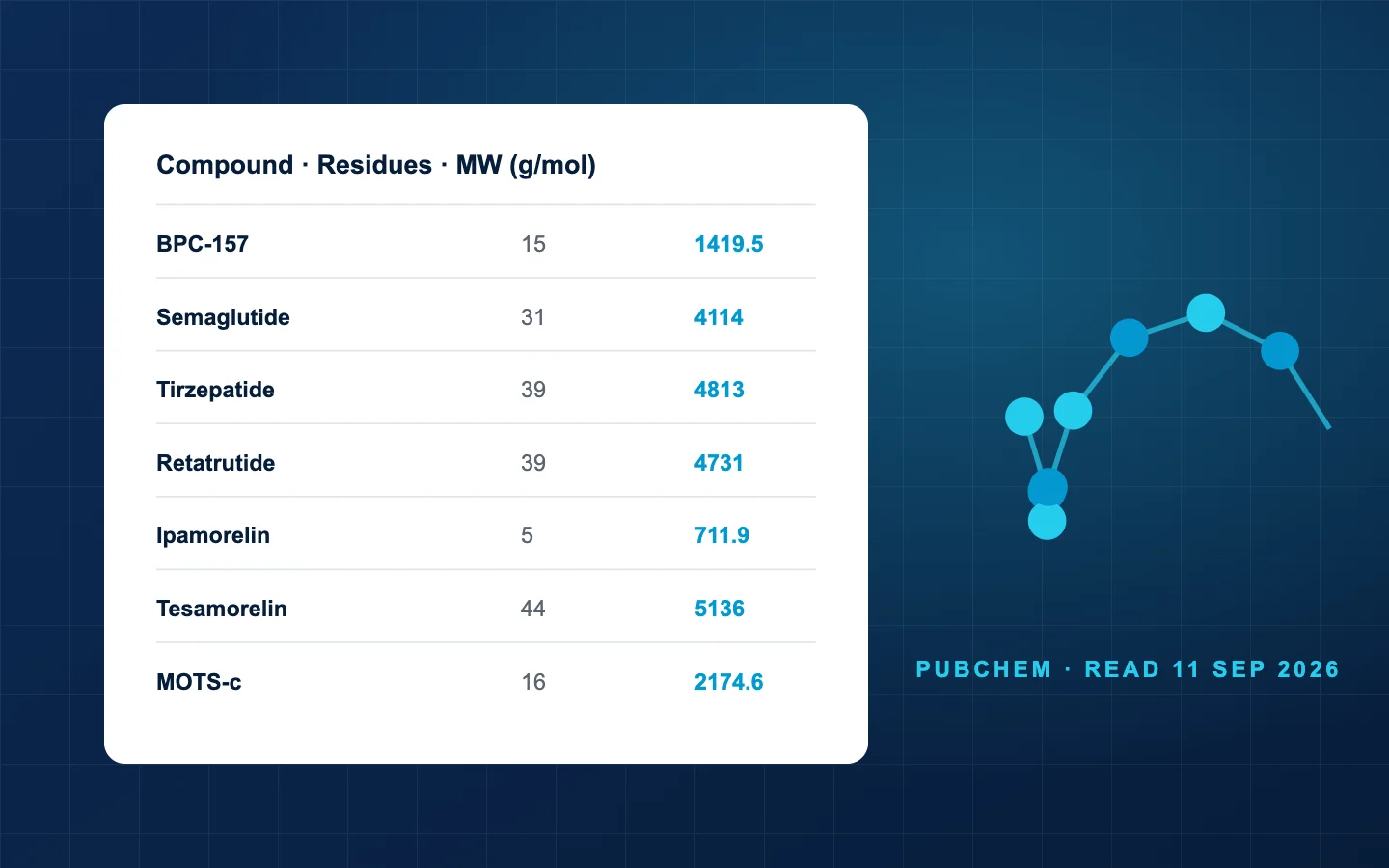
Every certificate of analysis reports an observed mass. To know whether that mass is right you need the calculated mass of the compound, and that number is surprisingly hard to find in one place across a catalog. This page gives it for all twelve compounds we sell, together with the residue count and the molecular formula, read from PubChem on 11 September 2026. Each row links to the PubChem record so the values can be checked at source.
Two further tables do the arithmetic a certificate reader and a bench worker need most often: the mass-spectrometry peaks to expect at three charge states, and the molar concentration of each catalog vial at three reconstitution volumes.
The reference table
| Compound | Residues | Molecular formula | Molecular weight (g/mol) | PubChem CID |
|---|---|---|---|---|
| BPC-157 | 15 | C62H98N16O22 | 1419.5 | 9941957 |
| TB-500 | 7 | C38H68N10O14 | 889.0 | 62707662 |
| Semaglutide | 31 | C187H291N45O59 | 4114 | 56843331 |
| Tirzepatide | 39 | C225H348N48O68 | 4813 | 166567236 |
| Retatrutide | 39 | C221H342N46O68 | 4731 | 171390338 |
| Ipamorelin | 5 | C38H49N9O5 | 711.9 | 9831659 |
| Tesamorelin | 44 | C221H366N72O67S | 5136 | 16137828 |
| GHK-Cu | 3 | C14H21CuN6O4 (complex) | 400.9 | 139035031 |
| NAD+ | not a peptide | C21H27N7O14P2 | 663.4 | 5892 |
| MOTS-c | 16 | C101H152N28O22S2 | 2174.6 | 146675088 |
| CJC-1295 (in the CJC + Ipamorelin blend) | 29 plus DAC linker | C165H269N47O46 | 3647.2 | 91971820 |
Molecular weights are average masses as listed by PubChem, rounded as PubChem rounds them. A certificate may report the monoisotopic mass instead, which for peptides above about 2,000 g/mol is a few daltons lower than the average mass. If the observed mass on a certificate is within about a dalton of either figure, the identity line is consistent with the table.
Which peaks should the mass spectrum show?
Electrospray mass spectrometers, the kind used for LC-MS identity, usually see peptides as multiply charged ions. Instead of one peak at the neutral mass M, the spectrum shows peaks at (M + z) ÷ z for each charge state z. A good certificate deconvolutes these and prints the neutral mass; a raw spectrum shows the charged peaks. The table gives both so that either kind of report can be checked.
| Compound | z = 1 (M + 1) | z = 2 (M + 2) ÷ 2 | z = 3 (M + 3) ÷ 3 |
|---|---|---|---|
| BPC-157 | 1420.5 | 710.8 | 474.2 |
| TB-500 | 890.0 | 445.5 | 297.3 |
| Semaglutide | 4115 | 2058 | 1372.3 |
| Tirzepatide | 4814 | 2407.5 | 1605.3 |
| Retatrutide | 4732 | 2366.5 | 1578 |
| Ipamorelin | 712.9 | 357.0 | 238.3 |
| Tesamorelin | 5137 | 2569 | 1713 |
| MOTS-c | 2175.6 | 1088.3 | 725.9 |
| CJC-1295 | 3648.2 | 1824.6 | 1216.7 |
Larger peptides commonly show charge states of 4, 5 and higher as well, and the arithmetic is the same. If a certificate's spectrum shows a base peak at 1372 for semaglutide, that is the triply charged ion of a 4114 g/mol compound, not a wrong mass. The certificate guide walks through the identity line in detail.
What is the molar concentration of each vial?
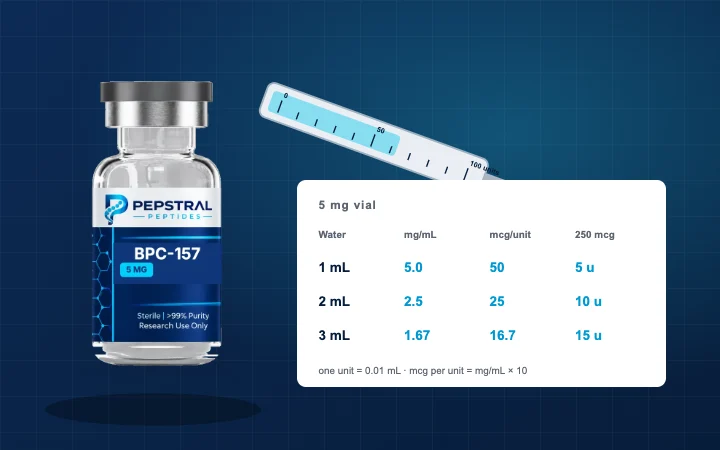
Divide the net mass by the molecular weight to get moles, then divide by the reconstitution volume. The table uses the catalog dose for each compound and assumes the label mass is net peptide, which the certificate confirms.
| Vial | Micromoles in the vial | 1 mL | 2 mL | 3 mL |
|---|---|---|---|---|
| BPC-157 5 mg | 3.52 | 3.52 mM | 1.76 mM | 1.17 mM |
| TB-500 5 mg | 5.62 | 5.62 mM | 2.81 mM | 1.87 mM |
| Semaglutide 5 mg | 1.22 | 1.22 mM | 0.61 mM | 0.41 mM |
| Tirzepatide 10 mg | 2.08 | 2.08 mM | 1.04 mM | 0.69 mM |
| Retatrutide 10 mg | 2.11 | 2.11 mM | 1.06 mM | 0.70 mM |
| Ipamorelin 5 mg | 7.02 | 7.02 mM | 3.51 mM | 2.34 mM |
| Tesamorelin 10 mg | 1.95 | 1.95 mM | 0.97 mM | 0.65 mM |
| GHK-Cu 50 mg | 124.7 | 124.7 mM | 62.4 mM | 41.6 mM |
| NAD+ 500 mg | 754 | 754 mM | 377 mM | 251 mM |
| MOTS-c 10 mg | 4.60 | 4.60 mM | 2.30 mM | 1.53 mM |
Blends are worked per component; the blends post has the method. These molar figures are what a receptor assay or a dose-response curve is actually built on, and they cannot be calculated from a label that gives only milligrams. This is also why net peptide content matters: a 5 mg gross-weight fill that holds 4 mg of peptide is 2.82 micromoles of BPC-157, not 3.52.
Why does residue count matter to a buyer?
Peptides are built one residue at a time, and every coupling step has a yield below 100%. The longer the chain, the more crude material is lost by the end and the more purification it takes to reach a given purity. That is the reason a 44-residue tesamorelin costs more per milligram than a 5-residue ipamorelin, and why any supplier selling long GLP-1 class peptides at short-peptide prices deserves a hard look. The synthesis post shows the arithmetic, and the pricing post covers the rest of the cost stack.
How do you use the table to spot a mislabelled vial?
Three quick checks against a certificate:
- Observed mass against the reference table. Within about a dalton of the average or monoisotopic mass: consistent. Off by tens of daltons: a deletion sequence, an oxidised residue, or the wrong compound. Off by hundreds: the wrong compound.
- Base peak against the charge-state table. If the raw spectrum's largest peak matches one of the charged values for the named compound, the identity is consistent even without deconvolution.
- Net content against the concentration table. If the certificate quantifies the peptide, compare it with the catalog dose; the label post covers what to do when it falls short.
What does the table not include?
Sequences, because they are long and the PubChem record carries them in full. Counter-ion mass, because it depends on the lot and is the reason net peptide content has to be measured rather than calculated. Extinction coefficients for UV quantification, which depend on the aromatic residues and are worth adding once we have verified values for each compound.
Frequently asked questions
Which molecular weight should I use for calculations, average or monoisotopic?
Average, for concentration and dose arithmetic. Monoisotopic, when comparing with a high-resolution mass spectrum. The table gives the average.
Why is GHK-Cu listed with copper in the formula?
Because it is sold as the copper complex, and the mass on a certificate for GHK-Cu will include the copper. The free tripeptide GHK has a molecular weight of about 340.
Why is NAD+ in a peptide table?
Because it is in the catalog and buyers ask the same questions about it. It is a dinucleotide, not a peptide, so residue count does not apply; the formula and weight are still what a certificate should match.
Where did the residue counts come from?
From the sequences in the compound research guides, which a qualified reviewer is checking before launch. The two entries most often described differently between suppliers are TB-500 and CJC-1295, which is why their rows carry a note.
References
- PubChem, National Library of Medicine. Compound records CID 9941957 (BPC-157), 62707662 (TB-500, the thymosin beta-4 fragment), 56843331 (semaglutide), 166567236 (tirzepatide), 171390338 (retatrutide), 9831659 (ipamorelin), 16137828 (tesamorelin), 139035031 (copper tripeptide GHK-Cu), 5892 (NAD+), 146675088 (MOTS-c), 91971820 (CJC-1295). Read 11 September 2026. pubchem.ncbi.nlm.nih.gov
- Bachem. Quality Control of Amino Acids and Peptides: A Guide. Identity by mass spectrometry. www.bachem.com/knowledge-center/quality-control-of-amino-acids-peptides-a-guide
Every product mentioned is sold for laboratory research use only and is not for human or animal use. Nothing on this page describes or recommends use of the material sold here in humans or animals.