How to read a certificate of analysis
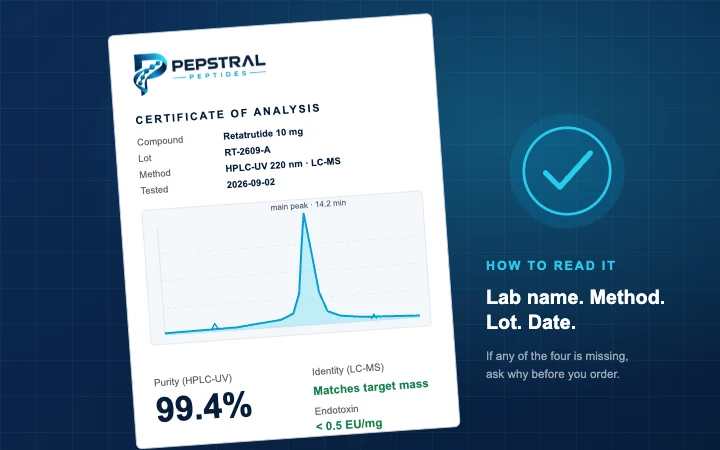
A certificate worth trusting names the laboratory, the method, the lot and the date, then reports four results: purity by HPLC, identity by LC-MS, net peptide content, and endotoxin. If any of the four names or the four numbers is missing, ask why before you order.
What are the four lines every certificate must have?
Before reading a single result, check the header. The laboratory must be named and must be independent of the vendor. The method must be stated for each test, because a purity figure means nothing without knowing the wavelength and column behind it. The lot number must match the vial in your hand. The date tells you whether the report describes the batch you received or one from two years ago. A certificate that is missing any of these is a summary, not evidence.
What does HPLC purity actually measure?
High-performance liquid chromatography separates the contents of the vial by how they interact with a column, then a UV detector at 220 nm measures how much material comes off at each moment. The main peak is the target sequence. Purity is the area of that peak divided by the area of all peaks, so 99.4% means that 99.4% of the UV-absorbing, peptide-related material is the intended peptide. It does not count water, counter-ions or salts, which do not absorb at 220 nm, and it does not tell you how much peptide is in the vial at all.
What does LC-MS identity confirm?
Liquid chromatography coupled to mass spectrometry weighs the molecule. The laboratory calculates the expected mass from the amino-acid sequence and compares it with the measured mass. A match confirms that the main peak is the right peptide and not a similar-looking impurity or a truncated sequence. Purity without identity is a large peak of something; identity without purity is the right peptide in an unknown amount of everything else. The two results only mean something together.
Why does net peptide content matter?
Lyophilized peptide is never 100% peptide by weight. The powder also holds counter-ions left from purification, typically acetate or trifluoroacetate, and bound water. Net peptide content, measured by amino-acid analysis, reports what fraction of the mass is peptide. The gap can be large, which is why a vial labelled by gross weight can contain much less peptide than one labelled by net peptide. Pepstral labels by net peptide, and the certificate shows the analysis behind the number.
What is an acceptable endotoxin result?
Endotoxins are fragments of bacterial cell walls that survive sterilisation and provoke strong responses in cell-based and in-vivo work. The limulus amebocyte lysate assay reports them in endotoxin units per milligram. Pepstral lists lots below 0.5 EU per mg. Whether that is low enough depends on your assay: analytical work is indifferent to endotoxin, while sensitive cell lines are not. Read the number against your own protocol rather than the vendor's pass mark.
How do you verify a certificate is genuine?
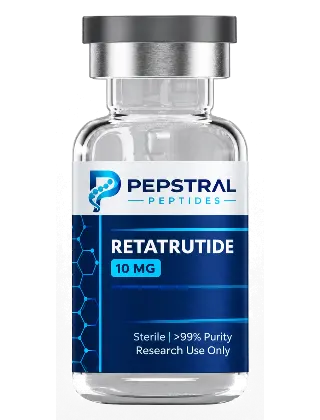
Start with the lot number: the one printed on the vial label must match the one on the report. Then go to the laboratory, not the vendor. Independent labs print a verification code or QR link on each report that resolves on their own site. A certificate that exists only as an image on the vendor's page cannot be checked and should be weighted accordingly.
| Line | What it tells you | Red flag |
|---|---|---|
| Laboratory | Who ran the tests | Vendor's own name, or no name |
| Method | How each number was produced | "Purity 99%" with no method |
| Lot | Which batch the report describes | No lot, or a lot that does not match the vial |
| Date | How current the report is | Older than the lot's shelf life |
| Purity (HPLC) | Share of peptide material that is the target | A round number, no chromatogram |
| Identity (LC-MS) | The right molecule | Missing entirely |
| Net peptide | How much peptide is in the vial | Label by gross weight |
| Endotoxin | Fit for cell work | Not reported |
Frequently asked questions
Is 99% purity the same as 99% of the vial being peptide?
No. HPLC purity is the share of peptide-related material that is the target sequence. Net peptide content, from amino-acid analysis, is the share of the vial's mass that is peptide at all. A vial can be 99% pure and 80% net peptide.
What is an acceptable endotoxin level?
Pepstral lists lots below 0.5 EU per mg. The right limit depends on the assay; cell-culture work is more sensitive to endotoxin than analytical work, so check the number against your protocol rather than the vendor's pass mark.
How do you check that a certificate is genuine?
Match the lot number on the vial to the certificate, then verify the report on the laboratory's own site using the verification code it prints. A certificate hosted only on the vendor's site with no laboratory reference cannot be checked.
For laboratory research use only.