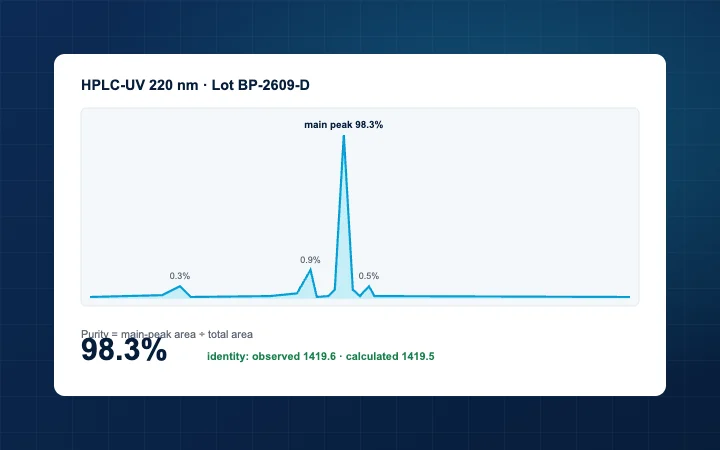
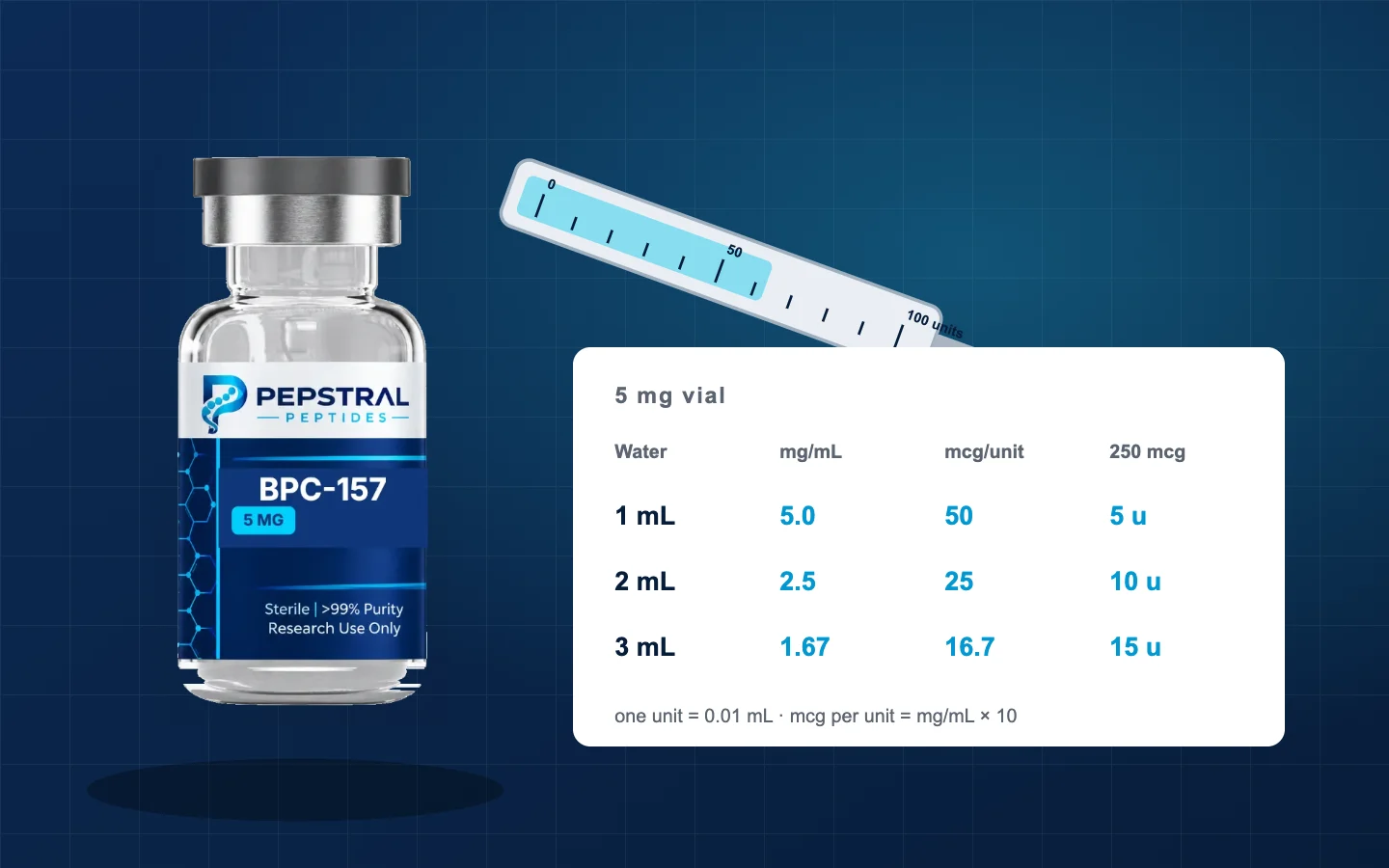
Concentration after reconstitution is the number every downstream calculation depends on, and it is decided by one division: net milligrams in the vial divided by millilitres of water added. This page does that division for every vial in the catalog at three common volumes, converts the result to micrograms per unit on a U-100 insulin syringe, and adds the molar concentration from the PubChem molecular weights. It assumes the label mass is net peptide, which the lot certificate confirms; if the certificate gives a different net content, use that figure instead.
For laboratory use only. The 250 mcg aliquot column is a bench quantity chosen to make the arithmetic concrete, not a dose of anything.
How are the numbers calculated?
- mg/mL = net mg ÷ mL added.
- mcg per unit = mg/mL × 10, because a U-100 insulin syringe has 100 units per millilitre, so one unit is 0.01 mL and holds one hundredth of the milligrams in a millilitre.
- Units for 250 mcg = 250 ÷ mcg per unit.
- mM = (net mg ÷ molecular weight) ÷ mL × 1000.
The reconstitution guide covers the method; this page is the lookup table.
5 mg vials
Applies to BPC-157, TB-500, semaglutide and ipamorelin.
| Water added | mg/mL | mcg per unit | Units for 250 mcg |
|---|---|---|---|
| 1 mL | 5.0 | 50 | 5 |
| 2 mL | 2.5 | 25 | 10 |
| 3 mL | 1.67 | 16.7 | 15 |
10 mg vials
Applies to tirzepatide, retatrutide, tesamorelin, MOTS-c, and, per component at a 1:1 ratio, the BPC-157 + TB-500 and CJC-1295 + Ipamorelin blends, where each component is 5 mg and the 5 mg table applies to each.
| Water added | mg/mL | mcg per unit | Units for 250 mcg |
|---|---|---|---|
| 1 mL | 10.0 | 100 | 2.5 |
| 2 mL | 5.0 | 50 | 5 |
| 3 mL | 3.33 | 33.3 | 7.5 |
A draw of 2.5 units is at the limit of what a 100-unit syringe can measure repeatably. For 10 mg vials, 2 or 3 mL gives draws that are easier to read.
What about the large-mass vials?
GHK-Cu 50 mg and NAD+ 500 mg do not fit the pattern above. At 2 mL, GHK-Cu is 25 mg/mL and one unit holds 250 mcg, so a 250 mcg aliquot is a single unit, which cannot be measured accurately. NAD+ at 500 mg needs more water than these volumes to dissolve comfortably.
| Vial | Water added | mg/mL | mcg per unit | Practical approach |
|---|---|---|---|---|
| GHK-Cu 50 mg | 2 mL | 25 | 250 | Make a stock, then dilute 1:10 to 2.5 mg/mL and use the 5 mg table |
| GHK-Cu 50 mg | 5 mL | 10 | 100 | Same; 1:4 dilution gives 2.5 mg/mL |
| NAD+ 500 mg | 5 mL | 100 | 1,000 | Stock only; dilute 1:20 or more for working solutions |
| NAD+ 500 mg | 10 mL | 50 | 500 | Stock only; dilute 1:10 or more |
Serial dilution from a stock is the normal way to reach microgram working concentrations from a large-mass vial, and it keeps the arithmetic in the tables above.
Molar concentration by vial
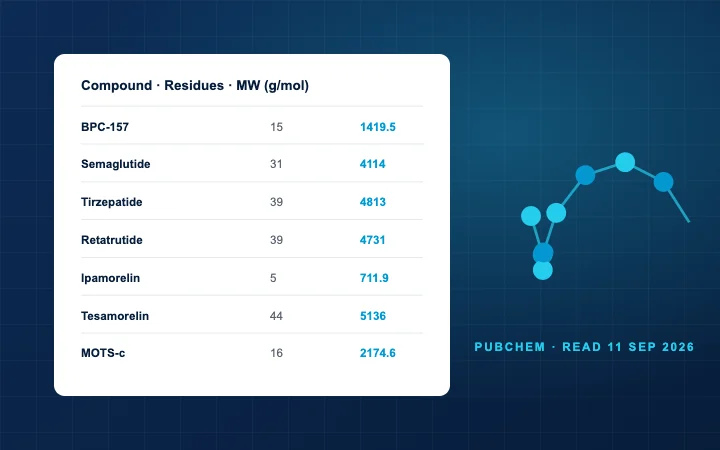
Molar figures use the PubChem molecular weights from the reference table and the catalog dose.
| Vial | Molecular weight | Micromoles | 1 mL | 2 mL | 3 mL |
|---|---|---|---|---|---|
| BPC-157 5 mg | 1419.5 | 3.52 | 3.52 mM | 1.76 mM | 1.17 mM |
| TB-500 5 mg | 889.0 | 5.62 | 5.62 mM | 2.81 mM | 1.87 mM |
| Semaglutide 5 mg | 4114 | 1.22 | 1.22 mM | 0.61 mM | 0.41 mM |
| Tirzepatide 10 mg | 4813 | 2.08 | 2.08 mM | 1.04 mM | 0.69 mM |
| Retatrutide 10 mg | 4731 | 2.11 | 2.11 mM | 1.06 mM | 0.70 mM |
| Ipamorelin 5 mg | 711.9 | 7.02 | 7.02 mM | 3.51 mM | 2.34 mM |
| Tesamorelin 10 mg | 5136 | 1.95 | 1.95 mM | 0.97 mM | 0.65 mM |
| GHK-Cu 50 mg | 400.9 | 124.7 | 124.7 mM | 62.4 mM | 41.6 mM |
| NAD+ 500 mg | 663.4 | 754 | 754 mM | 377 mM | 251 mM |
| MOTS-c 10 mg | 2174.6 | 4.60 | 4.60 mM | 2.30 mM | 1.53 mM |
The molar column is the one a receptor assay uses. Two vials with the same milligrams can differ fivefold in molarity: 5 mg of ipamorelin is 7.02 micromoles and 5 mg of semaglutide is 1.22, because one is a 5-residue peptide and the other is 31 residues.
How do you use the table with a real certificate?
- Read the net peptide content on the lot certificate. If it says 4.7 mg for a 5 mg vial, use 4.7 in the division. The label post explains why the label figure alone is not enough.
- Choose a volume that gives a draw you can read: 5 to 20 units for a small aliquot is comfortable; under 3 units is not.
- Write mg/mL, mcg per unit, the date and the lot on the vial after reconstitution. The storage guide gives the window that starts at that date.
- For blends, work each component separately; the blends post has the worked example.
Frequently asked questions
Why does the table use a U-100 insulin syringe?
Because it is the most common 1 mL syringe on a research bench and its unit markings are the easiest way to measure hundredths of a millilitre. Any 1 mL syringe marked in 0.01 mL divisions gives the same numbers.
What if I add a different volume?
Divide net milligrams by the volume you used. The three columns are the common cases; the arithmetic is the same for any volume.
Does the counter-ion change the concentration?
It changes the relationship between gross powder and net peptide, which is why the certificate's net content is the starting figure. Once you are working from net milligrams, the counter-ion is already accounted for.
Why is there no calculator on this page?
Because a fixed table is easier to print, keep at the bench and cite in a methods section than a form whose inputs are not recorded. The division is one line and the table shows it done.
References
- PubChem, National Library of Medicine. Compound records used for the molar column; CIDs listed in the reference table post. Read 11 September 2026. pubchem.ncbi.nlm.nih.gov
Every product mentioned is sold for laboratory research use only and is not for human or animal use. Nothing on this page describes or recommends use of the material sold here in humans or animals.