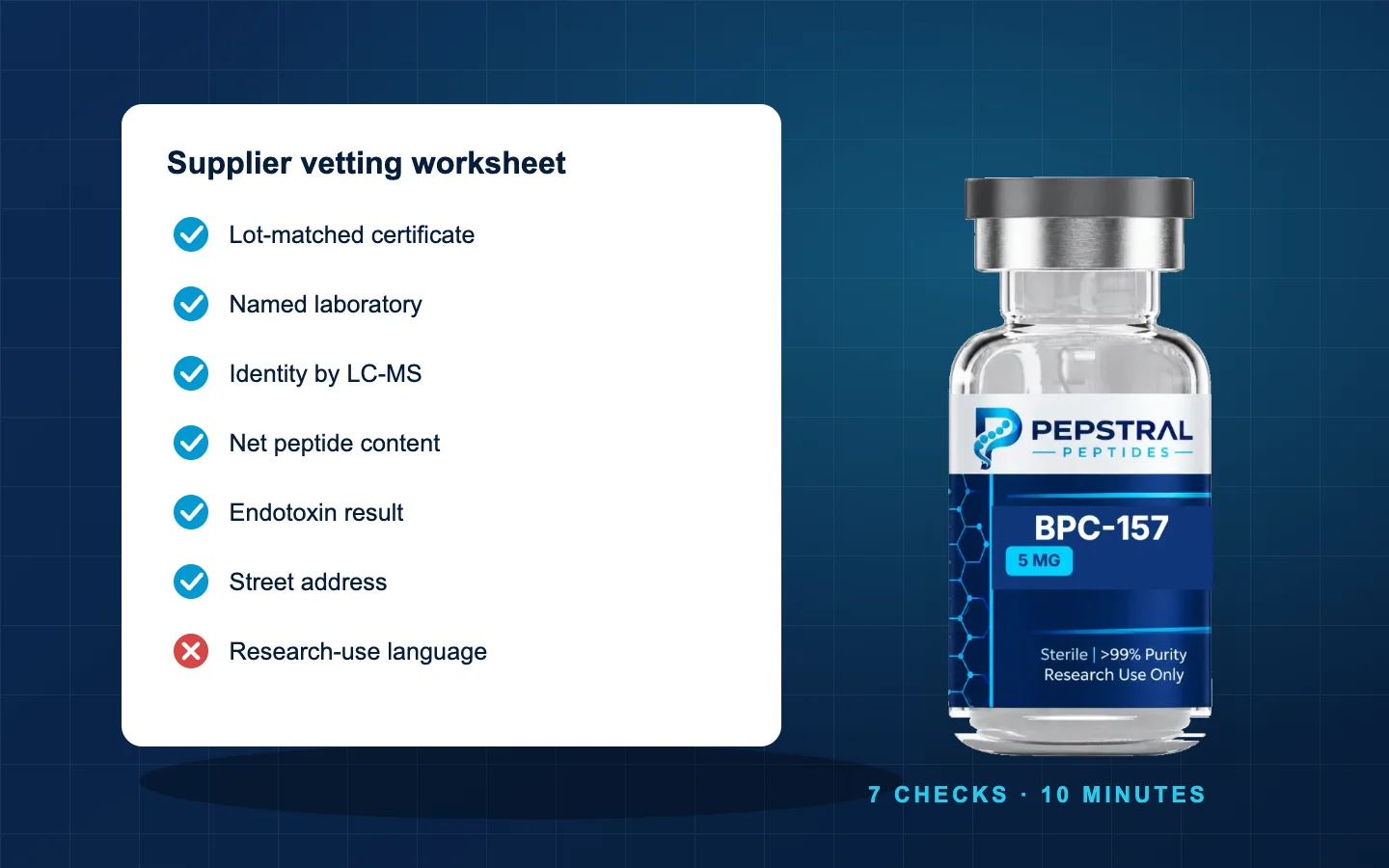
A supplier is worth ordering from when you can trace the vial in your hand to a test report for that exact lot, run by a laboratory you can name and contact. Everything else on the site is secondary to that one chain of evidence: the reviews, the purity badge in the header, the discount code. This post gives seven checks that take about ten minutes, a worksheet to score them, an example of what a good support answer looks like, and the test the FDA itself uses to decide what a seller is.
Does every product show a certificate for the current lot?
Open a product page and look for a lot number. Then open the certificate and confirm the same lot number appears on it. A supplier who tests every batch shows a certificate per lot, dated within the last few months, with a lot number that matches the label on the vial when it arrives.
A single undated certificate reused across every product, or one with no lot number at all, tells you the testing happened once, if at all. On this site the lot number sits on every product page next to the price, and the COA library lists each certificate by lot. The guide to reading a certificate walks through each line.
Is the testing laboratory named?
A certificate should carry the name of the laboratory that ran it, not just the supplier's logo. Third-party testing means the lab has no stake in the result. When the certificate is the supplier's own template with no lab name, the purity figure is a claim, not a measurement.
Look for a laboratory you can search for, with a website and a contact address, and a report number you could ask them to verify. Some independent labs publish a verification page where anyone can enter the report's task number and key and confirm it is genuine. A certificate that can be verified that way is worth more than one that cannot.
Does the certificate confirm identity, not just purity?
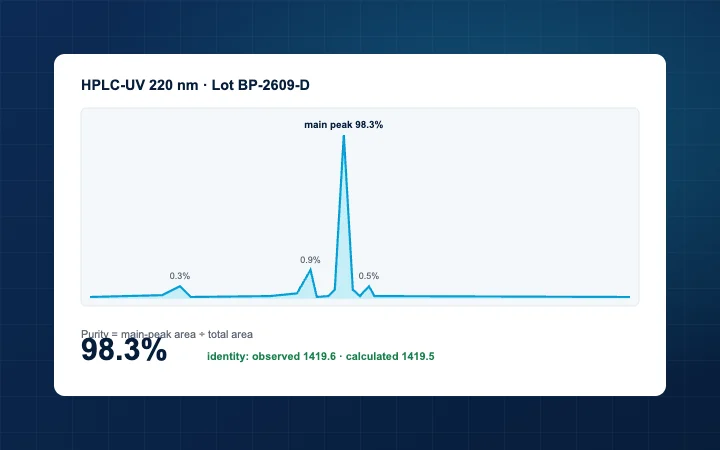
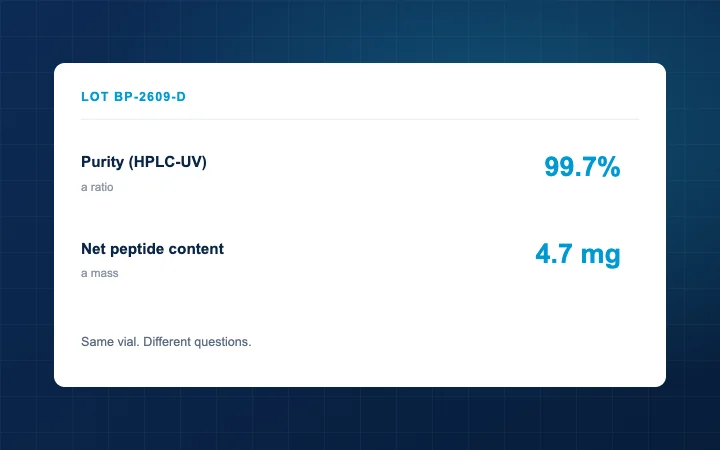
Purity and identity are different tests. An HPLC purity of 99% says that 99% of what came off the column was one compound. It does not say which compound. Identity comes from mass spectrometry, usually LC-MS, which measures the mass of the main peak and compares it with the mass calculated from the amino acid sequence.
A certificate that shows a purity percentage but no observed mass has skipped the test that proves the vial contains the peptide on the label. The reference table gives the expected mass for every compound in the catalog, so the comparison takes seconds.
Is net peptide content stated?
The dose on a label, 5 mg for example, should mean 5 mg of peptide. A lyophilized powder also contains water and counter-ions left over from purification. Bachem's quality guide defines net peptide content as the percentage of peptide relative to that non-peptidic material, and notes that peptides with many basic residues or a hygroscopic sequence can carry a large share of it even when they are extremely pure.
Suppliers who weigh gross powder and call it 5 mg are shipping less peptide than they charge for. A certificate that states net peptide content, or that quantifies the peptide against a reference standard, closes that gap. If it is not on the certificate, ask.
Is there an endotoxin result?
Endotoxin is a bacterial residue that survives filtration and lyophilization. It matters for any cell-based assay, where it can confound inflammatory readouts on its own. A certificate should report an endotoxin value with a limit and a method, most often a LAL assay run to USP chapter 85. Its absence does not prove contamination, but its presence shows the supplier runs the panel a laboratory user needs. The endotoxin post shows how to convert the figure to your working concentration.
Can you find a physical address and a person?
A supplier with a warehouse has an address. A supplier who ships from a home or a drop-shipper often does not list one. Check the footer and the contact page for a street address, a phone number and a support email on the site's own domain.
Then send one question before you order and judge the reply on substance. A good exchange looks like this:
You: Which laboratory ran lot BP-2609-D, and can I see the LC-MS line? Supplier: Lot BP-2609-D was tested by [laboratory name] on [date]; the certificate is at [link] and the observed mass is 1419.6 against a calculated 1419.5. Endotoxin was below 0.5 EU/mg by chromogenic LAL.
A reply that names the lab, gives the date and quotes the number has the report in front of them. A reply that says "all our products are 99% pure" does not.
What does the supplier say about use?
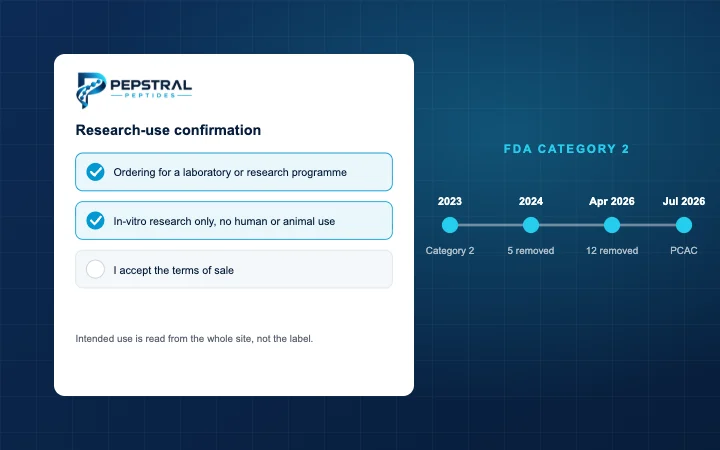
Research peptides are sold for laboratory use, and the FDA decides what a product is from how it is marketed, not from the disclaimer on the vial. In a warning letter dated 17 June 2026, the agency told a peptide seller that evidence from its website established the products were intended as drugs for human use, despite labelling that said they were not for human consumption. The claims that triggered it were benefit statements on product pages.
That matters for you for a practical reason. A supplier who publishes dosing guides, before-and-after language or "stack" advice has told regulators, payment processors and carriers what they are, and their supply can stop without notice. Look for a clear research-use statement, terms of sale that say who they sell to, and content that talks about assays and models rather than protocols.
The ten-minute worksheet
| Check | Pass looks like | Fail looks like |
|---|---|---|
| Lot-matched certificate | Lot on product page = lot on certificate = lot on vial | One generic certificate, or no lot number |
| Named laboratory | Lab name, report number, verifiable | Supplier template, "in-house" with no lab |
| Identity | Observed mass next to calculated mass | Purity percentage only |
| Net peptide content | Stated, or peptide quantified against a standard | Not mentioned |
| Endotoxin | Value, limit and method | Absent |
| Address and person | Street address, domain email, a reply that quotes the report | PO box or nothing; reply is a slogan |
| Language about use | Assays, models, handling | Dosing, results, cycles |
Score it. Seven passes is a supplier you can rely on. Five or six is a supplier to ask questions of. Fewer than five is a supplier to skip regardless of price.
Which red flags are not red flags?
- A small catalog. Twelve compounds tested properly beats a hundred compounds tested once.
- A laboratory outside the US. What matters is that it is independent and verifiable, not where it sits.
- A price above the cheapest option. The pricing post explains why the floor exists.
- A slow first reply. Judge the reply's content, not its speed.
A worked example
Take BPC-157. The product page shows lot BP-2609-D and a purity figure by HPLC-UV. The certificate for that lot is in the COA library with the LC-MS identity line and the endotoxin result. The BPC-157 research guide lists the models it appears in and the handling notes.
That is the full chain: label, lot, certificate, laboratory, and content written for the bench. Run the same seven checks on any supplier you are comparing and the differences show up quickly.
Frequently asked questions
Is a higher purity number always better?
Higher purity is better when the identity test confirms the main peak is the right compound. A 99.5% figure with no mass confirmation is less useful than a 98.5% figure with a matching observed mass, because only the second one tells you what the 98.5% is.
What if the supplier says the certificate is available on request?
Ask for it before you order, with the lot number. A supplier who tests each lot has the PDF ready. If the reply is a generic certificate with no lot number, or takes days, treat that as your answer.
Do I need to re-test what I receive?
For most bench work, a lot-matched third-party certificate is sufficient. For anything that will be published, or where the peptide is the variable under test, an independent HPLC run on receipt is cheap insurance. The post on independent testing covers cost and procedure.
How often should certificates be updated?
Every lot gets its own certificate, so the date on the certificate should be close to the date the lot went on sale. A supplier who lists a lot for a year without a new certificate is either selling from a very large batch or not testing new ones.
References
- US Food and Drug Administration. Warning Letter to Wholesale Peptide, 17 June 2026: research-use statements did not change the intended use FDA inferred from the website. www.fda.gov/inspections-compliance-enforcement-and-criminal-investigations/warning-letters/wholesale-peptide-729447-06172026
- Bachem. Quality Control of Amino Acids and Peptides: A Guide. Net peptide content, HPLC purity at 210 to 220 nm, identity by mass spectrometry. www.bachem.com/knowledge-center/quality-control-of-amino-acids-peptides-a-guide
- United States Pharmacopeia. General Chapter <85> Bacterial Endotoxins Test. www.usp.org/harmonization-standards/pdg/general-methods/bacterial-endotoxins
- Janoshik Analytical. Report verification by task number and unique key. janoshik.com/verify
Every product mentioned is sold for laboratory research use only and is not for human or animal use. Nothing on this page describes or recommends use of the material sold here in humans or animals.