Storage and stability by compound
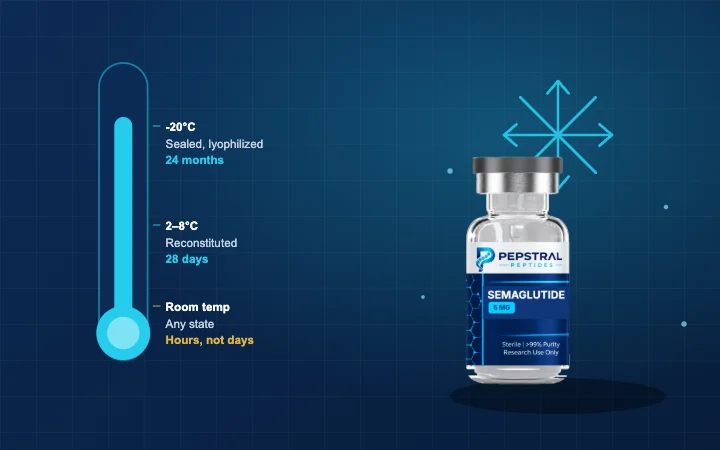
Sealed lyophilized vials keep for 24 months at -20°C and about 6 months at 2 to 8°C. Once reconstituted, refrigerate at 2 to 8°C and use within 28 days. Room temperature is measured in hours for any state. The certificate for your lot is the authority where it differs.
Why do lyophilized peptides last so long?
Freeze-drying removes the water that every degradation pathway needs. Without water there is no hydrolysis of the peptide bonds, oxidation slows to a crawl, and microbes cannot grow. A sealed vial at -20°C is close to chemically frozen in time, which is why the 24-month figure is conservative for most sequences. The two things that end that stability early are moisture entering through a damaged stopper and repeated warming, which is why a vial should reach room temperature before it is opened and go back to the freezer promptly if it is not being used.
What changes after reconstitution?
Adding water starts three clocks. Hydrolysis begins to cut peptide bonds, fastest at sequences containing aspartic acid and at low or high pH. Oxidation attacks methionine, cysteine and tryptophan residues, accelerated by light and dissolved oxygen. Microbial growth becomes possible, which is what the preservative in bacteriostatic water holds back. Refrigeration slows all three; the 28-day window is where the certificate's stability data says loss stays within limits for a preserved solution.
How does storage differ by compound class?
| Class | Sealed | Reconstituted | Notes |
|---|---|---|---|
| GLP-1 class (semaglutide, tirzepatide, retatrutide) | -20°C, 24 months | 2 to 8°C, 28 days | Light sensitive; keep in the carton. Slow to dissolve because of the fatty-acid side chain. |
| Repair peptides (BPC-157, TB-500) | -20°C, 24 months | 2 to 8°C, 28 days | Stable in solution; standard handling. |
| GH axis (CJC-1295, Ipamorelin, Tesamorelin) | -20°C, 24 months | 2 to 8°C, 28 days | Methionine-containing sequences oxidise; minimise headspace and light. |
| GHK-Cu | -20°C, 24 months | 2 to 8°C, 28 days | Blue solution is normal. Avoid metal spatulas and chelating buffers. |
| NAD+ | -20°C, 24 months | Prepare fresh | Degrades in solution within days; make what the experiment needs. |
| Blends | -20°C, 24 months | 2 to 8°C, 28 days | Follow the shorter window of the two components. |
How do you handle freeze-thaw?
A solution that will be drawn from repeatedly stays in the refrigerator. If an experiment needs a longer horizon than 28 days, divide the reconstituted vial into single-use aliquots in sterile vials, freeze each once at -20°C, and thaw only the aliquot you need. Each freeze-thaw cycle drives aggregation, so an aliquot is thawed once and never refrozen.
What are the signs a vial has degraded?
- Cloudiness or particles in a solution that was clear: aggregation.
- Colour change in a normally colourless solution: oxidation. GHK-Cu is the exception; its blue is the copper complex.
- A collapsed cake. Lyophilized powder should be a dry, porous plug. A glassy film or a shrunken pellet means moisture got in.
- Loss of activity in a control assay that previously worked. The certificate window is a guide; the assay is the truth.
Frequently asked questions
Can a reconstituted peptide be frozen to extend its life?
Only as single-use aliquots frozen once. Repeated freeze-thaw cycles cause aggregation. A vial that will be drawn from repeatedly belongs in the refrigerator within its 28-day window.
Does a sealed vial need to stay frozen during shipping?
Lyophilized powder tolerates days at ambient temperature without measurable loss, which is why sealed vials ship without cold packs. Cold packs are added for reconstituted products on request.
What does a degraded vial look like?
Cloudiness, visible particles, a colour change, or a lyophilized cake that has collapsed into a glassy film. Any of these means the vial should not be used.
For laboratory research use only.