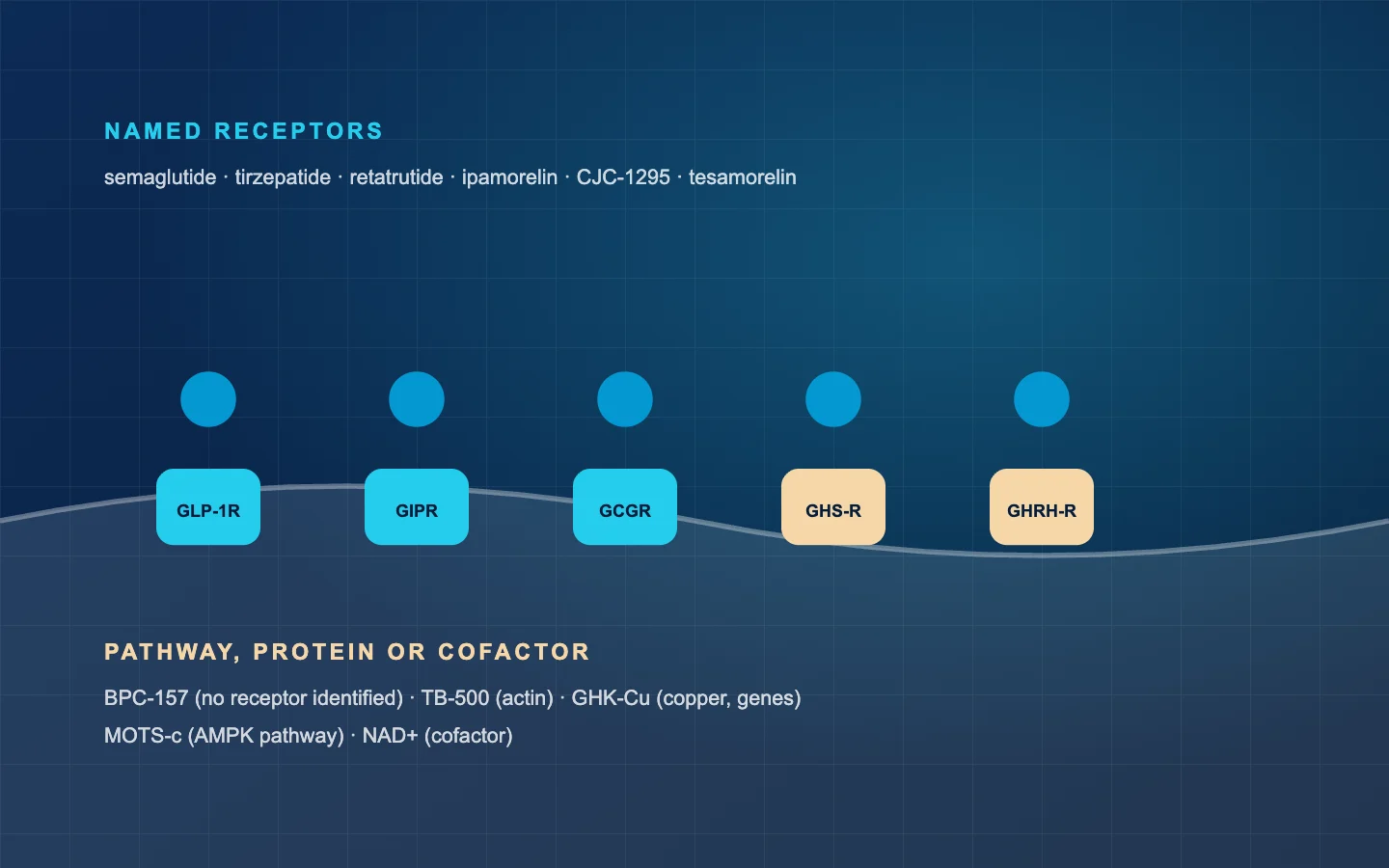
Every compound in this catalog does something to a cell, but only some of them do it by binding a receptor on the cell's surface. That distinction is the first thing an assay design needs, because a receptor ligand can be measured by binding and by a receptor-expressing reporter line, while a compound that works through actin, copper, a mitochondrial pathway or as a cofactor needs a functional readout instead.
This table gives the target for each compound with the paper that established it, and the sections after it explain what each class of target means for an experiment.
The target table
| Compound | Target | Type of target | Established by |
|---|---|---|---|
| Semaglutide | GLP-1 receptor | Cell-surface receptor, single agonist | Lau 2015 |
| Tirzepatide | GIP receptor and GLP-1 receptor | Cell-surface receptors, dual agonist | Coskun 2018 |
| Retatrutide | GIP, GLP-1 and glucagon receptors | Cell-surface receptors, triple agonist | Coskun 2022 |
| Ipamorelin | Growth hormone secretagogue receptor | Cell-surface receptor | Raun 1998 |
| CJC-1295 (in the CJC + Ipamorelin blend) | GHRH receptor | Cell-surface receptor | Jetté 2005 |
| Tesamorelin | GHRH receptor, as a GHRH analogue | Cell-surface receptor | Falutz 2007 |
| BPC-157 | No receptor identified; nitric-oxide system and angiogenic signalling described | Pathway, not receptor | Sikiric 2018 |
| TB-500 (thymosin beta-4 fragment) | G-actin, sequestered by binding | Intracellular protein | Safer 1991 |
| GHK-Cu | Copper delivery and modulation of gene expression | Multiple, no single receptor | Pickart 2018 |
| MOTS-c | Intracellular metabolic signalling through the AMPK pathway | Pathway, not receptor | Lee 2015 |
| NAD+ | Cofactor for dehydrogenases, sirtuins and PARPs | Cofactor, not a ligand | Standard biochemistry |
The BPC-157 + TB-500 blend combines the two repair compounds, one with no identified receptor and one that binds actin.
What does a named receptor mean for an assay?
It means three kinds of experiment are available that are not available for the other compounds:
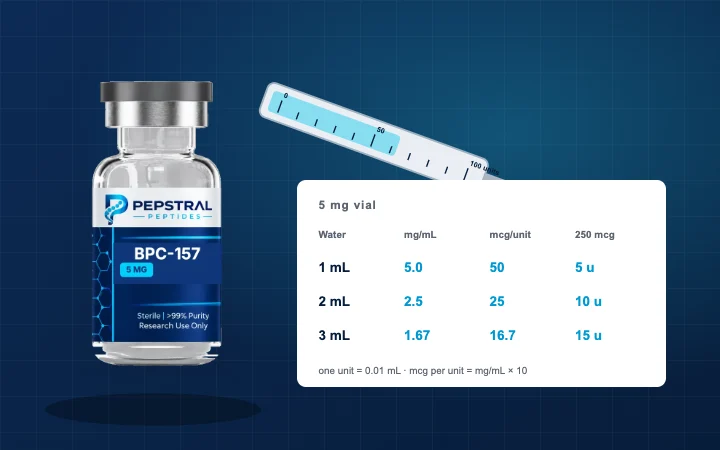
- Binding. Displacement of a labelled ligand from membranes or cells expressing the receptor gives an affinity. The molar concentrations in the concentration table are the input.
- Reporter cells. A line engineered to express the receptor and report its activation, often through cyclic AMP, gives a potency and an efficacy for each compound and lets agonists be compared on the same scale. For the GLP-1 class, the three discovery papers describe exactly this comparison across the incretin and glucagon receptors.
- Selectivity. Running the same compound against related receptors shows what else it touches. Raun and colleagues used this to show ipamorelin's selectivity in 1998.
For these five compounds, the receptor is also the reason the comparison pages can say something definite about which one fits a question.
What does a pathway or protein target mean?
A functional readout. TB-500 sequesters G-actin, as Safer and colleagues established in 1991, so its assays are about actin dynamics, cell migration and cytoskeletal change rather than binding to a surface receptor. GHK-Cu, in Pickart and Margolina's review, acts by delivering copper and shifting the expression of many genes, so its assays are transcriptional and phenotypic. MOTS-c, in Lee and colleagues' 2015 paper, signals through an intracellular metabolic pathway, and its readouts are metabolic.
BPC-157 has been studied extensively in injury models, and Sikiric's 2018 review describes effects on the nitric-oxide system and angiogenic signalling, but no receptor has been identified, so its assays are phenotypic by necessity.
For all of these, the experiment has to include the controls a functional assay needs, which the bacteriostatic water post and the TFA post describe: a vehicle that matches the preservative and counter-ion the stock carries, because a phenotypic readout cannot tell a peptide effect from a formulation effect on its own.
What does a cofactor mean?
NAD+ is not a ligand at all. It is a substrate and cofactor for dehydrogenases, sirtuins and PARP enzymes, and its assays measure enzyme activity or cellular NAD+ levels. It is in a peptide catalog because buyers ask for it alongside peptides, not because it behaves like one, and the NAD+ handling post explains how it differs on the bench.
How do you choose a first assay for each target class?
The target class narrows the first experiment before any compound-specific reading. A reasonable starting map:
| Target class | First assay | Confirmatory assay | Controls that matter most |
|---|---|---|---|
| Single cell-surface receptor (semaglutide, ipamorelin, CJC-1295, tesamorelin) | Reporter cell expressing the receptor, read by cyclic AMP or a downstream reporter | Radioligand or fluorescent displacement on membranes | Receptor-negative parent line; a reference agonist |
| Multi-receptor agonist (tirzepatide, retatrutide) | Same reporter assay run on each receptor separately | Selectivity panel across related receptors | Single-receptor reference compounds on each line |
| Intracellular protein target (TB-500) | Actin polymerisation or cell migration assay | Binding to purified G-actin | Vehicle matched for counter-ion and preservative |
| Gene-expression and copper delivery (GHK-Cu) | Transcriptional readout in the cell type of interest | Copper-free GHK comparison | Copper salt alone at matched concentration |
| Metabolic pathway (MOTS-c) | Pathway activation marker in cells | Metabolic flux or substrate assay | Pathway inhibitor arm |
| Cofactor (NAD+) | Enzyme activity with a known dehydrogenase | Cellular NAD+ measurement | Fresh versus aged stock, per the NAD+ post |
Two rows carry a control that is easy to skip. GHK-Cu is a copper complex, so a copper salt alone at the same concentration separates the peptide's effect from the metal's. And every functional assay needs a vehicle that carries the same counter-ion and preservative as the peptide stock, or a formulation effect will be read as a peptide effect.
Why does the target matter for a certificate?
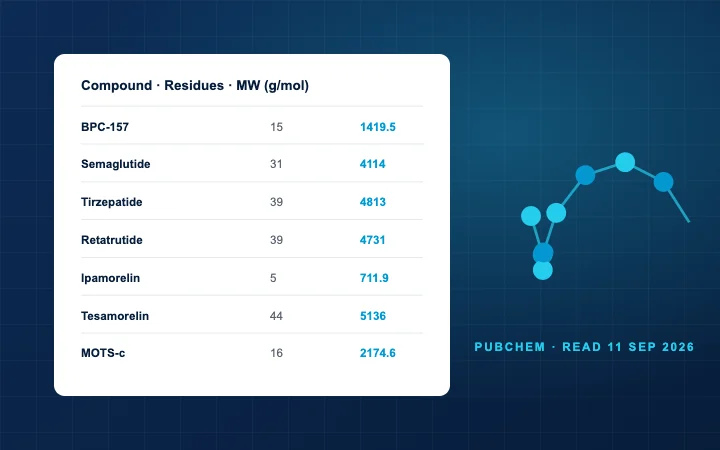
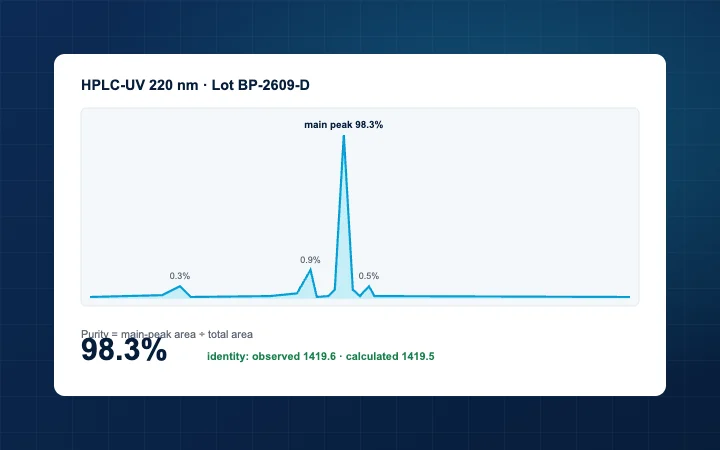
Because identity is the line that connects the vial to this table. A receptor assay run on a vial whose observed mass does not match the reference table is an assay on an unknown compound. For the two GHRH analogues, and for CJC-1295's two forms, the mass is also what distinguishes compounds that share a receptor, as the GH axis comparison and the DAC post explain.
Frequently asked questions
Does "no receptor identified" mean the compound is inactive?
No. It means the mechanism has not been traced to a specific surface receptor. BPC-157 has a large injury-model literature; what it lacks is a binding target, which changes the kind of assay that can be run, not whether effects have been reported.
Can a receptor ligand also have off-target effects?
Yes, and selectivity screening is how they are found. The tirzepatide and retatrutide papers report activity at more than one receptor by design; other compounds may have unintended activity that only a broader screen reveals.
Which compounds can be compared on the same scale?
Those sharing a receptor: the three GLP-1 class compounds at the GLP-1 receptor, and CJC-1295 with tesamorelin at the GHRH receptor. Ipamorelin acts at a different receptor and is compared with other secretagogues, not with GHRH analogues.
Where are the full mechanisms discussed?
In the compound research guides linked from Learn, each of which carries its own reference list.
References
- Lau J, Bloch P, Schäffer L, et al. Discovery of the Once-Weekly GLP-1 Analogue Semaglutide. Journal of Medicinal Chemistry 2015;58(18):7370-7380. doi.org/10.1021/acs.jmedchem.5b00726
- Coskun T, Sloop KW, Loghin C, et al. LY3298176, a novel dual GIP and GLP-1 receptor agonist. Molecular Metabolism 2018;18:3-14. doi.org/10.1016/j.molmet.2018.09.009
- Coskun T, Urva S, Roell WC, et al. LY3437943, a novel triple glucagon, GIP, and GLP-1 receptor agonist. Cell Metabolism 2022;34(9):1234-1247. doi.org/10.1016/j.cmet.2022.07.013
- Raun K, Hansen BS, Johansen NL, et al. Ipamorelin, the first selective growth hormone secretagogue. European Journal of Endocrinology 1998;139(5):552-561. doi.org/10.1530/eje.0.1390552
- Jetté L, Léger R, Thibaudeau K, et al. hGRF1-29-albumin bioconjugates activate the GRF receptor on the anterior pituitary in rats. Endocrinology 2005;146(7):3052-3058. doi.org/10.1210/en.2004-1286
- Falutz J, Allas S, Blot K, et al. Metabolic effects of a growth hormone-releasing factor in patients with HIV. New England Journal of Medicine 2007;357(23):2359-2370. doi.org/10.1056/NEJMoa072375
- Sikiric P, Rucman R, Turkovic B, et al. Novel Cytoprotective Mediator, Stable Gastric Pentadecapeptide BPC 157. Current Pharmaceutical Design 2018;24(18):1990-2001. doi.org/10.2174/1381612824666180608101119
- Safer D, Elzinga M, Nachmias VT. Thymosin beta 4 and Fx, an actin-sequestering peptide, are indistinguishable. Journal of Biological Chemistry 1991;266(7):4029-4032. pubmed.ncbi.nlm.nih.gov/1999398
- Pickart L, Margolina A. Regenerative and Protective Actions of the GHK-Cu Peptide in the Light of the New Gene Data. International Journal of Molecular Sciences 2018;19(7):1987. doi.org/10.3390/ijms19071987
- Lee C, Zeng J, Drew BG, et al. The mitochondrial-derived peptide MOTS-c promotes metabolic homeostasis and reduces obesity and insulin resistance. Cell Metabolism 2015;21(3):443-454. doi.org/10.1016/j.cmet.2015.02.009
Every product mentioned is sold for laboratory research use only and is not for human or animal use. Nothing on this page describes or recommends use of the material sold here in humans or animals.