
**Tirzepatide is a 39-residue peptide built on the sequence of GIP — glucose-dependent insulinotropic polypeptide — that also activates the GLP-1 receptor. Its molecular weight is 4813.5 Da, and the published pharmacology describes it as an imbalanced and biased dual agonist rather than a balanced one.**
Both of those points are routinely stated backwards. Tirzepatide is usually described as a GLP-1 drug that picked up GIP activity, and as a dual agonist that hits both receptors equally. Neither is accurate, and the difference matters for anyone reading the pharmacology literature. This post covers the backbone, the three modifications, what "biased" means, and what the certificate confirms.
The backbone is GIP
GIP and GLP-1 are both incretin hormones — gut peptides released after eating that act on pancreatic receptors. They are related but distinct, with different sequences and different receptors.
Tirzepatide's sequence derives from GIP. Coskun and colleagues' 2018 discovery paper describes it as a GIP analogue engineered to acquire GLP-1 receptor activity, not the reverse. The molecule's identity, in sequence terms, is GIP.
This is not pedantry. It explains why tirzepatide's receptor profile is asymmetric: it is close to native GIP at the GIP receptor because that is what it is, and weaker than native GLP-1 at the GLP-1 receptor because that activity was added to a scaffold that did not originally have it.
The three modifications
| Position | Change | Purpose |
|---|---|---|
| 2 | Aib (α-aminoisobutyric acid) | Blocks DPP-4 cleavage at the N-terminus |
| 13 | Aib | Second non-standard residue; contributes to receptor selectivity and stability |
| 20 | Lys, acylated with a C20 diacid | Albumin binding, via a γGlu–2×OEG linker |
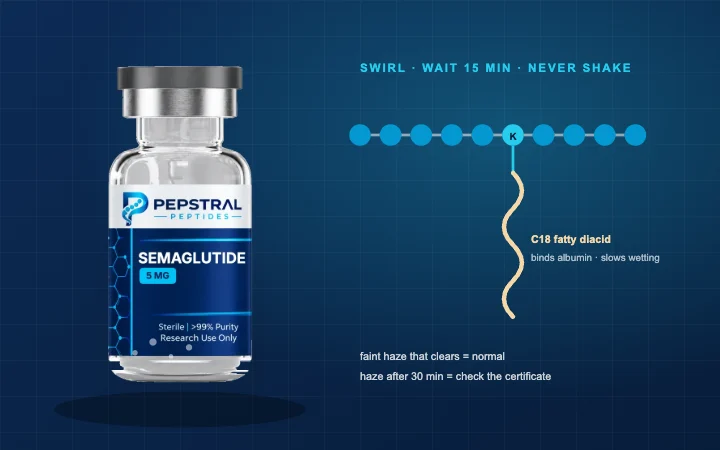
The pattern is identical in principle to semaglutide: use Aib to defeat DPP-4, use a fatty diacid to bind albumin and extend circulation. The differences are in the details — two Aib residues rather than one, and a C20 chain rather than C18.
The linker chemistry is the same γGlu plus two OEG spacers. Why acylated peptides last a week covers why a reversible albumin interaction converts a minutes-long half-life into a days-long one.
What "imbalanced and biased" means
Willard and colleagues published a 2020 characterisation in JCI Insight with that phrase in its title, and it is the most useful single reference on tirzepatide's receptor behaviour. Two separate findings sit inside it.
Imbalanced — the molecule is not equipotent at its two targets. It behaves close to native GIP at the GIP receptor, and substantially weaker than native GLP-1 at the GLP-1 receptor. A "dual agonist" that is near-native at one receptor and sub-native at the other is not splitting its activity evenly.
Biased — at the GLP-1 receptor it favours one downstream pathway over another. Receptor activation is not a single event: a GPCR can couple to G proteins (producing cAMP) and separately recruit β-arrestin (which drives receptor internalisation and desensitisation). Tirzepatide favours cAMP signalling over β-arrestin recruitment at the GLP-1 receptor.
Reduced β-arrestin recruitment means less receptor internalisation, which means the receptor stays available at the cell surface longer. That is a mechanistic observation from the published pharmacology, and it is as far as this post will take it — what it produces in an organism is a clinical question belonging to the approved products.
What are GPCRs covers the two-pathway architecture that makes biased agonism possible, and the receptor and target table places both incretin receptors in context.
What the certificate reports
| Field | Lot TIR10-0803 |
|---|---|
| Molecular weight | 4813.5 |
| Purity (RP-HPLC, 214 nm) | 99.80% |
| Identity | LC-MS/MS |
| Endotoxin | <0.05 EU/mL |
| Label | 10 mg |
4813.5 Da is the free-base mass. As with any acylated peptide, salt form is the question the certificate should answer and often does not — a sodium or acetate salt has a different mass and a different peptide content per milligram. TFA salt vs acetate salt covers the arithmetic, and net peptide content vs purity covers why label quantity and peptide quantity are different numbers.
The identity line matters more here than purity. At 39 residues with two non-standard amino acids and a C20 acyl chain, there are many plausible synthesis-related species that would chromatograph near the main peak. Mass spectrometry is what distinguishes them — what LC-MS confirms.
Handling
Behaves like the other acylated incretin analogues, which is to say slowly.
| Property | Behaviour |
|---|---|
| Dissolution | Slow; the C20 chain is more hydrophobic than semaglutide's C18 — why GLP-1 peptides dissolve slowly |
| Technique | Diluent down the vial wall, gentle swirl, wait. Never shake |
| Aggregation | Amphiphilic; accumulates at air–water interfaces — peptide aggregation explained |
| Adsorption | Significant at low concentration — why peptides stick to plastic |
| Storage | Standard lyophilized handling — how to store peptide vials |
A longer acyl chain means slower wetting. If semaglutide takes a while, expect tirzepatide to take longer. That is the chain doing its job, not a quality problem.
Where it sits among the incretin analogues
| Semaglutide | Tirzepatide | Retatrutide | |
|---|---|---|---|
| Parent hormone | GLP-1 | GIP | GIP-based |
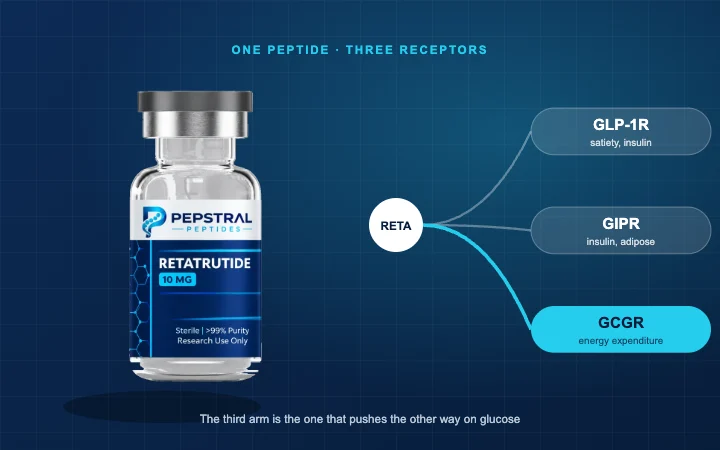
| Receptors | GLP-1 | GIP + GLP-1 | GIP + GLP-1 + glucagon |
| Residues | 31 | 39 | 39 |
| Aib positions | 8 | 2 and 13 | — |
| Acyl chain | C18 diacid | C20 diacid | C20 diacid |
| Free-base MW | 4113.6 | 4813.5 | — |
The progression is one of adding receptors to a GIP-derived scaffold. Why retatrutide adds a glucagon receptor covers the third step, and what the retatrutide trials measured covers how that compound's evidence base is structured.
Regulatory position
Tirzepatide is an approved prescription medicine in the United States and other major markets under brand names held by its originator. Those approvals cover specific manufactured products with defined specifications.
Research-grade tirzepatide is not those products and is not interchangeable with them. It is supplied for laboratory research only. The FDA has published specific concerns about unapproved GLP-1 products, and what "research use only" means covers the limits of that designation.
Frequently asked questions
Is tirzepatide a GLP-1 drug?
Its backbone is GIP. It activates the GLP-1 receptor as well, but describing it as a GLP-1 analogue reverses the actual sequence relationship.
What does "biased agonist" mean?
A receptor can signal through more than one downstream pathway. A biased agonist favours one over another. Tirzepatide favours cAMP signalling over β-arrestin recruitment at the GLP-1 receptor, per Willard et al. 2020.
Why two Aib residues instead of one?
Position 2 blocks DPP-4 cleavage, the same job Aib8 does in semaglutide. Position 13 contributes to receptor selectivity and stability. They are not redundant.
Why is the molecular weight 4813.5?
That is the free-base mass of the 39-residue peptide with its two Aib substitutions, the γGlu–2×OEG linker and the C20 diacid. The lot certificate here reports exactly that figure.
Does a C20 chain bind albumin more tightly than C18?
A longer chain generally increases albumin affinity and lipophilicity. The trade-off is slower dissolution and a greater tendency to aggregate, which is what you observe at the bench.
Can I compare potency between tirzepatide and semaglutide from the certificate?
No. Certificates report identity, purity, content and endotoxin. No analytical method on a certificate of analysis measures receptor activity or potency.
References
- Coskun T, Sloop KW, Loghin C, et al. LY3298176, a novel dual GIP and GLP-1 receptor agonist for the treatment of type 2 diabetes mellitus: From discovery to clinical proof of concept. Molecular Metabolism 2018;18:3-14. doi.org/10.1016/j.molmet.2018.09.009
- Willard FS, Douros JD, Gabe MB, et al. Tirzepatide is an imbalanced and biased dual GIP and GLP-1 receptor agonist. JCI Insight 2020;5(17):e140532. doi.org/10.1172/jci.insight.140532
- US Food and Drug Administration. FDA's Concerns with Unapproved GLP-1 Drugs Used for Weight Loss. www.fda.gov/drugs/postmarket-drug-safety-information-patients-and-providers/fdas-concerns-unapproved-glp-1-drugs-used-weight-loss
Every product mentioned is sold for laboratory research use only and is not for human or animal use. Nothing on this page describes or recommends use of the material sold here in humans or animals.