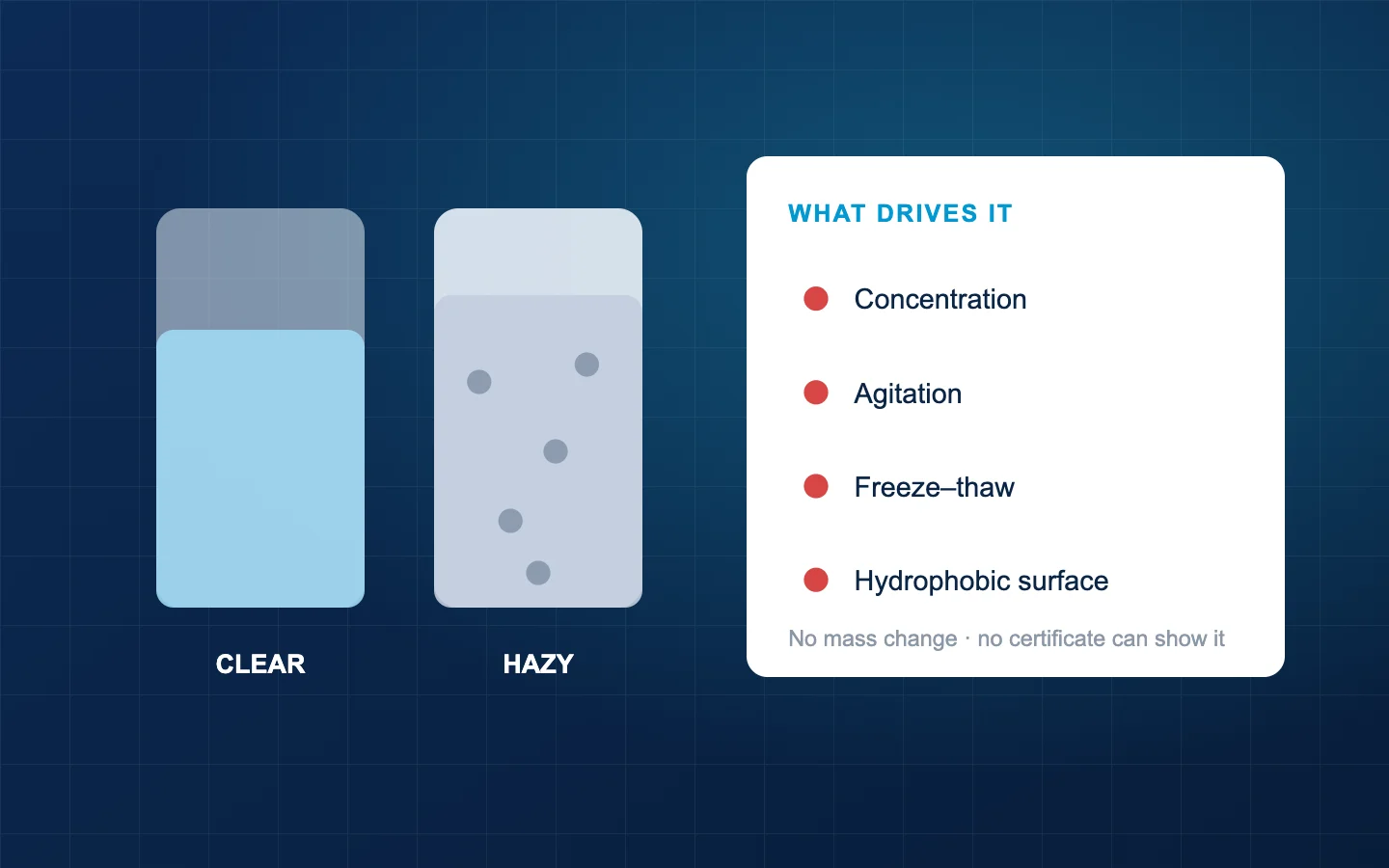
Every other failure mode in this catalogue leaves a trace. Deamidation shifts the mass by a dalton. Oxidation adds sixteen. A deletion sequence shows up as a separate peak. Aggregation leaves nothing — the molecules are chemically unchanged, and both the mass spectrometer and the HPLC can report a perfect result on material that has already stopped behaving. That is what makes it the failure worth understanding rather than looking up.
What is aggregation, exactly?
Manning and colleagues' review of protein pharmaceutical stability splits degradation into two categories, and the distinction is the whole point here. Chemical degradation changes covalent bonds — deamidation, oxidation, hydrolysis. Physical degradation leaves every bond intact and changes how the molecules relate to each other.
Aggregation is the physical route. Individual peptide molecules associate into dimers, then higher oligomers, then in the extreme into particles large enough to scatter light or fall out of solution. No bond is made or broken in the peptide itself. Weigh an aggregate and you weigh the same molecules you started with.
Why can no certificate catch it?
Because the two assays on a certificate both look past it.
Mass spectrometry ionises and weighs. Non-covalent associations generally do not survive that process — the aggregate comes apart and the instrument reports the monomer mass, correctly.
HPLC-UV separates by hydrophobicity on a column, under conditions with organic solvent and often acid, which likewise tend to disrupt non-covalent association.
So the purity figure and the identity line can both be accurate and still tell you nothing about whether the material in front of you is monomeric. And critically, a certificate describes the lyophilized powder as released. Aggregation happens overwhelmingly after you add water, which is downstream of everything the certificate covers. Our post on what LC-MS confirms makes the same point from the other direction.
What drives it?
| Driver | Why | What to do |
|---|---|---|
| Concentration | More molecules, more collisions. Aggregation is strongly concentration-dependent | Reconstitute to the concentration you need, not the most concentrated one possible |
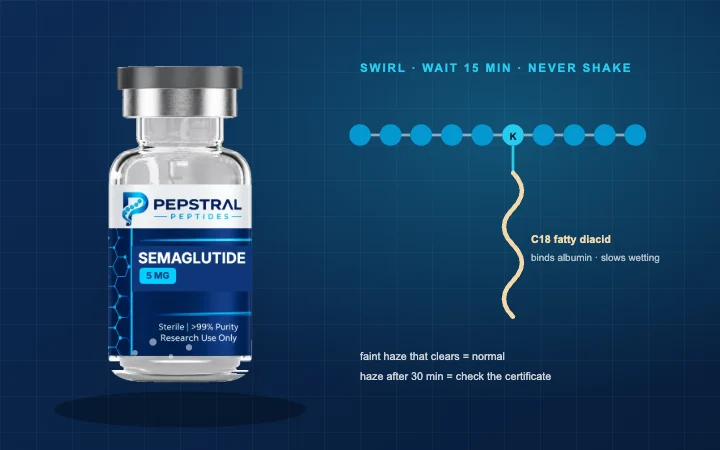
| Agitation | Shear and the air-water interface both promote unfolding and association | Swirl gently; never shake or vortex |
| Freeze-thaw | Ice formation concentrates solute and shifts pH in the remaining liquid | Aliquot, freeze once, thaw once |
| Hydrophobic surface | Exposed non-polar regions seek each other out | Unavoidable — it is a property of the sequence |
| pH near the isoelectric point | Net charge near zero means no electrostatic repulsion holding molecules apart | Move pH away from it, as the diluent post covers |
| Temperature | Raises molecular motion and the rate of everything | Refrigerate |
Which peptides are most at risk?
The ones with the most hydrophobic surface, and in this catalogue that means the acylated compounds. Semaglutide, tirzepatide, retatrutide and cagrilintide all carry fatty-acid chains bolted on to extend their half-life — and a fatty-acid chain is, by design, a large non-polar surface.
That is the same chemistry behind their slow reconstitution, covered in our posts on why GLP-1 peptides dissolve slowly and why acylated peptides last a week. The modification that makes them persist is the modification that makes them aggregate-prone. It is a trade, not a defect.
Sequences rich in leucine, isoleucine, valine, phenylalanine and tryptophan carry the same risk for the same reason.
How do you spot it?
Visible haze in a solution that was clear. Particles, flecks or strands. A solution that will not clear with gentle swirling and time. Persistent foaming that does not settle.
All of those are the late stage. The early stage — soluble dimers and small oligomers — is invisible, and that is the uncomfortable part: a perfectly clear solution can already contain a meaningful population of oligomers.
If the answer matters, it is an analytical question rather than a visual one. Size-exclusion chromatography separates by hydrodynamic size and will show an oligomer population that reversed-phase HPLC missed; dynamic light scattering measures particle size directly. Our independent testing post covers sending material out, though SEC is a different request from the standard purity panel.
Does it matter for an in-vitro experiment?
Usually yes, in two ways.
Your effective concentration drops. Aggregated peptide is not available to bind. You calculated a concentration from mass and volume, and the free monomer concentration is now lower by an unknown amount — which quietly shifts every point on a dose-response curve.
Aggregates can have their own activity. In some systems oligomers behave differently from monomers rather than simply being inert. An unexplained result from a hazy vial is not automatically a biological finding.
The handling habits that prevent it
- Swirl, never shake. Air-water interface and shear are two of the four drivers, and shaking supplies both.
- Reconstitute to the concentration you need. Do not make the most concentrated stock possible out of habit.
- Aliquot immediately, freeze once. This is the single highest-value habit — it is covered in our vial size post because it is also what makes a large vial economical.
- Keep it cold and keep it dark.
- Look before you draw. Thirty seconds of inspection against a light is the cheapest quality check you have.
Frequently asked questions
Can aggregation be reversed?
Small soluble oligomers sometimes disperse with gentle warming and dilution. Visible particles generally do not go back, and filtering removes the aggregate along with an unknown share of your peptide. Treat the vial as compromised rather than salvageable.
Is a little foam a problem?
Foam that settles in a minute is air. Foam that persists points at surface-active material, which can mean aggregation is underway.
Does the counter-ion affect aggregation?
It can — counter-ion influences solubility and local pH, and our TFA and acetate post covers the trade. It is a second-order effect next to concentration and agitation.
Why does lyophilized powder not aggregate?
It largely cannot. Aggregation needs molecular mobility, and the dry amorphous state has very little — the same reason the dry state is so much more stable overall, covered in our shipping post.
References
- Manning MC, Chou DK, Murphy BM, Payne RW, Katayama DS. Stability of protein pharmaceuticals: an update. Pharmaceutical Research 2010;27(4):544-575. doi.org/10.1007/s11095-009-0045-6
- Niu CH, Chiu YY. FDA perspective on peptide formulation and stability issues. Journal of Pharmaceutical Sciences 1998;87(11):1331-1334. doi.org/10.1021/js9800782
- Bachem. Quality Control of Amino Acids and Peptides: A Guide. www.bachem.com/knowledge-center/quality-control-of-amino-acids-peptides-a-guide
Every product mentioned is sold for laboratory research use only and is not for human or animal use. Nothing on this page describes or recommends use of the material sold here in humans or animals.