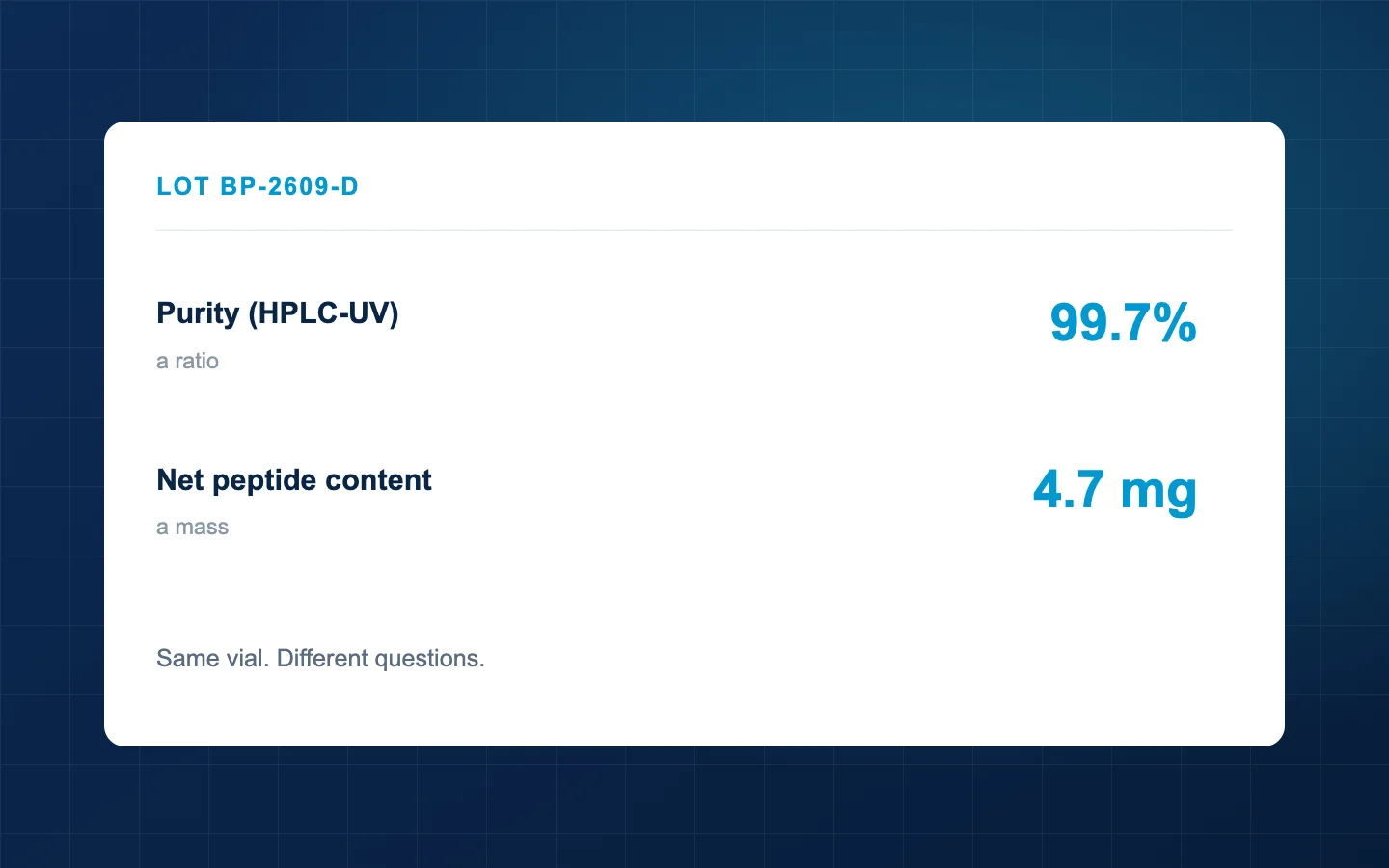
A certificate that says 99% purity has told you nothing about how much peptide is in the vial. Purity is a ratio: of the peptide-related material present, what share is the sequence you ordered. Net peptide content is a mass: how many milligrams of that sequence the vial actually holds. A vial can be 99% pure and contain noticeably less than its labelled dose, and nothing about that is a defect. This post explains what sits in the gap, why the two numbers answer different questions, and which one belongs in your arithmetic.
What is purity actually measuring?
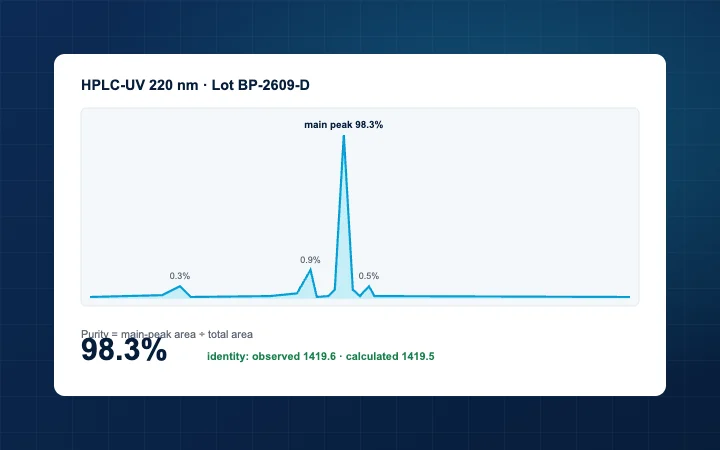
Purity from HPLC-UV is an area ratio. The chromatogram separates what is in the sample, a detector measures absorbance at a set wavelength, and the main peak's area is divided by the total area of all peaks. Report it as a percentage and you have "99.2% by HPLC-UV at 220 nm."
Two things follow from that definition. First, purity only counts what the detector sees — at 220 nm that means the peptide bond, so peptide-related species. Second, it is a relative figure. It says the target sequence dominates the peptide material present. It says nothing about how much material there is.
So what else is in the vial?
Three things, none of which is an impurity in the sense of a failed synthesis.
Counter-ion. Peptides are purified by reversed-phase HPLC using trifluoroacetic acid, and basic residues — arginine, lysine, histidine, and the free N-terminus — end up paired with trifluoroacetate. Roux and colleagues' evaluation of counter-ion exchange describes why this is difficult to avoid and what it takes to remove: TFA is tenacious, and a sequence with several basic residues carries proportionally more of it.
Residual water. Lyophilized powder is hygroscopic and retains some moisture. That is expected, and within limits it is desirable — a completely dry cake is not the goal.
Salts from buffers, where the process used them.
Add those together and the powder in the vial weighs more than the peptide in the vial. The labelled dose is a fill target for the powder; the net peptide content is the peptide inside it.
| Purity | Net peptide content | |
|---|---|---|
| What it is | A ratio of peak areas | A mass, in milligrams |
| Method | HPLC-UV, typically 220 nm | Amino acid analysis, or nitrogen determination |
| Answers | "Is this the right compound, cleanly made?" | "How much of it did I get?" |
| Typical value | ≥99% | Less than the labelled dose |
| Use it for | Judging synthesis and purification quality | Every dilution and concentration you calculate |
Why does this matter for your arithmetic?
Because a concentration is a mass over a volume, and if you use the wrong mass every number downstream inherits the error.
Take a 5 mg vial reconstituted in 2 mL. Using the labelled dose you would call it 2.5 mg/mL. If the certificate reports 4.7 mg net, the true concentration is 2.35 mg/mL — about 6% lower. That 6% does not wash out in the dilution series; it propagates through every point of it, unchanged.
For a rough handling step that is irrelevant. For a dose-response curve, a reported EC50, or a comparison between two compounds, it is the difference between a number you can publish and a number that is quietly wrong. Our post on molarity versus milligrams covers the second half of the same problem.
Why is net peptide content sometimes missing?
Because measuring it costs money. Amino acid analysis is a separate assay from the HPLC run that produced the purity figure, and a supplier who is only paying for purity and identity has no net content to report.
The FDA-perspective paper by Niu and Chiu makes the regulatory version of the point: content and potency are established for a specific product by specific methods, not inferred from a class. A missing net content line is not automatically a bad sign, but it does mean you cannot calculate a true concentration, and any protocol depending on one is resting on the labelled dose.
If a certificate omits it, the honest thing is to record that in your methods rather than assume the label. Our methods-section post treats "not reported" as a legitimate entry.
How do you check the two numbers are consistent?
They are not derived from each other, so you cannot. What you can do is sanity-check them against the mass:
- Net content close to the labelled dose on a strongly basic sequence is worth a second look — TFA-paired peptides usually give up more mass than that.
- Net content far below the label with high purity points at counter-ion and moisture, not at a synthesis problem.
- High net content with low purity is the combination that should stop you: plenty of material, but a meaningful share of it is not the compound you ordered.
Frequently asked questions
Does a higher purity number mean more peptide in the vial?
No, and this is the central confusion. Purity and quantity are independent. A 99.5% vial and a 98% vial can hold the same mass of peptide, or the 98% one can hold more.
Is trifluoroacetate harmful?
For in-vitro work the usual concern is not toxicity but interference — TFA affects pH and can influence some cell-based assays. Where that matters, acetate-exchanged material is the alternative, at extra cost. Our salt-form post covers the trade in full.
Which number should go on the vial label?
Both, ideally, and the labelled dose should be understood as the fill target. Our vial label post walks through the seven fields a good label carries.
Can I calculate net peptide content myself?
Not from a certificate. It requires amino acid analysis on the actual material. You can bound it — it will always be below the labelled dose — but the specific figure has to be measured.
References
- Bachem. Quality Control of Amino Acids and Peptides: A Guide. Net peptide content, counter-ions and moisture. www.bachem.com/knowledge-center/quality-control-of-amino-acids-peptides-a-guide
- Roux S, Zekri E, Rousseau B, et al. Elimination and exchange of trifluoroacetate counter-ion from cationic peptides: a critical evaluation of different approaches. Journal of Peptide Science 2007;14(3):354-359. doi.org/10.1002/psc.951
- Niu CH, Chiu YY. FDA perspective on peptide formulation and stability issues. Journal of Pharmaceutical Sciences 1998;87(11):1331-1334. doi.org/10.1021/js9800782
Every product mentioned is sold for laboratory research use only and is not for human or animal use. Nothing on this page describes or recommends use of the material sold here in humans or animals.