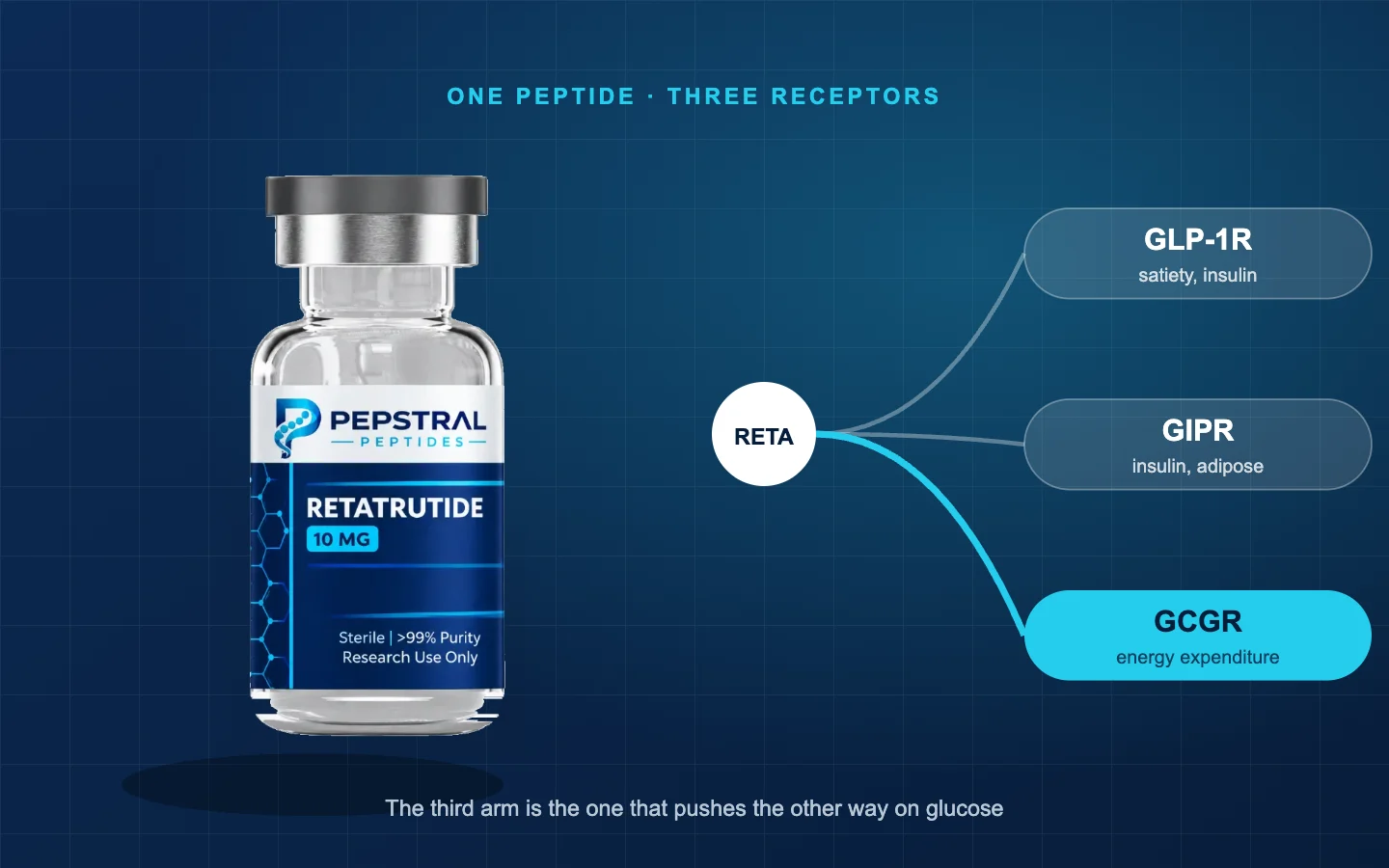
Every compound in the GLP-1 category does roughly the same thing at the same receptor. Retatrutide is the one that does not, and the difference is not that it is newer or stronger — it is that it engages a receptor whose natural ligand pushes in the opposite direction.
That is the interesting part, and it is the part that a product page never has room for.
One, two, three
Line the three compounds up by how many receptors they activate and the progression is obvious:
| Compound | GLP-1 receptor | GIP receptor | Glucagon receptor |
|---|---|---|---|
| Semaglutide | Yes | — | — |
| Tirzepatide | Yes | Yes | — |
| Retatrutide | Yes | Yes | Yes |
Each step adds a receptor, and each step was a deliberate design decision rather than an accident of selectivity. Retatrutide is a single 39-residue peptide carrying a C20 fatty diacid on a lysine side chain — one molecule, three receptors, not a mixture. Our acylation post covers what that fatty chain is for.
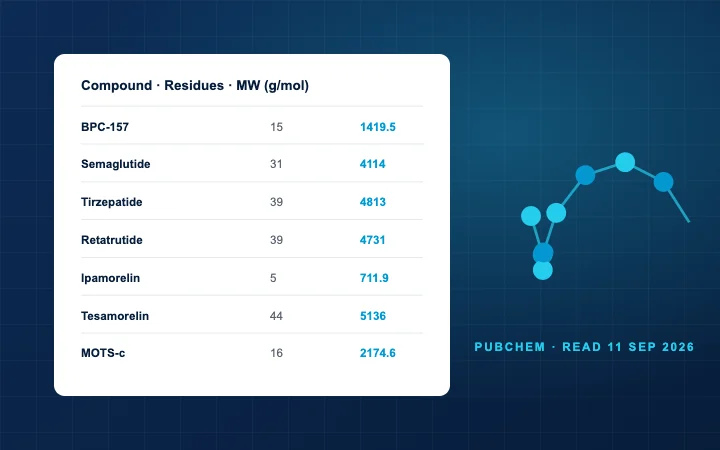
PubChem lists the compound as C221H342N46O68, molecular weight 4731. A small housekeeping note, because it catches people out: at the time of writing PubChem does not resolve the names "retatrutide" or "LY3437943" to a record. The entry exists under CID 171390338, where it is titled "Triple G" — a nickname borrowed from the editorial that accompanied the phase 2 results. If you search the database by name and find nothing, the compound is there; the index is not.
Why the glucagon receptor is the strange one
GLP-1 and GIP are both incretins. They are released from the gut after a meal, and both potentiate glucose-dependent insulin secretion. Adding the second to the first is an intuitive move: two pathways, same general direction.
Glucagon is not an incretin. It is the counter-regulatory hormone to insulin. Its principal job is to raise blood glucose by driving hepatic glycogenolysis and gluconeogenesis. A glucagon receptor agonist, given alone, would be expected to make glycaemic control worse.
So the obvious question about retatrutide is not "why three receptors" — it is why that third one.
The answer in the published rationale is energy expenditure. Glucagon receptor activation is associated with increased energy expenditure and hepatic fat oxidation, which is a lever the two incretin arms do not pull. The incretin arms mostly reduce energy in; the glucagon arm is there to raise energy out. Coskun and colleagues describe LY3437943 as engineered to enhance dual GIP/GLP-1 agonism with additional glucagon receptor agonism, specifically to improve energy expenditure alongside weight loss and glycaemic control.
The bet, stated plainly, is that the incretin arms pay the glucose bill the glucagon arm runs up, and what is left over is a mechanism the dual agonists do not have.
"Triple agonist" does not mean equal thirds
This is the detail most summaries drop, and it matters more than almost anything else in the compound's description.
From the Coskun abstract: in vitro, LY3437943 shows balanced GCGR and GLP-1R activity but more GIPR activity.
Read that carefully. It is not one-third at each receptor. Glucagon and GLP-1 receptor activity are roughly matched to each other, and GIP receptor activity sits above both. The molecule is weighted, and the weighting is a design parameter — you could build a triple agonist with a different ratio and get a different compound with different behaviour.
| What people assume | What the pharmacology says |
|---|---|
| Equal activity at three receptors | Glucagon ≈ GLP-1, with more at GIP |
| "Triple" means three times as strong | It means three targets; potency at each is separate |
| The three effects simply add up | They interact, and the glucagon arm partly opposes the others on glucose |
If you are writing a methods section, "triple agonist" is a category, not a characterisation. The ratio is the characterisation, and it belongs in your description of the compound.
What the human data showed, and why it is not your result
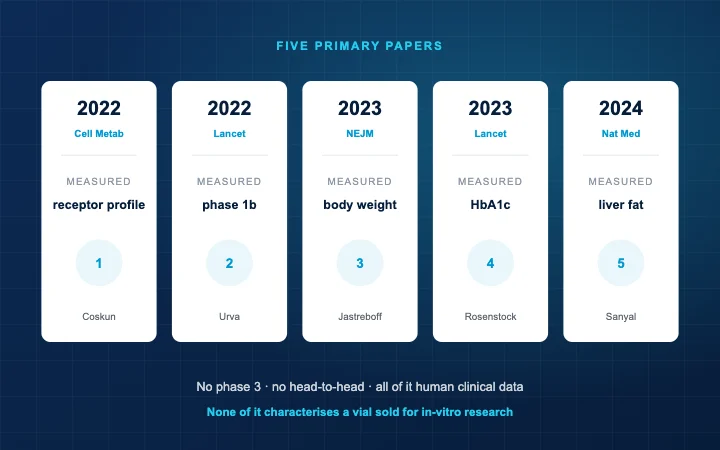
The phase 2 obesity trial (Jastreboff and colleagues, 2023, 338 adults, 48 weeks) reported a least-squares mean weight change of −24.2% at the 12 mg dose against −2.1% on placebo. The phase 1b and phase 2 diabetes work reported glycaemic effects in the same direction rather than the worsening a glucagon agonist alone would predict — which is the design bet paying off, at least in those cohorts.
Those are human clinical results, obtained with pharmaceutical-grade material under a protocol, with dose escalation, monitoring and a defined population. They describe the molecule's behaviour in that setting. They say nothing about the vial on your bench, they are not a characterisation of material sold for laboratory use, and everything in this catalogue is for in-vitro research only. Our post on why clinical trial data does not transfer is the longer version of that argument, and it applies to this compound more than to most, precisely because the human dataset is so prominent.
What the trials are genuinely useful for is orientation: they tell you the three-receptor design does something the dual-receptor design does not, which is the hypothesis a bench experiment would be built to interrogate.
What three receptors mean for an experiment
The practical consequence is about attribution, and it is easy to get wrong.
If you run retatrutide on a single cell line expressing a single receptor, you have measured that arm. You have not measured the compound. If you run it on a system expressing all three, you have measured the compound but you cannot say which arm produced what.
Three ways through it:
- Selective reference compounds on the same plate. A GLP-1-only agonist, a GIP-only agonist and a glucagon-only agonist run alongside retatrutide give you the shape of each arm under your conditions.
- Receptor-selective antagonists. Knocking out one arm at a time is the cleanest attribution available, and is how the contribution of the glucagon component gets isolated.
- A dual-agonist comparator. Tirzepatide is retatrutide minus the glucagon arm, near enough, and running both at matched exposure is the comparison that isolates what the third receptor adds. Our side-by-side page sets out the structural differences.
Our receptor and target table lists which receptor each compound in the catalogue acts on, and the reference table carries the formula and mass you will need for the molar arithmetic.
Frequently asked questions
Is retatrutide a mixture of three peptides?
No. It is one peptide with one sequence, one molecular formula and one mass on the certificate. The three activities come from a single molecule engaging three receptors, which is a different thing entirely from a blend. We do sell a genuine blend — retatrutide with cagrilintide — and that one really is two compounds in a vial, which is why it has two masses to confirm and a separate set of design problems.
Does the glucagon arm make it harder to work with in a glucose assay?
It makes the design question sharper rather than the handling harder. In any system where hepatic or islet glucose handling is a readout, the glucagon arm is an active variable pointing one way while the incretin arms point the other, and a net result with no arm-level controls is uninterpretable. In assays with no glucose readout, the issue does not arise.
Why is it 39 residues when GLP-1 is 31?
Because it is not a GLP-1 analogue with extras bolted on. Multi-receptor agonists are built by finding a sequence that fits more than one receptor pocket, and that generally means a longer backbone with non-coded residues at the positions where the fit has to be forced. Retatrutide carries substitutions of that kind, plus the fatty diacid that gives it the weekly exposure profile. Our post on why the same peptide has five different names covers why the development code LY3437943 still appears in most of the primary literature.
Which vial size should I start with?
For a first characterisation, the smallest — you will change your mind about concentration once. The 10 mg vial is 2.11 µmol, which is a large molar amount for most in-vitro work. Our reconstitution and concentration post has the table for all five sizes, and how to choose a vial size works through the trade-off between waste and repeat orders.
Where does the certificate come in?
Every lot we ship carries HPLC-UV purity at 220 nm and identity by LC-MS against the calculated mass, and the certificate page has the current lots. For a 4731 g/mol peptide the mass confirmation is the meaningful identity check — our post on what LC-MS confirms covers what that result does and does not establish.
References
- Coskun T, Urva S, Roell WC, et al. LY3437943, a novel triple glucagon, GIP, and GLP-1 receptor agonist for glycemic control and weight loss: from discovery to clinical proof of concept. Cell Metabolism 2022;34(9):1234-1247.e9. doi.org/10.1016/j.cmet.2022.07.013
- Urva S, Coskun T, Lou MT, et al. LY3437943, a novel triple GIP, GLP-1, and glucagon receptor agonist in people with type 2 diabetes: a phase 1b, multicentre, double-blind, placebo-controlled, randomised, multiple-ascending dose trial. The Lancet 2022;400(10366):1869-1881. doi.org/10.1016/S0140-6736(22)02033-5
- Jastreboff AM, Kaplan LM, Frías JP, et al. Triple-hormone-receptor agonist retatrutide for obesity — a phase 2 trial. New England Journal of Medicine 2023;389(6):514-526. doi.org/10.1056/NEJMoa2301972
- PubChem CID 171390338 (record titled "Triple G"): molecular formula C221H342N46O68, molecular weight 4731. pubchem.ncbi.nlm.nih.gov/compound/171390338
Every product mentioned is sold for laboratory research use only and is not for human or animal use. Nothing on this page describes or recommends use of the material sold here in humans or animals.