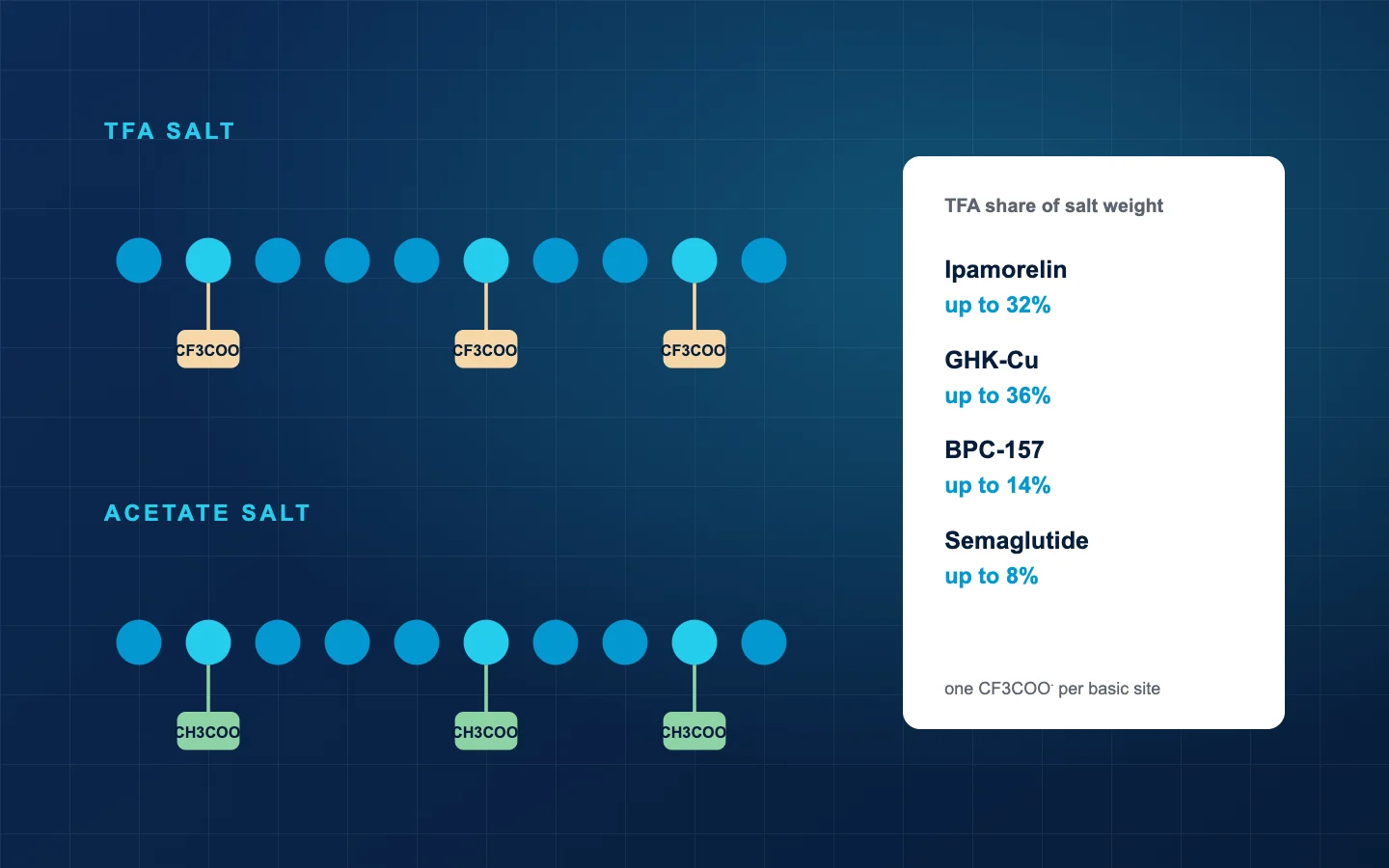
Almost every research peptide arrives as a trifluoroacetate salt. Trifluoroacetic acid is the reagent that cuts the finished chain off the synthesis resin, and it is the acid in the mobile phase that purifies the peptide by HPLC. By the time the powder is freeze-dried, every basic site on the peptide has paired with a trifluoroacetate ion, and those ions ship in the vial. For most work that is a footnote in the net peptide content. For some cell assays it is a variable.
This post explains where the counter-ion comes from, how much of it a given peptide carries, what the evidence says about its effect on cells, and when to ask for a different salt.
Where does the counter-ion come from?
The synthesis post describes the two steps: cleavage from the resin in trifluoroacetic acid, then purification on a reverse-phase column whose solvent contains a small percentage of the same acid. Both steps leave the peptide in a solution full of trifluoroacetate.
Freeze-drying removes the free acid and the water, but not the trifluoroacetate that has paired with the peptide's positive charges. Bachem's quality guide notes that the minimum number of counter-ions is proportional to the number of basic residues in the sequence, and that peptides rich in basic residues have low net peptide content for that reason even when they are very pure.
How much TFA does each peptide carry?
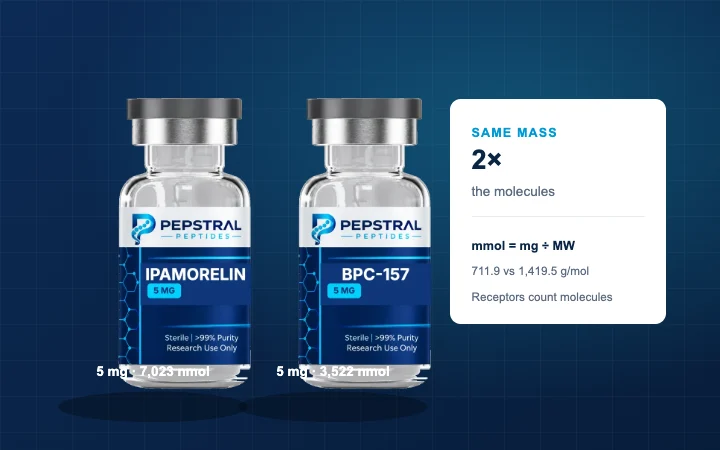
Each basic site, meaning a lysine, arginine or histidine side chain plus the free N-terminal amine, pairs with one trifluoroacetate of mass 113 g/mol. The table estimates the upper bound for four catalog compounds, assuming every basic site is paired:
| Compound | Basic sites (approximate) | TFA mass per molecule | Peptide mass | TFA as share of salt weight |
|---|---|---|---|---|
| Ipamorelin 711.9 g/mol | 3 (His, Lys, N-terminus) | 339 | 711.9 | up to about 32% |
| BPC-157 1419.5 g/mol | 2 (Lys, N-terminus) | 226 | 1419.5 | up to about 14% |
| GHK-Cu 400.9 g/mol | 2 (Lys, N-terminus; copper complex alters this) | up to 226 | 400.9 | up to about 36% |
| Semaglutide 4114 g/mol | 3 (His, Arg, N-terminus; the acylated lysine is not free) | 339 | 4114 | up to about 8% |
These are illustrations, not measurements, and real values are usually below the upper bound. The pattern is what matters: a short peptide with several basic residues can be a third counter-ion by weight, while a long peptide with few basic residues is mostly peptide. This is the mechanism behind the net-peptide-content gap discussed in the pricing post, and it is why a 5 mg label on a small basic peptide needs the certificate's net content line before it can be trusted.
Does trifluoroacetate affect cells?
Yes, in at least some systems. Cornish and colleagues reported in 1999 that trifluoroacetate, present as a contaminant in purified peptides and proteins, inhibited the proliferation of cultured osteoblasts and chondrocytes at concentrations that can arise from peptide preparations. The paper is a caution for any proliferation assay: a peptide that seems to slow cell growth may be doing so through its counter-ion. AmbioPharm's guidance for developers points the same way, describing acetate as the preferred counter-ion once a peptide moves beyond early research, partly because TFA salts can provoke responses of their own.
The effect is not universal, and many cell experiments are run on TFA salts without trouble. The question is whether your readout overlaps with what the counter-ion can do.
When should you ask for acetate?
| Situation | TFA salt acceptable? | Recommendation |
|---|---|---|
| Receptor binding, enzyme kinetics, analytical work | Yes | No change needed |
| Established cell lines, short exposure, non-proliferation readout | Usually | Run a TFA-matched vehicle control once |
| Proliferation, viability or differentiation assays | Doubtful | Acetate salt, or a control with matched trifluoroacetate |
| Primary cells, stem cells, bone and cartilage cells | Doubtful | Acetate salt |
| Small basic peptides at high concentration | Doubtful | Acetate salt; the TFA share is largest here |
| In vivo work | Design decision | Acetate is the usual choice at later stages |
Salt exchange from TFA to acetate is a routine ion-exchange step that synthesis houses offer as a service, and a supplier can quote it for a lot. The D'Hondt review treats counter-ion content as one of the impurity classes worth specifying, which is the right way to think about it: a known component whose amount should be on the certificate.
How do you control for it if you cannot change it?
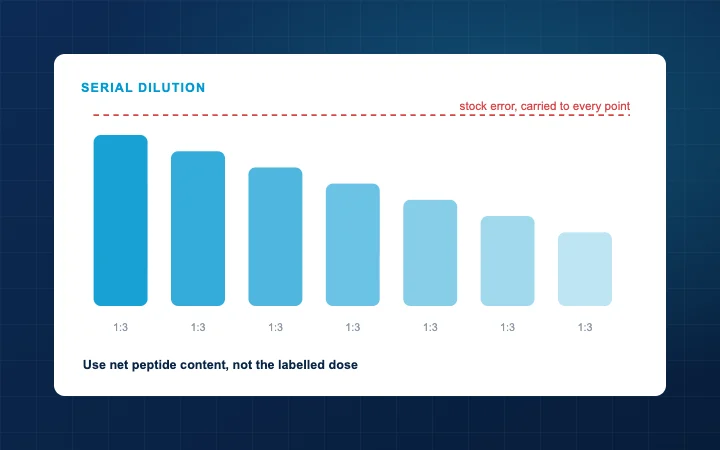
Make a vehicle control with trifluoroacetate at the concentration your peptide stock carries. Sodium trifluoroacetate is an inexpensive reagent; dissolve it to match the counter-ion mass per millilitre in the stock, dilute it identically into the assay, and treat it as the vehicle. If the control shows the effect, the counter-ion is the cause. If it does not, the peptide is.
To size the control, use the certificate's net peptide content: the difference between gross weight and net peptide, minus a small allowance for water, is the counter-ion mass in the vial.
What should the certificate say?
The counter-ion is rarely on the chromatogram, so it appears on a certificate in one of three ways: as a stated salt form, as a measured TFA content, or implicitly through net peptide content. A certificate that reports net peptide content lets you calculate the counter-ion share; one that reports the salt form tells you which ion it is; the best report both. The certificate guide shows where each line sits, and the label post explains why the label alone cannot carry this.
Frequently asked questions
Is the TFA salt less pure than the acetate salt?
No. Purity by HPLC measures the peptide fraction and is the same for both. The salt form changes net peptide content and the counter-ion's biological presence, not purity.
Can I remove TFA myself?
Repeated lyophilization from dilute hydrochloric acid, or an ion-exchange step, converts the salt. Both need a laboratory that can handle the acid and re-lyophilize. Asking the supplier for acetate is simpler and gives a certificate for the result.
Why do suppliers ship TFA salts at all?
Because TFA is the cleavage and purification acid, and exchanging it adds a step and a cost. For most research uses it is not needed, so the TFA salt is the default and acetate is available on request.
Does the counter-ion affect molecular weight on the certificate?
The mass spectrometer sees the peptide ion, not the salt, so the observed mass matches the reference table regardless of counter-ion. The salt form changes the powder's weight, not the peptide's mass.
References
- Cornish J, Callon KE, Lin CQ, et al. Trifluoroacetate, a contaminant in purified proteins, inhibits proliferation of osteoblasts and chondrocytes. American Journal of Physiology 1999;277(5):E779-E783. doi.org/10.1152/ajpendo.1999.277.5.E779
- AmbioPharm. Which salt form should I choose for my peptide? TFA, acetate and HCl salts; salt exchange by ion exchange. www.ambiopharm.com/faq/which-salt-form-should-i-choose-for-my-peptide
- Bachem. Quality Control of Amino Acids and Peptides: A Guide. Net peptide content; counter-ion proportional to basic residues. www.bachem.com/knowledge-center/quality-control-of-amino-acids-peptides-a-guide
- D'Hondt M, Bracke N, Taevernier L, et al. Related impurities in peptide medicines. Journal of Pharmaceutical and Biomedical Analysis 2014;101:2-30. doi.org/10.1016/j.jpba.2014.06.012
Every product mentioned is sold for laboratory research use only and is not for human or animal use. Nothing on this page describes or recommends use of the material sold here in humans or animals.