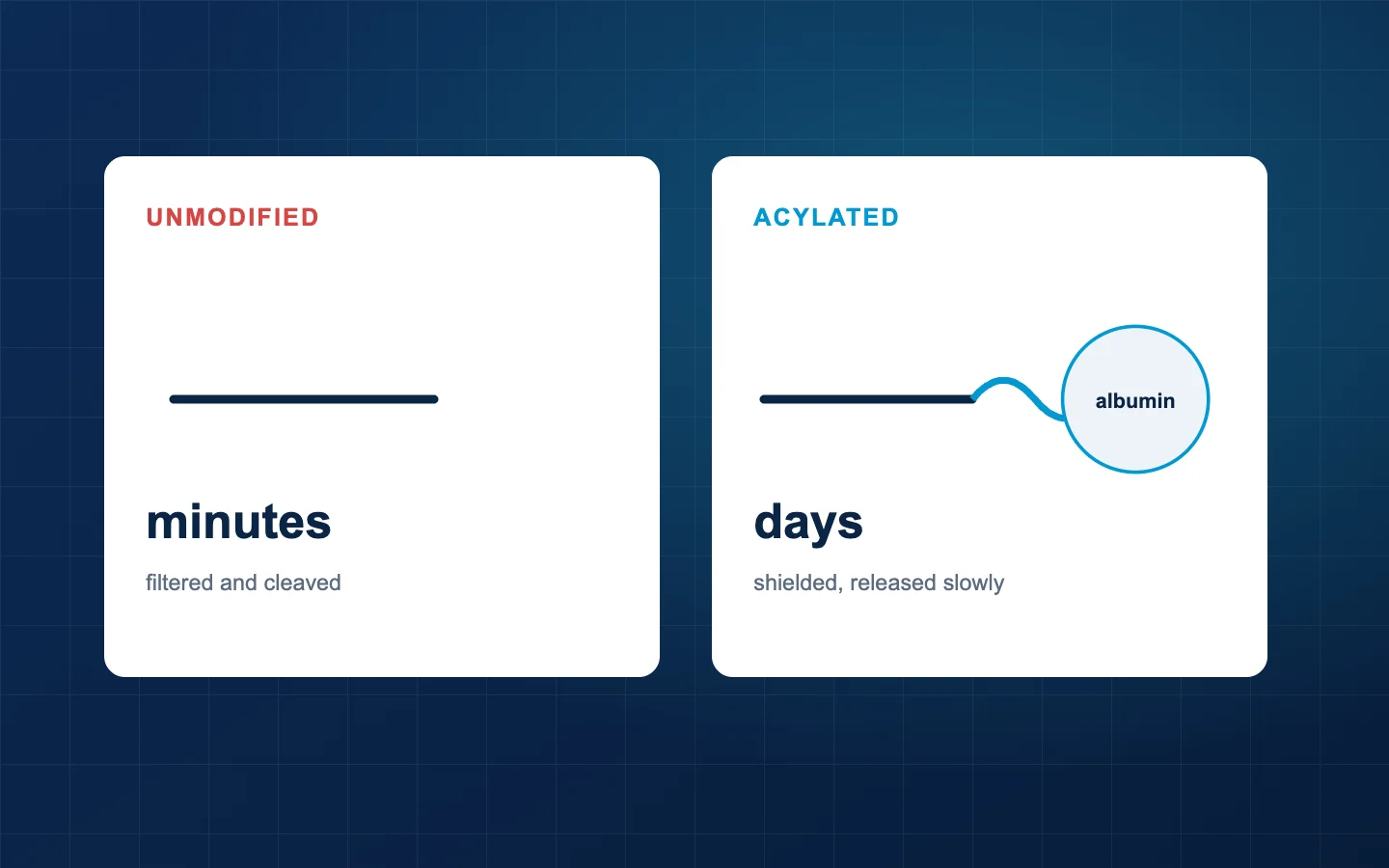
Sermorelin and semaglutide are both peptides. One clears in minutes; the other is administered weekly. Nothing about being a peptide determines that — the difference is a deliberate chemical modification, and understanding it explains several things at once: why the GLP-1 class dissolves so slowly, why CJC-1295 comes in two forms, and why "peptide half-life" is not a useful general statement.
Why do unmodified peptides clear so fast?
Two reasons, both structural.
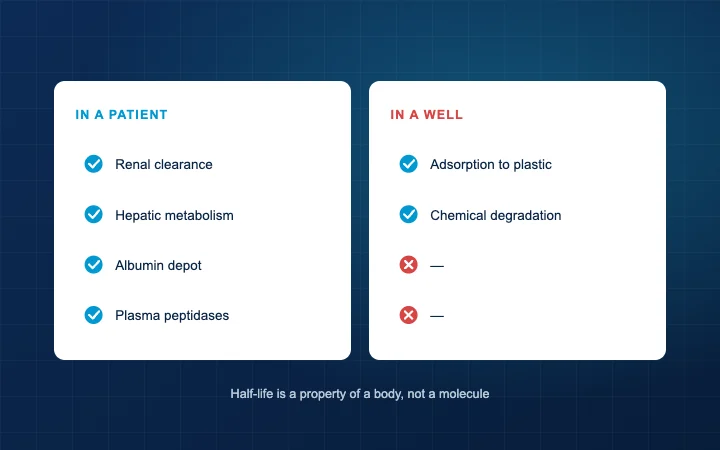
Renal filtration. The kidney filters by size, and the cutoff sits around 60-70 kDa. A short peptide at 1-4 kDa passes straight through. Nothing has to break it down for it to disappear.
Peptidases. Circulation and tissue are full of enzymes that cleave peptide bonds. Some are specific — DPP-4 famously trims two residues from the N-terminus of incretins — and some are general.
Between them, an unmodified short peptide has a circulating half-life measured in minutes. Sermorelin, the reference GHRH analogue, is the clean example: 29 residues, no protective modification, gone quickly. That is not a defect; for studies of pulsatile signalling it is exactly what is wanted.
What does acylation do?
It attaches a fatty-acid chain to the peptide, usually to a lysine side chain via a linker. The chain does not change what the peptide binds — the receptor-facing parts are left alone — but it gives the molecule a new property: affinity for albumin, the most abundant protein in plasma.
Albumin's natural job includes ferrying fatty acids, so it has binding pockets shaped for exactly this. The acylated peptide associates with albumin reversibly: most of the dose is bound at any moment, and bound peptide is too large to filter and largely shielded from peptidases. As free peptide is cleared, more releases from albumin to replace it.
The result is a depot in the bloodstream. Jing and colleagues' 2025 work on GLP-1 protractors describes the design space directly — what you change about the chain and linker to tune how tightly it holds and how slowly it releases.
| Compound | Modification | Consequence |
|---|---|---|
| Sermorelin | None | Minutes |
| CJC-1295 no-DAC | Substitutions resisting cleavage | Minutes, but resists enzymatic trimming |
| CJC-1295 with DAC | Covalent albumin-binding group | Days |
| Semaglutide | Fatty-acid acylation | Days |
| Cagrilintide | Fatty-acid acylation | Days |
| Tesamorelin | Stabilising modification | Intermediate |
How is the DAC approach different?
The drug affinity complex on CJC-1295 reaches the same destination by a different road. Rather than a fatty chain that associates reversibly, DAC carries a reactive group that forms a covalent bond to albumin once administered.
The practical difference for a researcher is that the two forms of CJC-1295 are genuinely different tools. The no-DAC form produces a pulse; the DAC form produces a plateau. Our DAC comparison post covers which suits which question, and it matters that the blends in this catalogue use the no-DAC form.
Why does this make the vial harder to handle?
Because a fatty-acid chain is hydrophobic, and you have bolted it onto a molecule you now want to dissolve in water.
Two consequences follow, both covered in our post on why GLP-1 peptides dissolve slowly:
- Slow reconstitution. These vials need time and gentle swirling. Shaking introduces air and shear, which is the wrong intervention.
- Aggregation risk. Manning and colleagues' review of protein stability treats aggregation as a physical degradation route driven by hydrophobic interaction, concentration and agitation. An acylated peptide has more hydrophobic surface than its unmodified parent, so it sits further along that risk curve.
This is why the acylated compounds in this catalogue — semaglutide, cagrilintide, retatrutide, tirzepatide — carry the same handling note, and why a hazy solution in that class deserves attention rather than a shake.
Frequently asked questions
Does acylation change what the peptide binds?
The design intent is that it does not — the chain is attached away from the receptor-facing region. In practice affinity usually shifts somewhat, which is part of what the medicinal chemistry has to balance.
Why not acylate everything?
Because a long half-life is not always desirable. Studying pulsatile release means you want a pulse. Sermorelin's fast clearance is the feature that makes it the reference GHRH analogue, and acylating it would destroy the thing it is useful for.
Is a longer half-life relevant to in-vitro work?
Often not directly — there is no kidney and no albumin in a plate well unless you put serum in it. But serum-containing media do contain albumin, and an acylated peptide will bind it, changing the free concentration your cells actually see. That is a real confound worth accounting for, and it does not apply to unmodified peptides in the same way.
Do acylated peptides need different storage?
Not in the dry state — the same sealed, frozen, dark conditions. The difference shows up after reconstitution, where their aggregation risk is higher. Our solution-stability post covers the window.
References
- Jing W, et al. A new protractor potentiates glucagon-like peptide 1 with slow-release depot and long-term action. Journal of Medicinal Chemistry 2025. doi.org/10.1021/acs.jmedchem.4c02970
- Lau DCW, Erichsen L, Francisco AM, et al. Once-weekly cagrilintide for weight management in people with overweight and obesity. The Lancet 2021;398(10317):2160-2172. doi.org/10.1016/S0140-6736(21)01751-7
- Manning MC, Chou DK, Murphy BM, Payne RW, Katayama DS. Stability of protein pharmaceuticals: an update. Pharmaceutical Research 2010;27(4):544-575. doi.org/10.1007/s11095-009-0045-6
Every product mentioned is sold for laboratory research use only and is not for human or animal use. Nothing on this page describes or recommends use of the material sold here in humans or animals.