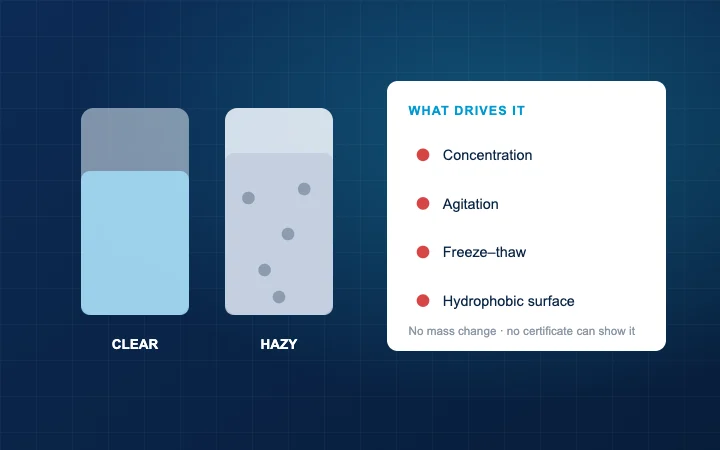

A peptide in a tube is in two places at once: in the liquid, and on the wall. The wall fraction is invisible, it forms within minutes, and it is subtracted from the concentration you calculated when you weighed the powder. Adsorption is not degradation — the molecules are intact, nothing has oxidised, nothing has hydrolysed — which is precisely why nothing on a certificate of analysis can warn you about it. The uncomfortable part is the arithmetic: a surface holds roughly a fixed quantity of peptide, so the more dilute your solution, the larger the share of it that ends up stuck.
Why does a surface hold a peptide at all?
Two mechanisms, and most containers offer one or the other.
Hydrophobic interaction. Polypropylene, polystyrene and PTFE present non-polar surfaces. Any peptide with exposed greasy patches — aliphatic and aromatic side chains, or an attached fatty-acid chain — is more comfortable spread against that surface than surrounded by water. This is the same driving force behind aggregation, described in our aggregation post, pointed at a wall instead of at another peptide molecule.
Electrostatic interaction. Borosilicate glass carries surface silanol groups that are deprotonated and therefore negative across most working pH values. That makes glass a weak cation exchanger, and a peptide carrying net positive charge is the counter-ion it is looking for.
Both are non-covalent, both are reversible in principle, and both reach equilibrium fast. Kristensen and colleagues, quantifying the effect by analytical HPLC, described the adsorption of the cationic peptides they tested as rapid.
How much is actually lost?
This is where honesty matters more than a number, because the published figures are enormous and they are not transferable.
| Source | What was measured | What it found |
|---|---|---|
| Kristensen 2015 | Mastoparan X, melittin and magainin 2 in common glass and plastic containers, by analytical HPLC | At typical working concentrations, 90% or more of the peptide could be lost from solution to the container walls |
| Goebel-Stengel 2011 | Eight radiolabelled endocrine peptides — ghrelin, sulfated CCK-8, CRF, GLP-1, insulin, leptin, nesfatin-1, PYY — held 48 hours in glass and plastic, untreated or siliconised | Large, peptide-specific differences in how much bound to each surface type; with 1% BSA and lyophilisation in the best-suited tube, recovery exceeded 89% for every peptide |
| Suelter 1983 | Protein recovery at microgram level from glass and plastic | 50% glycerol or 0.2 mM Triton X-100 in the solvent reduced loss; coating surfaces with BSA was less effective, and adding BSA to the solvent was counterproductive |
Three things follow. The losses can be catastrophic rather than marginal. They are specific to the peptide and the surface — Goebel-Stengel's own conclusion was that binding is unpredictable and containers have to be chosen empirically. And no one has measured any of this for the compounds in this catalogue, so we will not quote a percentage for them, and neither should anyone else.
Which peptides are worst affected?
| Property | Why it raises adsorption | Where it shows up here |
|---|---|---|
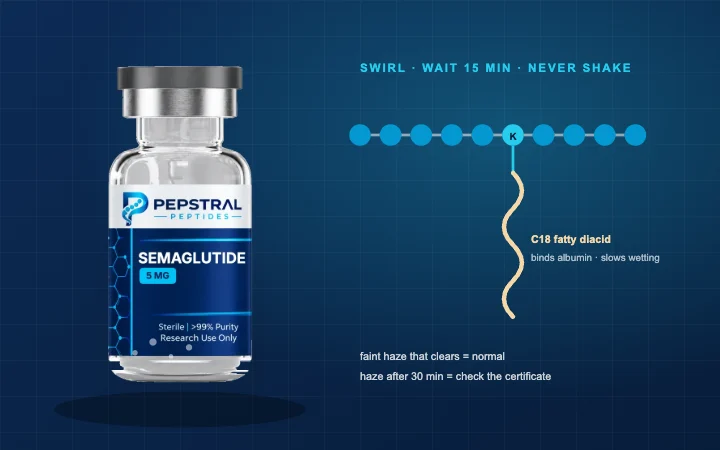
| Large hydrophobic surface | Non-polar patches prefer a non-polar wall to water | The acylated class — semaglutide, tirzepatide, retatrutide and cagrilintide all carry a fatty-acid chain, as the acylation post describes |
| Net positive charge | Pairs with negatively charged glass | Kisspeptin-10 is one example: the sequence we set out in its own post, Tyr-Asn-Trp-Asn-Ser-Phe-Gly-Leu-Arg-Phe-NH₂, contains an arginine and an amidated C-terminus and no aspartate or glutamate at all |
| Low working concentration | The wall takes a roughly fixed amount, so the fraction lost climbs as concentration drops | Any nanomolar working solution, whatever the sequence |
| High surface-to-volume ratio | More wall per microlitre | Microplate wells, small-volume tubes, narrow tips |
| Long contact time | Equilibrium is approached rather than instant in some systems | Overnight incubations, plates left on the bench |
Short, highly polar sequences are the least affected — one of the several ways the small bioregulators behave more simply, covered in why tripeptides behave differently in solution.
What does "low-bind" plasticware actually give you?
Low-binding or low-retention labware is polymer chosen or surface-treated to present less for a peptide to hold on to. It is a real effect and a sensible default. Two cautions.
The reduction figures belong to the manufacturer's test system, usually with a named model protein, and they do not automatically describe your peptide. Goebel-Stengel's finding — that identical surfaces gave very different recoveries for different peptides — is the general warning against reading any single figure as a property of the tube.
Consistency is worth as much as the treatment. If every tube, tip and plate in an experiment is the same item from the same batch, the loss is at least a constant rather than a source of scatter between conditions. Changing consumables mid-experiment is how an adsorption problem becomes an irreproducibility problem.
Carrier protein: the most effective fix, and the least usable
Adding 0.1–1% bovine serum albumin gives the wall something else to bind. It works, and Goebel-Stengel's best recoveries came from combining it with the right tube. But it is not always an option, and sometimes it is the wrong option.
- Mass spectrometry. Albumin at 1% swamps a peptide analyte. This is disqualifying, not inconvenient.
- Protein quantification. Any total-protein assay now measures mostly carrier.
- Cell work. A serum protein is an active ingredient in a culture system, not a neutral additive.
- Binding and receptor assays. Albumin can bind the analyte itself. For the acylated GLP-1 class this is the point of the modification — the fatty-acid chain exists to bind albumin — so adding albumin to a solution of those compounds is adding a competing partner, not a coating.
- It is a reagent with its own variability. Lot-to-lot differences and endotoxin content both travel with it, which matters for the work described in our endotoxin post.
Suelter and DeLuca's older result is worth keeping in view because it cuts the other way: at microgram level they found adding BSA to the solvent counterproductive, and 50% glycerol or 0.2 mM Triton X-100 more effective. Two careful groups, two different recommendations, both defensible — which tells you this is a property of the system rather than a rule to memorise.
Siliconised glass
Silanising a glass surface caps the silanol groups and makes the surface non-polar, which removes the electrostatic mechanism. It is standard practice in some peptide workflows and it is easy to assume it must help.
In Goebel-Stengel's comparison it did not: siliconisation decreased recovery of the labelled peptides across the surfaces tested. Trading a charged surface for a greasy one is not automatically an improvement — it depends on which mechanism was doing the binding in the first place.
What it does to your results
The practical consequence is a quiet, systematic error in the direction you would least like.
Your stated concentration becomes an upper bound. You calculated it from mass and volume, as in our molarity post, and that calculation is still correct about what went into the tube. It is no longer correct about what is in the liquid.
Concentration-response curves shift. Every point is lower than labelled by an unknown factor, so a potency value derived from them is a property of your plasticware as much as of the peptide.
Dilute controls suffer most. The lowest concentrations lose the largest share, which distorts the shape of the curve rather than just its position.
A certificate cannot help you here. It describes the lyophilised powder as released, which is upstream of your tube — the same blind spot as aggregation, and for the same reason.
Handling habits that reduce the loss
General laboratory practice rather than anything specific to this catalogue:
- Keep stocks concentrated and dilute late, so the dilute solution exists for the shortest possible time.
- Prepare and store in the vessel you will actually use, and avoid transfers — every transfer is a fresh surface.
- Use the same consumables throughout an experiment.
- Pre-rinse or pre-coat only if you can justify it, and apply the same treatment to controls and standards.
- Where the answer must be quantitative, measure the solution rather than trusting the calculation. For a sequence containing tryptophan or tyrosine, absorbance at 280 nm reads the peptide in the liquid, which is the quantity that matters.
- Record the labware in the methods section, as the methods-reporting post recommends. It is the variable most often omitted and most often responsible.
Frequently asked questions
Can a certificate of analysis tell me whether a peptide adsorbs?
No. A certificate reports identity, purity, content and contaminants for the powder as released. Adsorption happens later, in your vessel, and changes neither mass nor purity. It belongs in the same category as aggregation: a real failure that no line on the certificate is looking for.
Is glass better than plastic, or the other way round?
Neither, universally. They bind by different mechanisms, and the published comparisons show the ranking changing from peptide to peptide. For work where recovery matters, the answer is to test the candidates with your own peptide rather than to adopt a rule.
Does rinsing the tube recover the stuck peptide?
Partly, and unpredictably. An organic or acidic rinse will desorb some fraction, but you will not know which fraction, so it rescues a sample rather than restoring a concentration. If the number matters, prevention is the only reliable route.
Does this matter for a concentrated stock?
Much less, as a proportion. The wall takes a similar quantity regardless of concentration, so it is a rounding error against a milligram-per-millilitre stock and a substantial share of a nanomolar working solution. That asymmetry is the single most useful thing to remember about adsorption.
Every product referenced here is supplied for laboratory research use only and is not for human or animal use.
References
- Kristensen K, Henriksen JR, Andresen TL. Adsorption of cationic peptides to solid surfaces of glass and plastic. PLOS ONE 2015;10(5):e0122419. doi.org/10.1371/journal.pone.0122419
- Goebel-Stengel M, Stengel A, Taché Y, Reeve JR Jr. The importance of using the optimal plasticware and glassware in studies involving peptides. Analytical Biochemistry 2011;414(1):38-46. doi.org/10.1016/j.ab.2011.02.009
- Suelter CH, DeLuca M. How to prevent losses of protein by adsorption to glass and plastic. Analytical Biochemistry 1983;135(1):112-119. doi.org/10.1016/0003-2697(83)90738-8
- Manning MC, Chou DK, Murphy BM, Payne RW, Katayama DS. Stability of protein pharmaceuticals: an update. Pharmaceutical Research 2010;27(4):544-575. doi.org/10.1007/s11095-009-0045-6
Every product mentioned is sold for laboratory research use only and is not for human or animal use. Nothing on this page describes or recommends use of the material sold here in humans or animals.