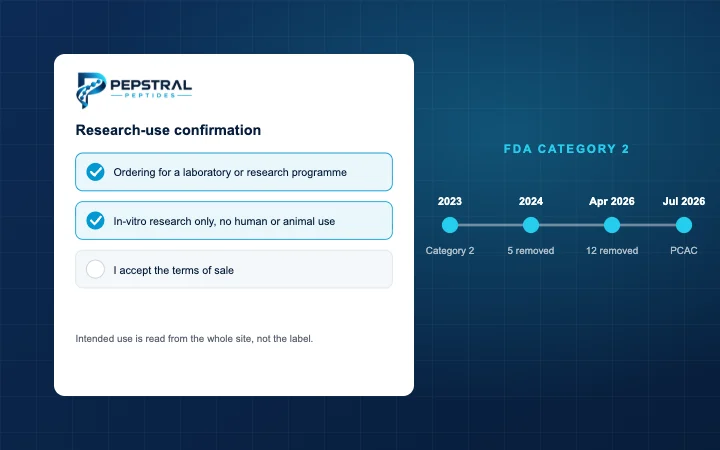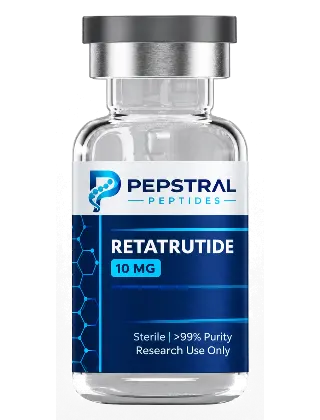
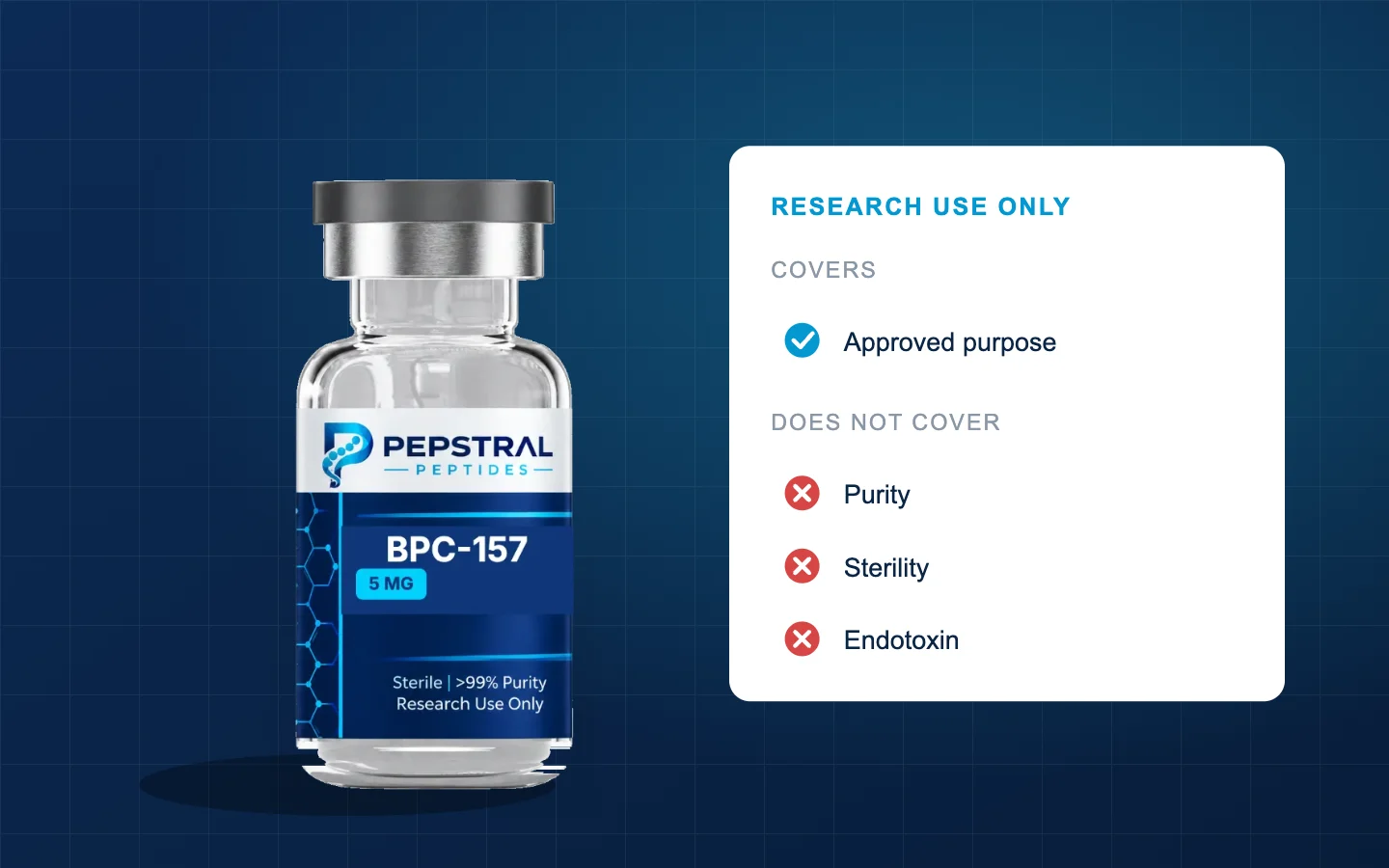
Every product page on this site ends with the same sentence, and every vial carries a version of it on the label: for in-vitro laboratory research use only, not for human or animal consumption. It is easy to read that as boilerplate a lawyer insisted on. It is not — it is a statement about what the material is, and it is worth understanding rather than scrolling past.
What does the designation actually say?
Research use only describes regulatory status. The material is supplied for laboratory investigation and has not been evaluated or approved by any regulator for diagnostic or therapeutic use in humans or animals.
That is a statement about what has been established about the material, not a claim that it is dangerous or a hint that it is secretly something else. Enormous quantities of legitimate laboratory reagents carry the designation for the ordinary reason that nobody has taken them through the evaluation required to say anything more.
The phrase is doing the same job as "not for navigation" on a decorative globe: describing the purpose the thing was prepared for.
What does it not mean?
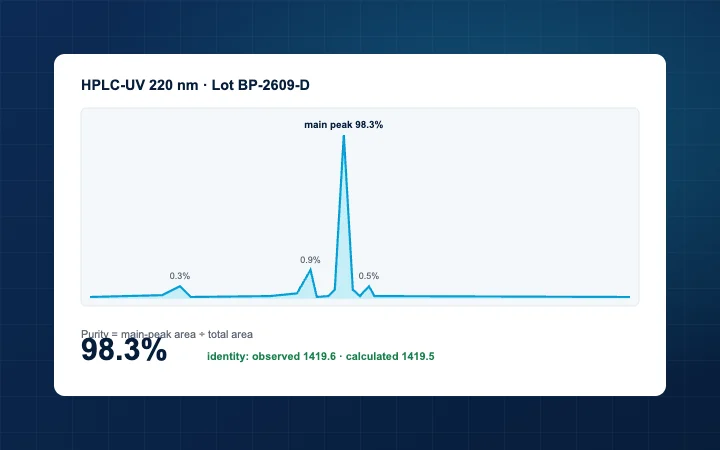
It is not a quality grade. This is the most common misreading. RUO says nothing about purity, identity, sterility or endotoxin — those are separate, measured figures that belong on a certificate. A material can be RUO and 99.7% pure with a full analytical panel, or RUO and poorly characterised. The designation does not distinguish them, which is why our supplier vetting post is about the certificate rather than the label.
It is not a synonym for "unregulated". Regulatory frameworks apply to laboratory materials, to their import, and to how they may be described and marketed. RUO is a category within a system, not an exit from it.
It is not a formality to work around. The designation states the terms on which the material is supplied. Treating it as a hurdle rather than a description misunderstands the transaction.
| What it covers | What it does not | |
|---|---|---|
| RUO designation | Approved purpose of the material | Purity, sterility, endotoxin |
| Certificate of analysis | Measured quality figures for a lot | Regulatory status |
| Sterility line | Whether organisms are present | Whether it is approved for anything |
| Endotoxin line | LPS burden, as a number | Suitability for any particular use |
Those are four separate claims, and a responsible product page carries all of them separately rather than letting one imply the others. Our post on sterility, endotoxin and pyrogens makes the same argument about conflating the middle two.
Why is the label on the vial as well as the page?
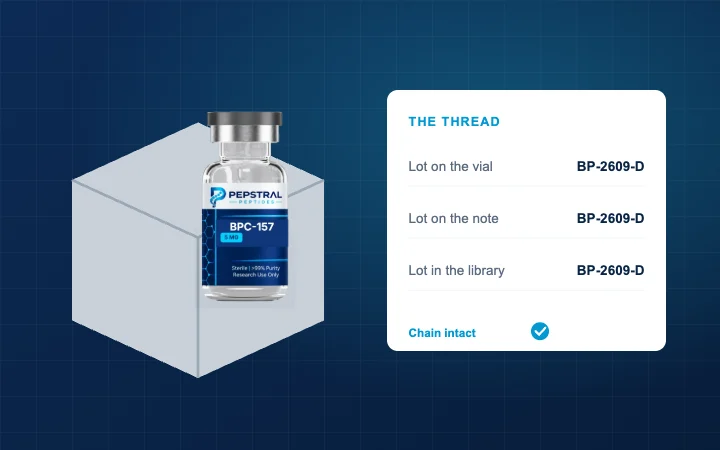
Because a vial outlives the page it was bought from. It goes into a freezer, gets moved between benches, and may be picked up months later by someone who never saw the website.
The label is where the material identifies itself: compound, dose, lot, purity, and what it is for. Our vial label post covers all seven fields, and the research-use line is one of them for exactly this reason — it travels with the material.
What does it ask of a buyer?
Nothing elaborate, and nothing that a working laboratory does not already do:
- The material belongs in a laboratory, handled by someone competent to handle reagents.
- It is recorded — lot, date, storage — like any other reagent. Our methods post covers what a record should hold.
- It is not for human or animal consumption, diagnosis or treatment, and no part of this site should be read as suggesting otherwise.
- Local rules apply, and they vary. What is routine in one jurisdiction may not be in another.
Where we draw the line
This site publishes chemistry, handling and analytical guidance. It does not publish dosing protocols, human or animal, and it will not — that boundary is written into our editorial policy alongside the commitment not to publish efficacy claims or invented authorship.
When we cite a clinical trial, it is as primary literature on a compound class. It never describes the material sold here, and our post on why trial data does not transfer explains why importing those numbers would be a technical error as well as a category one.
A note on this post specifically: it describes the designation in general terms. It is not legal advice, it makes no claim about any particular jurisdiction's requirements, and like our post on ordering legality it is flagged in our own records as needing review by a qualified attorney. If your question is whether something is lawful for you to do, the answer comes from a lawyer, not from a supplier's blog.
Frequently asked questions
Does RUO mean the peptide is low quality?
No, and the two are unrelated. Quality is what the certificate measures — purity by HPLC, identity by mass spectrometry, endotoxin by LAL. Read those figures; the designation tells you nothing about them.
Why do certificates and labels repeat it so often?
Because the material moves and the context does not travel with it. Repetition on the page, the label and the certificate means the statement is present wherever the material is.
Is "for laboratory use only" the same thing?
They are used interchangeably in practice and both signal that the material is not supplied for diagnostic or therapeutic purposes. The precise wording that applies to a given product category is exactly the kind of detail worth a lawyer rather than an inference.
Does the designation change what I must record?
Not really — good practice is the same for any reagent. Supplier, lot, purity, storage and handling. What changes is that for RUO material there is no approved-use framework to lean on, so your own record is the whole provenance trail.
References
- U.S. Food and Drug Administration — guidance and regulatory information on laboratory products and their intended use. www.fda.gov
- Niu CH, Chiu YY. FDA perspective on peptide formulation and stability issues. Journal of Pharmaceutical Sciences 1998;87(11):1331-1334. doi.org/10.1021/js9800782
- Bachem. Quality Control of Amino Acids and Peptides: A Guide. www.bachem.com/knowledge-center/quality-control-of-amino-acids-peptides-a-guide
Every product mentioned is sold for laboratory research use only and is not for human or animal use. Nothing on this page describes or recommends use of the material sold here in humans or animals.