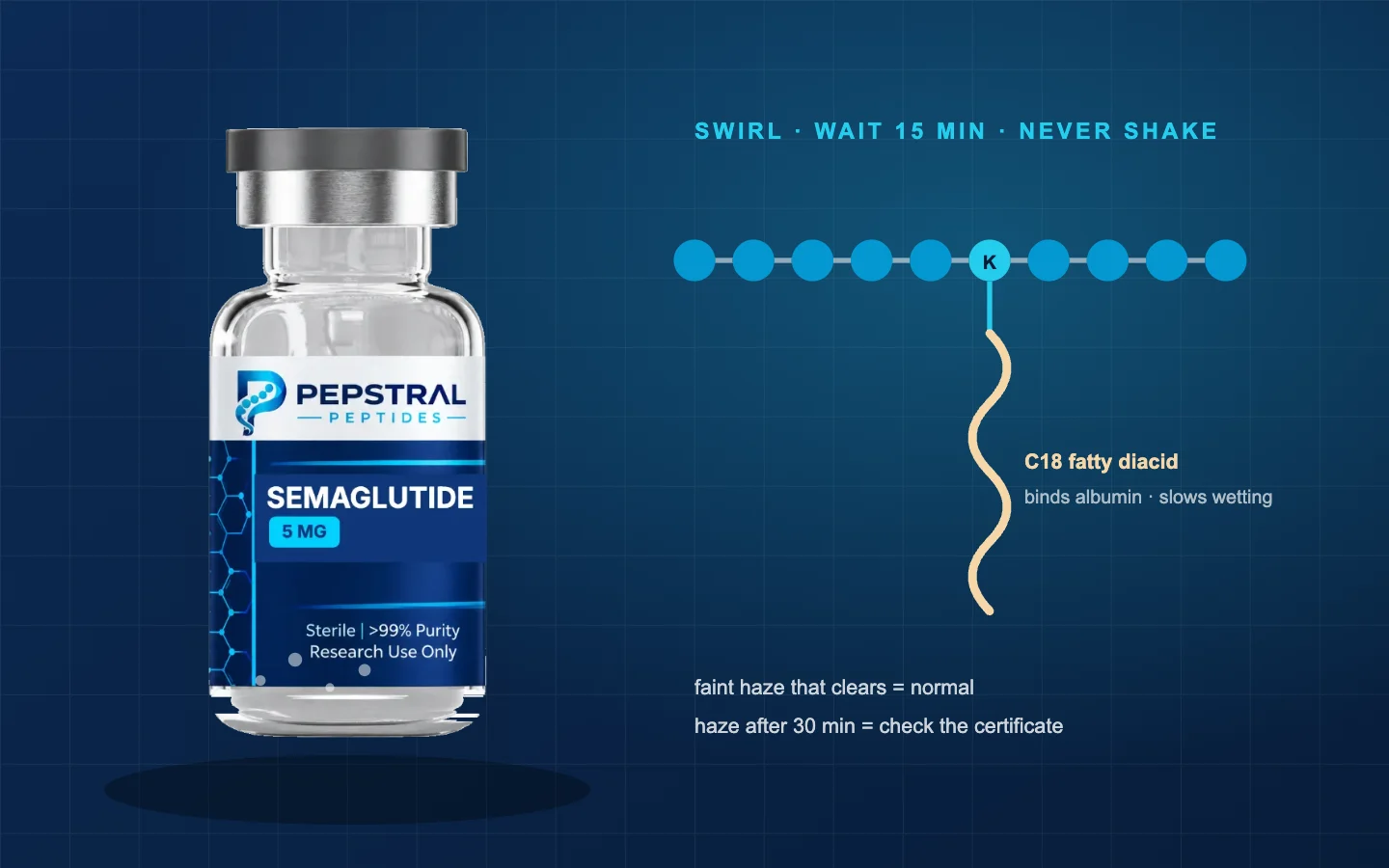
Semaglutide, tirzepatide and retatrutide take longer to dissolve than a short peptide such as BPC-157, and the reason is the modification that makes them useful. Each carries a fatty-acid chain attached to one lysine residue through a short linker. The chain lets the peptide bind albumin in circulation, which is why these compounds act for days rather than minutes. It also makes the lyophilized powder slow to wet and the molecules prone to cluster in solution. This post explains the chain, what it does to dissolution, and a method that gives a clear solution without shaking.
What is the side chain?
The three discovery papers describe the same design applied three times:
| Compound | Backbone | Side chain | Attached at | Purpose |
|---|---|---|---|---|
| Semaglutide | 31-residue GLP-1 analogue | C18 fatty diacid through a linker | Lysine 26 | Albumin binding for once-weekly exposure |
| Tirzepatide | 39-residue GIP-derived dual agonist | C20 fatty diacid through a linker | Lysine 20 | Albumin binding, weekly exposure |
| Retatrutide | 39-residue triple agonist | C20 fatty diacid through a linker | Lysine side chain | Albumin binding, weekly exposure |
Lau and colleagues describe the semaglutide design in 2015: a GLP-1 backbone with two amino-acid substitutions, one of which protects the chain from enzymatic cleavage, and a C18 diacid on a spacer to bind albumin tightly. Coskun and colleagues used the same strategy for tirzepatide in 2018, with a C20 diacid on a GIP-derived sequence, and again for retatrutide in 2022. The fatty diacid is the part that matters for the bench.
Why does the chain slow dissolution?
A native peptide is mostly polar and dissolves like a salt: water reaches every part of the molecule at once. A lipidated peptide is part polar, part fat. The fatty-acid chain avoids water, and when many of these molecules meet in solution they arrange themselves so the chains face each other and the peptide faces the water, the same behaviour that lets the chain bind the hydrophobic pockets of albumin. Three things follow for the powder in the vial.
- It wets slowly. The lyophilized cake is partly hydrophobic, so water beads on it instead of soaking in.
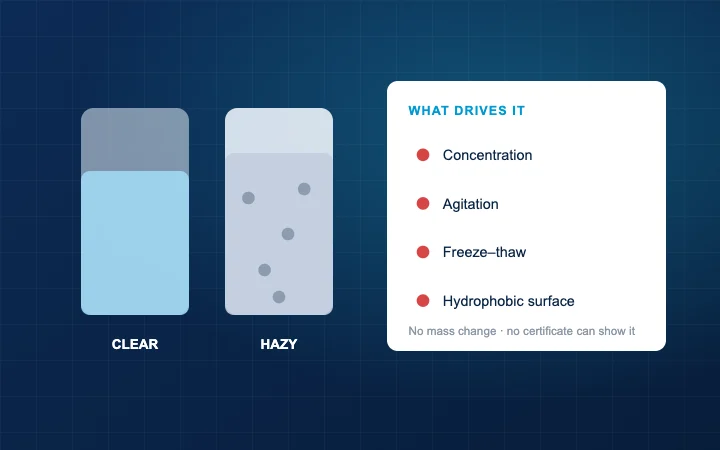
- It self-associates. Molecules cluster as they dissolve, and the clusters take time to disperse. This is also why the solution can look faintly cloudy at first.
- It dislikes agitation. Shaking creates air-water interfaces where amphiphilic molecules line up and can aggregate irreversibly. A shaken vial can turn from cloudy to permanently hazy.
None of this changes the chemistry. The peptide that dissolves in fifteen minutes is the same compound as one that dissolved in fifteen seconds; the storage guide notes that the GLP-1 class is also light sensitive, which is the other handling difference.
How do you reconstitute a GLP-1 class peptide?
The general method in the reconstitution guide applies, with four adjustments.
- Let the vial reach room temperature, sealed. Cold glass condenses moisture and cold water wets the cake even more slowly.
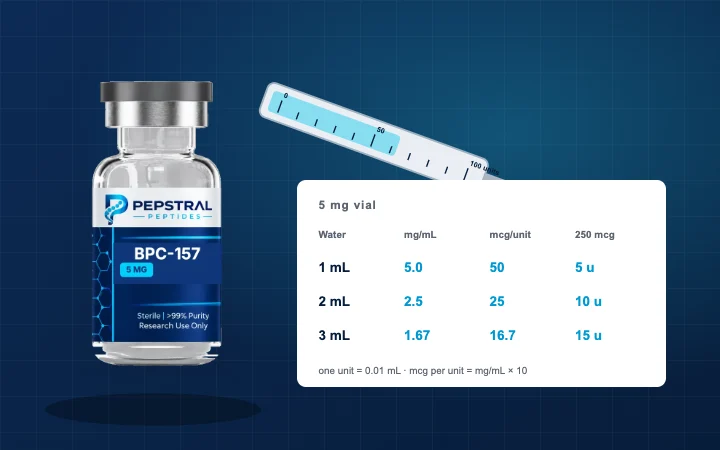
- Add the water down the inside wall. Let it pool over the cake rather than hitting it. Two or three millilitres gives a concentration that dissolves more readily than one; the concentration table gives the resulting figures for each vial.
- Swirl gently, then wait. Ten to fifteen minutes at room temperature with an occasional swirl. Do not shake, do not vortex, do not sonicate, and do not warm the vial in your hand or a water bath above room temperature.
- Check against the light. The solution should be clear and free of particles. If it is faintly cloudy, wait another ten minutes and swirl again. If it is still cloudy or has visible particles after thirty minutes, stop and check the lot certificate.
Then label the vial with the concentration and date, keep it at 2 to 8°C in the carton or wrapped from light, and use it within the window the storage guide gives for the GLP-1 class.
What does normal look like, and what does not?
| Observation | Meaning | Action |
|---|---|---|
| Powder sits on top of the water for the first minute | Slow wetting, expected | Swirl, wait |
| Faint haze that clears within fifteen minutes | Clusters dispersing, expected | Wait |
| Clear solution with a few bubbles | Normal | Let bubbles rise before drawing |
| Haze that persists past thirty minutes | Possible aggregation or a different compound | Check the certificate; do not shake to force it |
| Visible fibres, flakes or a gel | Aggregation, often from shaking or heat | Do not use; record the lot |
| Yellow tint | Oxidation or light exposure | Do not use; record the lot |
The certificate line to check is identity. A lot whose observed mass matches the reference table and whose purity is above 98% will dissolve clear with patience; one that will not is either damaged or not what the label says.
Why does concentration matter more for this class?
At high concentration, self-association is faster and haze is more likely. A 10 mg vial of retatrutide in 1 mL is 10 mg/mL and may take longer to clear than the same vial in 3 mL at 3.3 mg/mL. If your assay allows it, reconstitute at the lower concentration and adjust the draw. The concentration table shows the trade-off in units per aliquot.
Frequently asked questions
Can I use sterile water instead of bacteriostatic water for these peptides?
For immediate single use, yes. For a vial you will draw from over days, bacteriostatic water holds back microbial growth. The reconstitution guide covers the choice. Neither changes dissolution time.
Does warming the vial speed it up?
Warming to room temperature does. Warming above it is a risk: heat accelerates aggregation and degradation of lipidated peptides, and the time saved is not worth a lot lost. Room temperature and patience is the method.
Why is the solution more viscous than water?
Because of the same self-association. At 5 to 10 mg/mL, a lipidated peptide solution can feel slightly thicker when drawn. That is expected and does not indicate a problem.
Do BPC-157 or ipamorelin behave this way?
No. They are unmodified peptides and dissolve within seconds. Slow dissolution is specific to acylated compounds, which in this catalog means the three GLP-1 class peptides.
References
- Lau J, Bloch P, Schäffer L, et al. Discovery of the Once-Weekly Glucagon-Like Peptide-1 (GLP-1) Analogue Semaglutide. Journal of Medicinal Chemistry 2015;58(18):7370-7380. doi.org/10.1021/acs.jmedchem.5b00726
- Coskun T, Sloop KW, Loghin C, et al. LY3298176, a novel dual GIP and GLP-1 receptor agonist for the treatment of type 2 diabetes mellitus: From discovery to clinical proof of concept. Molecular Metabolism 2018;18:3-14. doi.org/10.1016/j.molmet.2018.09.009
- Coskun T, Urva S, Roell WC, et al. LY3437943, a novel triple glucagon, GIP, and GLP-1 receptor agonist for glycemic control and weight loss: From discovery to clinical proof of concept. Cell Metabolism 2022;34(9):1234-1247. doi.org/10.1016/j.cmet.2022.07.013
Every product mentioned is sold for laboratory research use only and is not for human or animal use. Nothing on this page describes or recommends use of the material sold here in humans or animals.