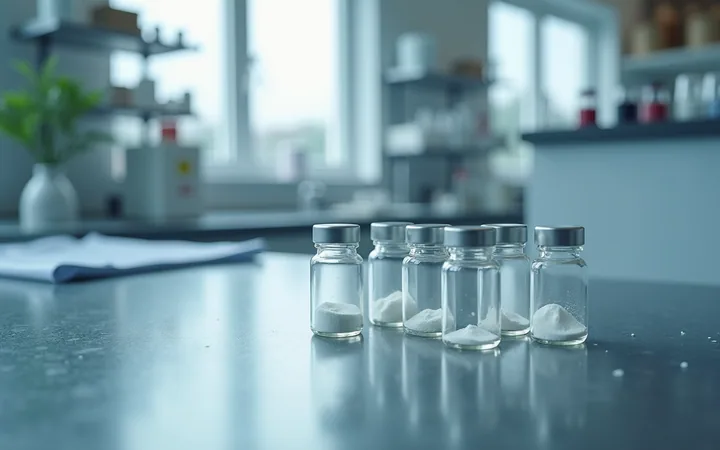

Searches for peptide storage cases, containers and freezer boxes are common, and most of what is sold for the purpose solves a problem the vial does not have. A crimped, stoppered, lyophilized vial is already in the best container it will ever be in. What damages a stored peptide is almost always something the buyer does after that: opens it in humid air, leaves a solution in a clear tube on a lit bench, lets a moist cake warm, or thaws the same aliquot five times. This post is about protecting against those four things, with the minimum of equipment. The storage guide has the temperature rules by compound class and the expiry-date post explains what is actually degrading; this one is about containers, light, desiccant and organisation.
What a vial needs protecting from
| Threat | What it does | Which vials are exposed |
|---|---|---|
| Moisture | Plasticises the dry cake, restarts hydrolysis and deamidation | Any vial that has been opened, any vial with a damaged crimp, any vial in a freezer that frosts |
| Light | Photo-oxidises tryptophan and, more slowly, tyrosine and histidine | Solutions in clear tubes; sequences with tryptophan such as melanotan-1 and MOTS-c |
| Heat | Brings a moist cake toward its glass transition; accelerates every route | Vials left at room temperature for days, or warmed and cooled repeatedly |
| Freeze-thaw | Concentrates solutes as ice forms, drives aggregation and adsorption in solution | Any solution thawed more than once |
Moisture is first because it is the one the vial's own design defends against, and the one most often defeated by the buyer. Lai and Topp's review of solid-state stability puts residual water at the centre of every degradation route in a dry peptide, and the expiry-date post explains why.
Desiccant: when it helps and when it is theatre
A sachet of silica gel in a box of unopened vials does nothing, because each vial's crimp seal is a far better moisture barrier than the box. It becomes useful in three situations.
- A vial that has been opened and resealed. The stopper no longer seals as the crimp did. A desiccated secondary container slows what the broken seal lets in.
- A frost-prone freezer. Every door-opening condenses humid air inside; a desiccated box keeps the vials' exterior dry so that condensation does not reach the stopper edge.
- Transport. A vial in transit sees temperature cycling, and cycling drives condensation. Desiccant in the shipping container is sensible; the cold-shipping post covers what else transit does and does not do.
Indicating silica gel, which changes colour when spent, is the kind to use, because a saturated sachet is worse than none: it holds moist air against the vials. Replace it when it changes.
Light: amber, foil, or neither
ICH Q1B, the photostability guideline, frames the question properly: exposure is the product of intensity and time, and the sensitive residues are tryptophan first, then tyrosine, histidine and methionine. Three cases.
- A lyophilized vial in its box in a freezer receives no light. Neither amber glass nor foil adds anything.
- A solution in a clear tube on a lit bench receives hours of exposure. For a tryptophan-containing peptide, that is where photo-oxidation happens; the melanotan-1 post and the MOTS-c post both make this the first handling point. Amber tubes filter the ultraviolet and blue wavelengths responsible; foil wrapping blocks all light and is the cheaper, uglier, equally effective option.
- A sequence with no tryptophan, tyrosine, histidine or methionine, which describes most of the short bioregulators, has no light-sensitive residue and needs no protection beyond habit.
The oxidation post names the residues; a glance at a sequence tells you which case applies.
Containers: what matters and what does not
For the lyophilized vial, nothing beyond the box it came in and a freezer at minus 20 °C. Insulated cases, foam racks and branded storage boxes change nothing about moisture, light or temperature inside a sealed vial in a freezer; they organise, which is a real benefit, but not a protective one.
For solutions, the container matters a great deal, and it is the tube, not the box.
- Low-binding polypropylene for anything cationic or hydrophobic below micromolar, for the reasons in the adsorption post. Glass is worse than ordinary polypropylene for most peptides, not better.
- Small aliquots in small tubes. A 50 microlitre aliquot in a 1.5 mL tube has a large headspace and a large surface; 200 microlitre tubes suit small volumes better.
- Screw caps with O-rings for frozen storage; snap caps let air exchange over months.
- Amber or foil for solutions of light-sensitive sequences, as above.
Freezer organisation: the one rule
Aliquot on first use. Everything else is housekeeping around that rule.
- Reconstitute the vial once, as the vial appearance post describes, and divide the solution into single-use aliquots sized to one experiment.
- Label each aliquot with compound, lot, concentration, date made and a freeze-thaw count. The lot number is what connects the tube back to its certificate in the COA library; the label post explains why that link matters.
- Keep a freezer map, a sheet or a spreadsheet, that says which box holds which lot. A freezer searched by hand is a freezer that warms.
- Keep bulk lyophilized vials in a separate, rarely opened box from working aliquots.
- Record what the reconstituted shelf-life post recommends recording: diluent, volume, concentration, date.
A design that follows these five points does not need a storage case at all. One that does not follow them is not rescued by one.
Moving vials between sites
Lyophilized vials travel well, as the cold-shipping post explains: a few days at ambient temperature does not measurably change a sealed dry cake. The risks are mechanical and moisture-related, not thermal. Pack vials upright, padded, with indicating desiccant, and let them equilibrate to room temperature before opening so that condensation forms on the outside of a cold vial rather than inside a warm one. Solutions travel badly and should be made at the destination.
Frequently asked questions
Do I need a special storage case for peptide vials?
No. A sealed lyophilized vial in its box at minus 20 °C is as protected as it can be. Cases organise; they do not protect.
When is desiccant worth using?
For opened or resealed vials, in a freezer that frosts, and in transit. Not for intact unopened vials, whose crimp seal is a better barrier than any sachet.
Amber tube or foil?
Either, for a solution of a light-sensitive sequence. Foil blocks everything and costs nothing; amber filters the wavelengths that matter and lets you see the liquid. For a vial in a closed box, neither is needed.
Which tubes for aliquots?
Low-binding polypropylene, small enough that the aliquot fills most of it, with a screw cap and O-ring for frozen storage.
What is the one thing to get right?
Aliquot on first use, label with the lot number, and never open the bulk vial twice.
References
- International Council for Harmonisation. ICH Q1B: Photostability Testing of New Drug Substances and Products. 1996. www.ich.org/page/quality-guidelines
- Lai MC, Topp EM. Solid-state chemical stability of proteins and peptides. Journal of Pharmaceutical Sciences 1999;88(5):489-500. doi.org/10.1021/js980374e
Every product mentioned is sold for laboratory research use only and is not for human or animal use. Nothing on this page describes or recommends use of the material sold here in humans or animals.