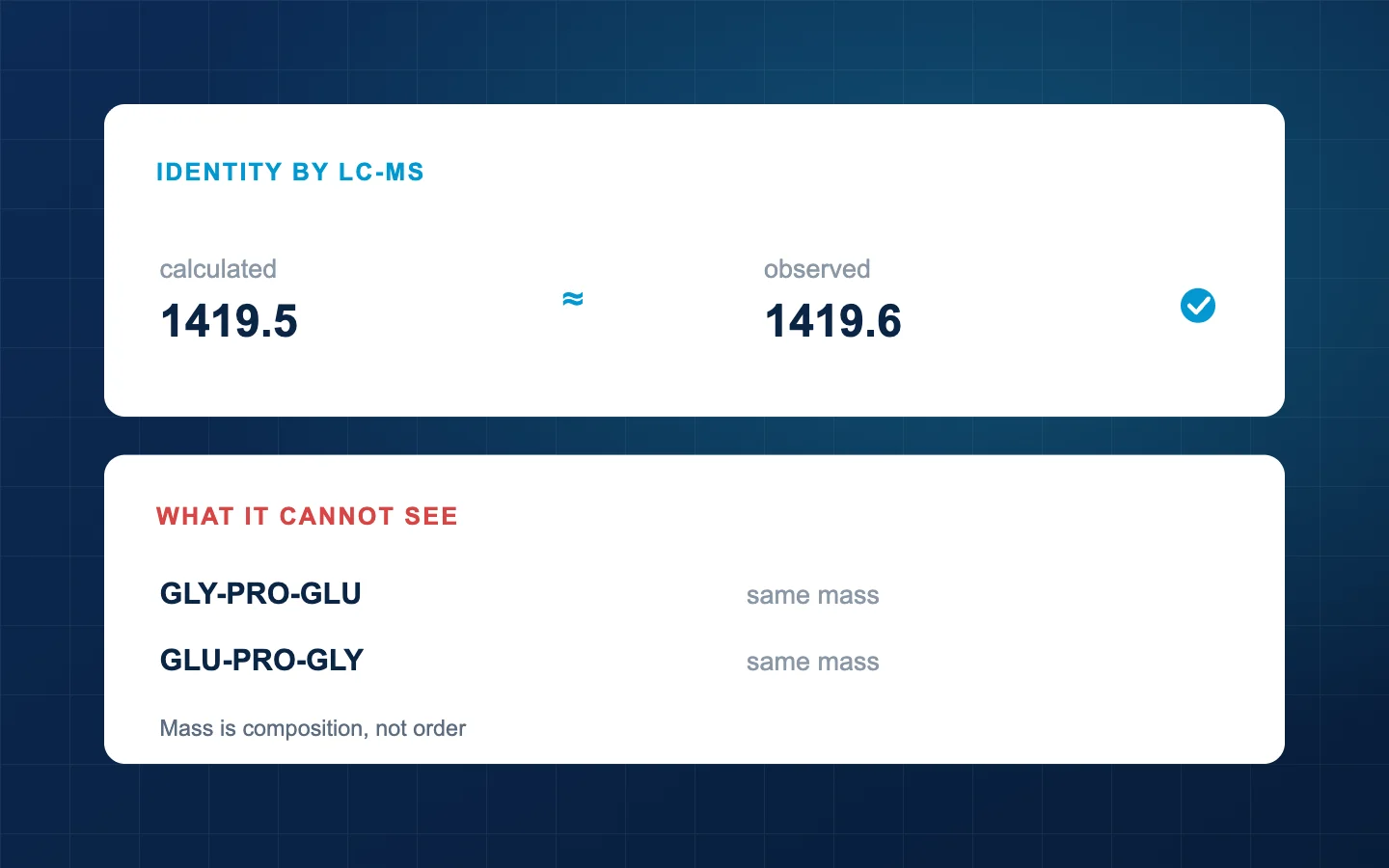
A certificate's identity line usually reads something like "Confirmed by LC-MS" or "Matches the calculated mass for the sequence." That is a genuine check and a narrower one than most buyers assume. Mass spectrometry weighs a molecule with great precision; it does not read a sequence. Knowing exactly what the measurement covers tells you which failures it catches and which it cannot.
What is the measurement actually doing?
The sample is separated by liquid chromatography, then ionised and the ions sorted by mass-to-charge ratio. Peptides typically pick up several protons, so the instrument sees a series of charge states, and the software deconvolutes those to a single molecular mass.
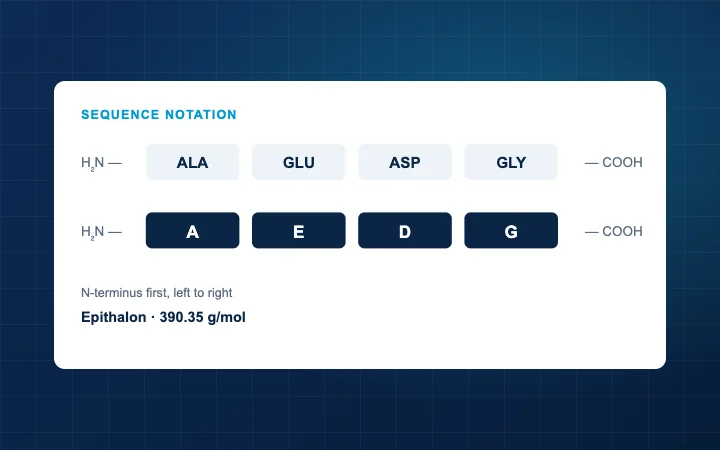
That measured mass is compared against the mass calculated from the intended sequence. Add up the residue masses, add water for the bond formation, account for any modification, and you have a target. If the observed figure lands within tolerance, identity is reported as confirmed. Our sequence post walks through that calculation with a worked example you can check.
What does a mass check catch well?
Very well, in fact — because the common synthesis and degradation failures each shift the mass by a characteristic amount.
| Failure | Mass shift | Caught? |
|---|---|---|
| A residue missing (deletion sequence) | −(that residue's mass), 57 to 186 Da | Easily |
| Methionine oxidised | +16 Da | Yes |
| Asparagine or glutamine deamidated | +1 Da | Yes, with good resolution |
| A protecting group left on | +large, depends on group | Easily |
| Truncation at either terminus | −(sum of the lost residues) | Easily |
| Wrong compound entirely | Usually a large difference | Easily |
A deletion sequence — the most common synthesis defect, where one coupling step failed — is precisely the kind of thing a mass check finds, because losing even the smallest residue, glycine, drops 57 Da.
What can mass spectrometry not tell you?
It cannot distinguish sequences of identical composition. Mass depends on which residues are present, not the order they are in. Gly-Pro-Glu and Glu-Pro-Gly contain the same three residues and weigh exactly the same. A mass match is consistent with the intended sequence; it does not prove it.
This matters less in practice than it sounds, because solid-phase synthesis builds sequences in a defined order — the machine is not going to spontaneously scramble them. But it means the honest statement is "the observed mass matches the calculated mass for this sequence", not "the sequence was verified". Actually reading the order requires tandem MS, fragmenting the peptide and reconstructing it from the pieces, which is a different and more expensive experiment.
It cannot distinguish some isomers. Leucine and isoleucine have identical masses. A D-amino acid substituted for its L form weighs the same. Neither is visible to a mass measurement.
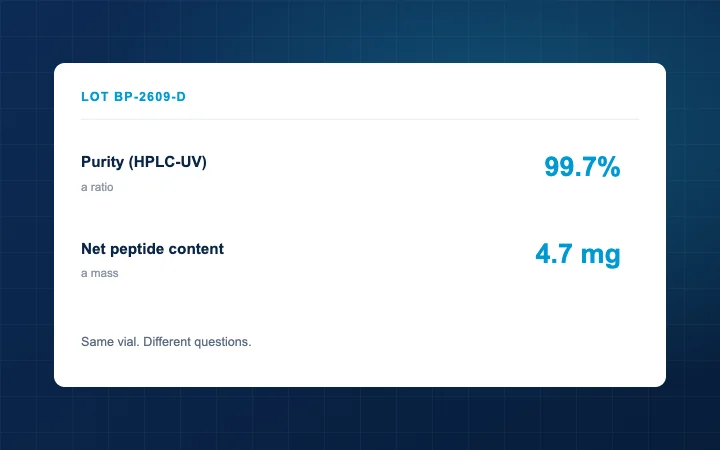
It does not measure quantity. Ionisation efficiency varies by molecule, so peak intensity is not proportional to how much is present. That is what net peptide content is for.
It does not measure purity. That is the HPLC job, and our chromatogram post covers reading it.
Why the tolerance matters
A certificate should state the observed mass, not just "confirmed". The gap between observed and calculated is informative: within a fraction of a dalton is a strong match, while several daltons out needs explaining.
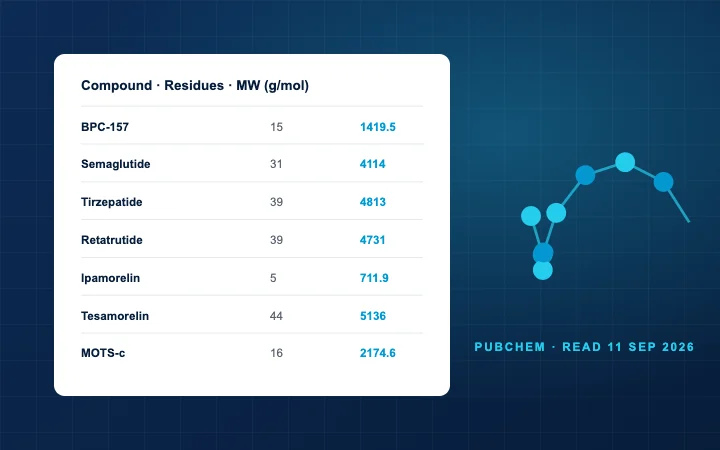
It should also be clear which mass is quoted. Average mass accounts for natural isotope abundance and is what you use for weighing and dissolving. Monoisotopic mass uses the lightest isotope of each element and is what a high-resolution instrument reports. For a peptide the size of BPC-157 the two differ by around a dalton — irrelevant for making a solution, decisive for interpreting a spectrum.
How do you read identity and purity together?
The pairing is the point:
- Identity confirmed, purity high — the right compound, cleanly made.
- Identity confirmed, purity low — right compound, but a meaningful share of the material is something else.
- Identity not confirmed, purity high — a very clean sample of something. This is the combination that should stop an order.
- Purity reported, identity absent — an incomplete certificate. It has told you the sample is homogeneous without saying what it is.
That last case is common enough to be worth watching for, and it is one of the checks in our supplier vetting post.
Frequently asked questions
Does a mass match prove I received what I ordered?
It proves the material has the mass expected for that sequence, which rules out most realistic failures. Combined with a clean chromatogram it is the standard evidence for research-grade peptides. Absolute sequence proof needs tandem MS.
What does "within tolerance" mean in practice?
It depends on the instrument's resolution and should be stated. A certificate giving the observed mass lets you judge for yourself; one saying only "confirmed" is asking for trust.
Can LC-MS see the counter-ion?
Not as part of the peptide mass — trifluoroacetate does not travel with the molecule through the measurement the way it sits with the powder. This is another reason the quoted molecular weight is the free peptide, while the powder in your vial weighs more.
Why do some certificates say "LC-MS" and others "ESI-MS" or "MALDI"?
Those name the ionisation and separation technique. ESI and MALDI are two ways of getting the molecule into the gas phase; LC-MS means chromatography was coupled to the mass spectrometer. All answer the same question here.
References
- Bachem. Quality Control of Amino Acids and Peptides: A Guide. Identity confirmation and mass determination. www.bachem.com/knowledge-center/quality-control-of-amino-acids-peptides-a-guide
- Niu CH, Chiu YY. FDA perspective on peptide formulation and stability issues. Journal of Pharmaceutical Sciences 1998;87(11):1331-1334. doi.org/10.1021/js9800782
- PubChem, National Center for Biotechnology Information — molecular formulas and weights used in the worked examples. pubchem.ncbi.nlm.nih.gov
Every product mentioned is sold for laboratory research use only and is not for human or animal use. Nothing on this page describes or recommends use of the material sold here in humans or animals.