Retatrutide has an unusual problem for a research compound: too much publicity and not enough context. The headline figure from the obesity trial is quoted everywhere, usually without the dose, the duration, the comparator or the population it came from, and almost never with the observation that it is a human clinical result.
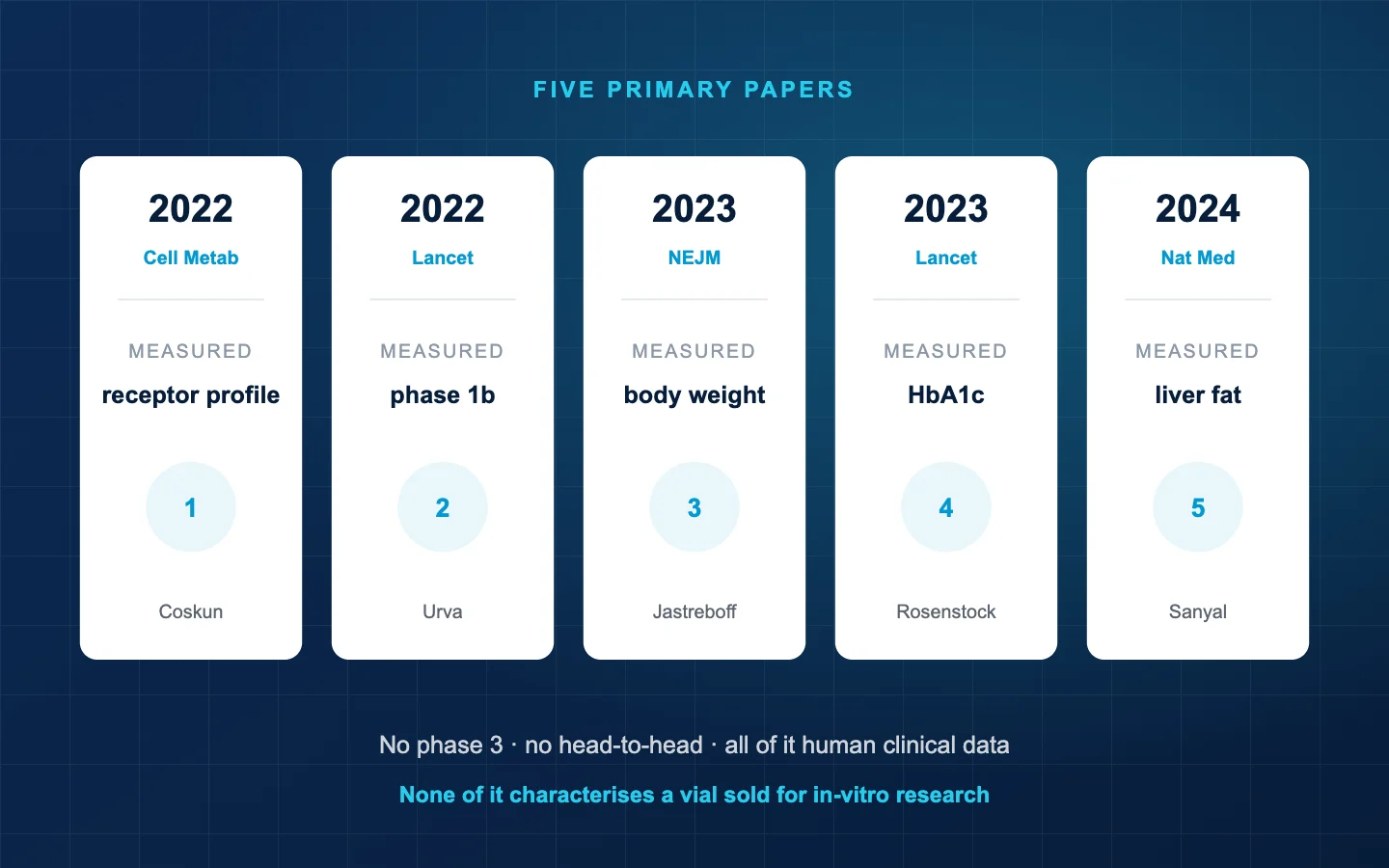
This post is the counterweight. Five primary papers, what each one was actually built to measure, the numbers as published, and where the boundary sits between that literature and anything you would do with a vial.
The five papers
| Paper | What it was | Primary question |
|---|---|---|
| Coskun 2022, Cell Metabolism | Discovery and pharmacology | What does this molecule do at the three receptors, and in obese mice? |
| Urva 2022, The Lancet | Phase 1b, multiple ascending dose | Is it tolerated in people with type 2 diabetes, and at what exposure? |
| Jastreboff 2023, NEJM | Phase 2, obesity | What is the dose–response for weight over 48 weeks? |
| Rosenstock 2023, The Lancet | Phase 2, type 2 diabetes | What does it do to HbA1c at 24 weeks? |
| Sanyal 2024, Nature Medicine | Phase 2a, liver fat | What does it do to hepatic fat at 24 weeks? |
Note what is not in that column. There is no phase 3 outcome trial in the list, no head-to-head against tirzepatide at matched exposure, and no in-vitro characterisation of the sort a bench researcher would actually reuse beyond the discovery paper.
Coskun 2022: where the compound came from
The discovery paper is the one that matters most for laboratory work and gets quoted least.
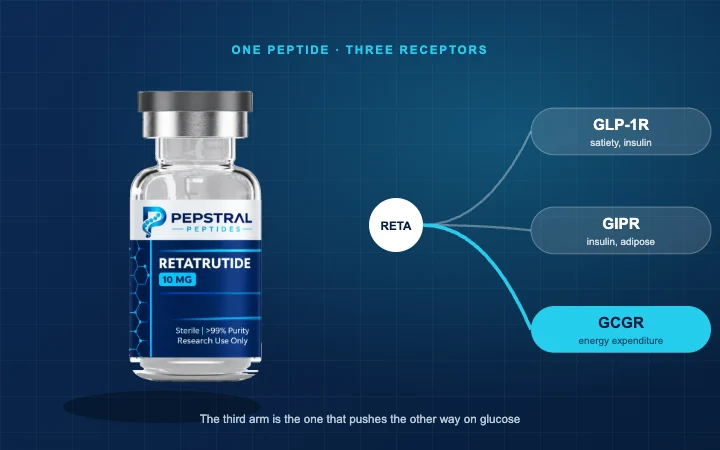
It describes LY3437943 as a triple agonist at the glucagon receptor, the GIP receptor and the GLP-1 receptor, and reports the in-vitro balance as balanced glucagon and GLP-1 receptor activity with more GIP receptor activity. In obese mice, it decreased body weight and improved glycaemic control, with the weight effect attributed to both increased energy expenditure and reduced calorie intake.
That last clause is the interesting one, because it is the claim the third receptor was added to support. Our post on why retatrutide adds a glucagon receptor works through the design logic.
The full text is paywalled, so the potency figures at each receptor are not quoted here. If you need them for a methods section, the paper is the source and a summary is not.
Urva 2022: the first human exposure
A phase 1b multiple-ascending-dose trial in people with type 2 diabetes. Phase 1b studies exist to establish tolerability and pharmacokinetics, not efficacy, and the useful output is the dosing structure the later trials inherited — including the escalation schedule that turns up again in every phase 2 arm.
Jastreboff 2023: the number everybody quotes
338 adults with a BMI of 30 or higher, or 27 to 30 with a weight-related condition. Randomised to placebo or retatrutide at 1, 4, 8 or 12 mg once weekly, some arms differing only in their starting dose. Primary endpoint was percentage weight change at 24 weeks; 48-week change was secondary.
Least-squares mean percentage change in body weight at 48 weeks:
| Group | Change |
|---|---|
| Placebo | −2.1% |
| 1 mg | −8.7% |
| 4 mg (combined) | −17.1% |
| 8 mg (combined) | −22.8% |
| 12 mg | −24.2% |
At 24 weeks — the primary endpoint — the 12 mg figure was −17.5%, not −24.2%. The number that circulates is the 48-week secondary endpoint at the top dose.
Two findings that travel less well than the headline, both from the same abstract: the most common adverse events were gastrointestinal, dose-related, and partially mitigated by starting at 2 mg rather than 4 mg; and there were dose-dependent increases in heart rate, peaking at 24 weeks and declining thereafter. A summary that reports −24.2% and omits those is not reporting the trial.
Rosenstock 2023: glycaemic control, with an active comparator
281 participants with type 2 diabetes, HbA1c 7.0–10.5%, BMI 25–50, on diet and exercise or a stable metformin dose. This trial is more informative than the obesity one for a reason that has nothing to do with the endpoint: it had an active comparator, dulaglutide 1.5 mg, not just placebo.
Least-squares mean HbA1c change at 24 weeks:
| Group | Change |
|---|---|
| Placebo | −0.01% |
| Dulaglutide 1.5 mg | −1.41% |
| Retatrutide 0.5 mg | −0.43% |
| Retatrutide 4 mg | −1.30% to −1.39% |
| Retatrutide 8 mg | −1.88% to −1.99% |
| Retatrutide 12 mg | −2.02% |
The comparator arm is what makes this readable. A placebo-controlled result tells you a compound does something; an active-controlled result tells you where it sits against an existing single-receptor agonist. At 4 mg, retatrutide landed close to dulaglutide; the separation appears at 8 mg and above.
Worth noting for the design bet described in the glucagon-arm post: a glucagon receptor agonist alone would be expected to raise HbA1c. It did not.
Sanyal 2024: liver fat
A phase 2a trial with relative change in liver fat at 24 weeks as the primary endpoint.
| Group | Relative liver fat change |
|---|---|
| Placebo | +0.3% |
| 1 mg | −42.9% |
| 4 mg | −57.0% |
| 8 mg | −81.4% |
| 12 mg | −82.4% |
In the 8 mg and 12 mg groups, 79% and 86% of participants respectively reached liver fat below 5%. All doses were reported as statistically superior to placebo at P < 0.001.
This is the trial most directly downstream of the glucagon arm, since hepatic fat oxidation is the mechanism that arm is there to engage.
Why none of this is your result
Everything above shares four properties, and each one severs it from a laboratory experiment:
- It is human clinical data. Generated in people, under protocol, with informed consent, monitoring and stopping rules. Nothing in this catalogue is for human use, and no result above is a claim about the material we sell.
- It used pharmaceutical-grade material of known provenance. Manufactured, released and characterised under a regulatory framework that a research-grade vial does not sit inside — whatever its certificate says.
- Every figure is a least-squares mean from a modelled analysis of a defined population, with a dose-escalation schedule and a 24- or 48-week horizon. It is not a property of the molecule you can carry into a cell assay.
- The endpoints have no in-vitro equivalent. Body weight, HbA1c and hepatic fat fraction are not things a plate measures.
The longer version of this argument is in why clinical trial data does not transfer, and it applies to retatrutide harder than to almost anything else in the catalogue precisely because the clinical dataset is so visible. What "research use only" actually means covers the framing from the other direction.
What the literature is good for: knowing which receptors are engaged and in what balance, knowing that the triple design does something the dual design does not, and knowing which questions are already answered so your experiment can ask one that is not.
Frequently asked questions
Is there a phase 3 trial?
Not in the published record as of this writing. Everything above is phase 1b or phase 2. Treating a phase 2 dose–response as a settled characterisation of a compound is the most common way the literature gets over-read.
Why do different sources quote different weight-loss figures?
Because they are quoting different endpoints. −17.5% is the 12 mg group at 24 weeks, the primary endpoint. −24.2% is the same group at 48 weeks, a secondary endpoint. −22.8% is the combined 8 mg group at 48 weeks. All three are in the same paper and all three are correct; none of them is "the" figure.
Can I cite these papers in my methods section?
Cite them for what they establish — the receptor profile, the design rationale, the provenance of the compound. Do not cite a clinical endpoint as support for an in-vitro hypothesis; the reviewer will notice. Our post on reporting a peptide in a methods section covers what belongs there.
Does the certificate on a vial relate to these trials in any way?
No, and it is worth being blunt about it. A certificate reports purity by HPLC-UV and identity by LC-MS for one lot of material. It says the vial contains what the label says, to a stated purity. It says nothing about how that material would behave in any biological system, and the trials say nothing about the vial. Our certificate page has the current lots, and how to read an HPLC chromatogram covers what the purity figure is actually measuring.
Which compounds in the catalogue have a comparable literature?
Tirzepatide and semaglutide, both with larger and longer datasets, and both with the same transfer problem. The receptor and target table lists the primary pharmacology reference for each compound we stock.
References
- Coskun T, Urva S, Roell WC, et al. LY3437943, a novel triple glucagon, GIP, and GLP-1 receptor agonist for glycemic control and weight loss: from discovery to clinical proof of concept. Cell Metabolism 2022;34(9):1234-1247.e9. doi.org/10.1016/j.cmet.2022.07.013
- Urva S, Coskun T, Lou MT, et al. LY3437943, a novel triple GIP, GLP-1, and glucagon receptor agonist in people with type 2 diabetes: a phase 1b, multicentre, double-blind, placebo-controlled, randomised, multiple-ascending dose trial. The Lancet 2022;400(10366):1869-1881. doi.org/10.1016/S0140-6736(22)02033-5
- Jastreboff AM, Kaplan LM, Frías JP, et al. Triple-hormone-receptor agonist retatrutide for obesity — a phase 2 trial. New England Journal of Medicine 2023;389(6):514-526. ClinicalTrials.gov NCT04881760. doi.org/10.1056/NEJMoa2301972
- Rosenstock J, Frias J, Jastreboff AM, et al. Retatrutide, a GIP, GLP-1 and glucagon receptor agonist, for people with type 2 diabetes: a randomised, double-blind, placebo and active-controlled, parallel-group, phase 2 trial conducted in the USA. The Lancet 2023;402(10401):529-544. ClinicalTrials.gov NCT04867785. doi.org/10.1016/S0140-6736(23)01053-X
- Sanyal AJ, Kaplan LM, Frias JP, et al. Triple hormone receptor agonist retatrutide for metabolic dysfunction-associated steatotic liver disease: a randomized phase 2a trial. Nature Medicine 2024;30(7):2037-2048. doi.org/10.1038/s41591-024-03018-2
Every product mentioned is sold for laboratory research use only and is not for human or animal use. Nothing on this page describes or recommends use of the material sold here in humans or animals.