
Semaglutide is a 31-amino-acid analogue of human GLP-1 with three deliberate structural changes, and a free-base molecular weight of 4113.6 Da. Each modification exists to solve a specific problem with the native hormone, and the salt form the material is supplied in changes both the mass and the peptide content per milligram.
This post is about the molecule and the certificate — what the modifications do chemically, what mass spectrometry confirms, why salt form is a substantive question rather than a technicality, and how the molecule behaves on a bench. It is not about what semaglutide does in people. That subject belongs to the approved prescription products, and research-grade material is not those products.
The problem the structure solves
Native human GLP-1 has a half-life of roughly two minutes. Two things destroy it: dipeptidyl peptidase-4 (DPP-4) cleaves it near the N-terminus, and renal clearance removes what survives. A peptide that disappears in two minutes is not a usable weekly molecule.
Lau and colleagues' 2015 discovery paper describes the three changes that produced one:
| Position | Change | What it does |
|---|---|---|
| 8 | Ala → Aib (α-aminoisobutyric acid) | Blocks DPP-4 cleavage. Aib is a non-standard amino acid with two methyl groups on the α-carbon; the enzyme cannot accommodate it |
| 26 | Lys, acylated | Attachment point for the C18 diacid via a γGlu–2×OEG linker |
| 34 | Lys → Arg | Removes the second lysine so acylation happens only at position 26 |
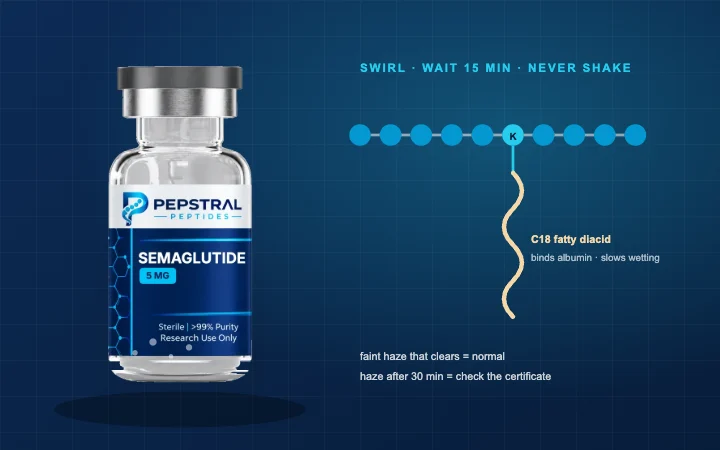
The acylation is the interesting one. A C18 fatty diacid — octadecanedioic acid — is attached to Lys26 through a linker made of γ-glutamic acid and two short polyethylene-glycol-like spacers (OEG units). That chain binds serum albumin reversibly. The molecule circulates bound to albumin, protected from renal filtration, releasing slowly. Why acylated peptides last a week covers this strategy in general terms.
The Lys34Arg substitution looks trivial and is not. With two lysines, acylation chemistry would produce a mixture of regioisomers — some molecules modified at 26, some at 34, some at both. Removing one lysine makes the reaction unambiguous and the product a single defined substance.
What the certificate should say
| Field | Expected |
|---|---|
| Molecular weight | 4113.6 Da (free base) |
| Identity method | LC-MS/MS or MALDI-MS |
| Purity | RP-HPLC area percent at 214 nm |
| Net content | Stated separately from label quantity |
| Salt form | Should be stated explicitly |
That last row is the one most certificates handle poorly, and it is not a detail.
Why salt form is a substantive question
Peptides are purified as salts. The counter-ion is part of the solid, contributes mass, and is not peptide. For a molecule with multiple ionisable groups this is a significant fraction of the powder — TFA salt vs acetate salt covers the general case and the arithmetic.
For semaglutide specifically there is a regulatory dimension on top of the chemistry. The FDA has stated that semaglutide sodium and semaglutide acetate are different substances from semaglutide base, and that products containing those salt forms are not the approved active ingredient. The agency raised this directly in its statements on unapproved GLP-1 products.
Two practical consequences:
Mass. A salt form does not weigh 4113.6 Da. A certificate reporting a mass meaningfully above that figure may be describing a salt rather than the free base — or may have a transcription problem. Either way it is worth asking which.
Content per milligram. If 10 mg of powder is 85% peptide by mass, you have 8.5 mg of semaglutide, not 10. Net peptide content vs purity explains why this gap is normal and why the two figures must be read together. Any concentration calculated from the label rather than from net content will be wrong — see molarity vs milligrams.
Handling
The acylation dominates the physical behaviour, and it makes semaglutide noticeably less convenient than an unmodified peptide of similar size.
| Property | Behaviour |
|---|---|
| Dissolution | Slow. The C18 chain is hydrophobic and resists wetting. Why GLP-1 peptides dissolve slowly covers this specifically |
| Technique | Add diluent down the vial wall, swirl, wait. Do not shake — agitation drives aggregation |
| Aggregation | Amphiphilic molecules self-associate at the air–water interface; see peptide aggregation explained |
| Adsorption | Binds plastic readily, per why peptides stick to plastic |
| Lyophilized storage | Standard, how to store peptide vials |
| In solution | How long does reconstituted peptide last applies |
The "do not shake" instruction is not fussiness. The same amphiphilic character that makes the molecule bind albumin makes it accumulate at air–liquid interfaces, and vigorous mixing multiplies that interface. Slow dissolution is the correct behaviour and is not a sign of poor material.
Regulatory position
Semaglutide is an approved prescription medicine in the United States and most major markets, marketed under brand names by its originator. That approval covers specific manufactured products with established specifications, supply chains and labelling.
Research-grade semaglutide is not that product. It is not interchangeable with it, has not been through the same controls, and is supplied here for laboratory research only. The FDA has been explicit about its concerns with unapproved GLP-1 products, and that guidance is the relevant source rather than anything on a vendor's page.
What "research use only" means covers what that designation does and does not accomplish — including the point that it does not make surrounding claims lawful if those claims describe human use.
How it compares to the other GLP-1 analogues
| Semaglutide | Tirzepatide | Retatrutide | |
|---|---|---|---|
| Receptors | GLP-1 | GLP-1 + GIP | GLP-1 + GIP + glucagon |
| Residues | 31 | 39 | 39 |
| Free-base MW | 4113.6 | 4813.5 | — |
| Acyl chain | C18 diacid | C20 diacid | C20 diacid |
| DPP-4 block | Aib8 | Aib2 and Aib13 | Aib |
All three use the same two engineering ideas — an Aib substitution to block DPP-4, and a fatty diacid to bind albumin — applied to different receptor profiles. Why retatrutide adds a glucagon receptor covers where that progression came from.
Frequently asked questions
What does the Aib at position 8 do?
It blocks DPP-4, the enzyme that cleaves native GLP-1 within about two minutes. Aib is a non-standard residue whose extra methyl group prevents the enzyme binding. Without it, none of the other modifications would matter.
Why 4113.6 and not a round number?
Because it is the sum of the atomic masses of a 31-residue peptide plus the linker and C18 diacid. Peptide masses are rarely round. Two lots in this catalogue report exactly 4113.6.
Is research semaglutide the same as the prescription product?
No. The prescription products are specific approved formulations with established manufacturing controls. Research-grade material is supplied for laboratory use and is not interchangeable with an approved medicine.
Why does it take so long to dissolve?
The C18 fatty acid chain is hydrophobic and resists wetting. Add diluent slowly down the vial wall and allow time. Shaking makes aggregation worse, not dissolution faster.
Does the certificate tell me the salt form?
It should, and many do not. If the mass reported differs meaningfully from 4113.6 Da, ask the supplier which salt form the material is and what the peptide content per milligram is.
What is the OEG linker for?
Spacing. The two OEG units hold the albumin-binding diacid far enough from the peptide backbone that it can reach albumin without the peptide's receptor-binding region being obstructed.
References
- Lau J, Bloch P, Schaffer L, et al. Discovery of the Once-Weekly Glucagon-Like Peptide-1 (GLP-1) Analogue Semaglutide. Journal of Medicinal Chemistry 2015;58(18):7370-80. doi.org/10.1021/acs.jmedchem.5b00726
- Knudsen LB, Lau J. The Discovery and Development of Liraglutide and Semaglutide. Frontiers in Endocrinology 2019;10:155. doi.org/10.3389/fendo.2019.00155
- US Food and Drug Administration. FDA's Concerns with Unapproved GLP-1 Drugs Used for Weight Loss. www.fda.gov/drugs/postmarket-drug-safety-information-patients-and-providers/fdas-concerns-unapproved-glp-1-drugs-used-weight-loss
Every product mentioned is sold for laboratory research use only and is not for human or animal use. Nothing on this page describes or recommends use of the material sold here in humans or animals.