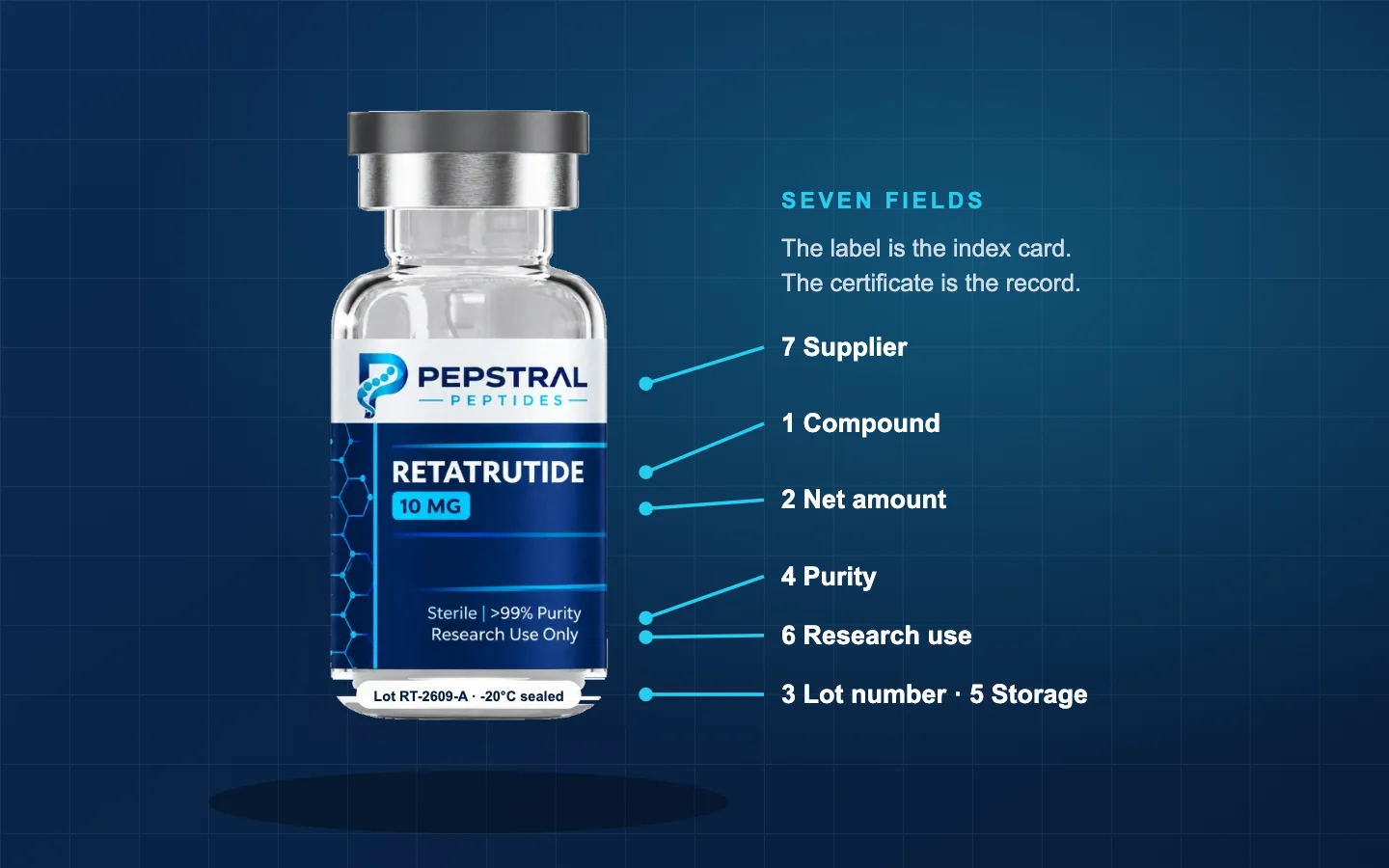
A research peptide label has one job: to connect the vial in your hand to a test report and a set of handling rules. Seven fields do that. If the label carries all seven and the lot number matches a certificate, you can trust the vial as far as the certificate goes. If any field is missing or the lot does not match, stop and ask the supplier before you add water.
This post walks the label field by field, using the layout on our own vials, works through a label-to-certificate comparison, and ends with the three things no label can tell you.
What are the seven fields on a research peptide label?
| Field | What it should say | Why it is there |
|---|---|---|
| Compound name | The accepted name, and the sequence code or synonym where one exists | So the identity test on the certificate can be matched to the name |
| Net amount | Milligrams of peptide, stated as net content | So every concentration you calculate starts from the right mass |
| Lot number | A unique code per batch, printed not handwritten | The only link between this vial and its certificate |
| Purity | The HPLC figure for this lot, or the minimum the supplier guarantees | A claim you can check against the certificate |
| Storage | Temperature range sealed, and after reconstitution | The handling rule that governs the stability window |
| Research-use statement | "For laboratory research use only. Not for human or animal use." | The intended-use declaration that defines what the product is |
| Supplier | Name and a way to reach them | The party responsible for the certificate |
How do you check the compound name?
Match the name on the label to the name on the product page and the certificate. Blends should name both components and state the ratio, as the CJC-1295 + Ipamorelin blend does. A vial that says only "GLP-1" or "repair blend" cannot be matched to a certificate, because the identity test names a specific sequence.
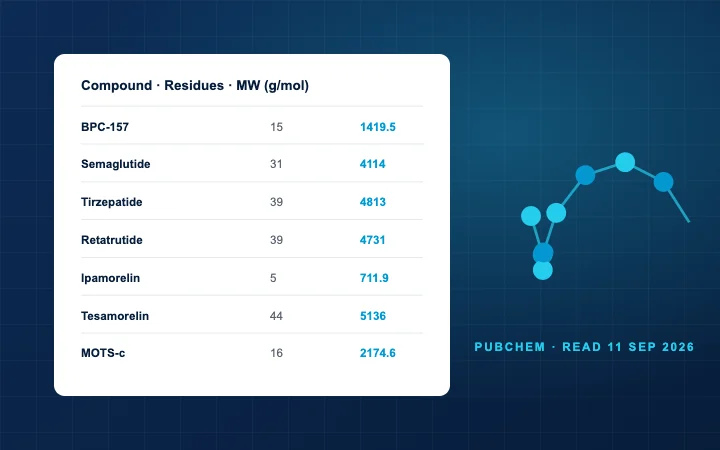
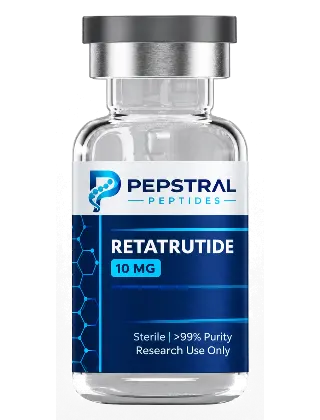
Names on our labels follow the product page exactly, so the retatrutide vial reads Retatrutide 10 mg with the lot below it. Where a compound has a widely used code name, the certificate should carry it too, so that the reference table entry and the PubChem record can be matched without guesswork.
Is the amount net peptide or gross powder?
The label states a number of milligrams. Whether that number means peptide or powder is decided by the certificate, not the label. Bachem's quality guide separates the two: purity is the share of peptidic material that is the target, and net peptide content is the share of the powder that is peptide at all, the rest being counter-ions and moisture.
A supplier who fills by gross weight can put 5 mg of powder in a vial and label it 5 mg. If the certificate reports net peptide content, or quantifies the peptide against a reference, the label figure is net. If it does not, treat the figure as gross and expect somewhere between 60% and 90% of it to be peptide. The certificate guide shows where net content appears on a report, and the post on price differences explains why this one line changes the effective price more than anything else.
What does the lot number let you do?
Everything. Enter it in the COA library and the certificate for that batch comes up, with the test date, the laboratory, the observed mass, the purity figure and the endotoxin result. Without a lot number there is no way to know which test, if any, applies to the vial.
Two checks are worth making the day the vial arrives: that the lot on the label matches the lot on the product page you ordered from, and that the certificate for that lot is dated within the last several months. A lot that has been on sale for a year without a fresh certificate is a question to ask.
What should the purity line say?
Either the measured figure for this lot, which is what our labels carry, or the minimum the supplier guarantees, written as "at least" a percentage. A label that prints a purity figure with no lot number is printing a number nobody can check. A label figure that differs from the certificate figure for the same lot is a labelling error at best. The post on purity thresholds covers what the number means once you have confirmed it.
What storage instruction should you expect?
Two lines: the sealed storage temperature, usually -20°C in the dark, and the post-reconstitution instruction, usually 2 to 8°C with a window in days. GLP-1 class compounds add a light-protection note. If the label gives only one temperature, assume it refers to the sealed vial and follow the storage guide for the reconstituted window.
Why is the research-use line on every vial?
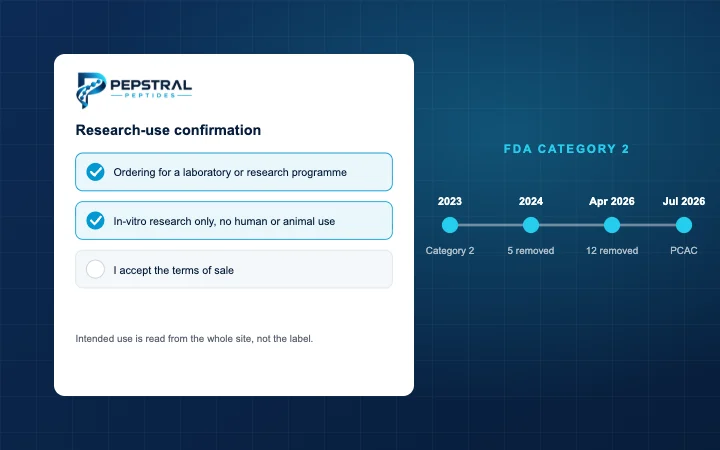
Because it states what the product is. Research peptides are sold as laboratory chemicals, and the research-use statement is the supplier's declaration of intended use. It is a necessary line, not a sufficient one: in a June 2026 warning letter the FDA told a seller that its website established the products were intended as drugs despite the not-for-human-consumption wording on the labels. The label declares intended use; the rest of the supplier's site has to agree with it. The legality post explains the framework.
A worked label-to-certificate comparison
Take a BPC-157 vial as it arrives and the certificate for its lot side by side:
| Field | On the label | On the certificate | Match? |
|---|---|---|---|
| Compound | BPC-157 | BPC-157, sequence stated | Yes |
| Amount | 5 mg | Net peptide content 5.1 mg | Yes, and confirmed net |
| Lot | BP-2609-D | BP-2609-D | Yes |
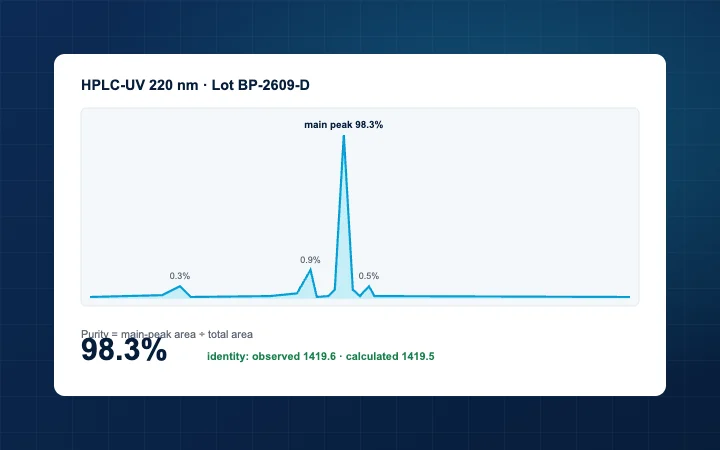
| Purity | 99.7% HPLC | 99.7% HPLC-UV, 220 nm | Yes |
| Storage | -20°C sealed; 2 to 8°C reconstituted | Same | Yes |
| Research-use line | Present | Present | Yes |
| Identity | Not on label | Observed mass 1419.6, calculated 1419.5 | Certificate only |
| Endotoxin | Not on label | Below 0.5 EU/mg, chromogenic LAL | Certificate only |
Eight lines, six on the label, two that only the certificate can supply. If any of the first six disagree, the certificate does not describe the vial. If the last two are missing from the certificate, the vial has not been fully characterised.
What can a label not tell you?
- Identity. Only the mass spectrometry line on the certificate confirms the vial contains the named sequence.
- Actual purity. The label repeats a number; the chromatogram on the certificate is the measurement.
- Endotoxin. No label carries it, and for cell work it matters. It is on the certificate or it was not measured.
The label is the index card. The certificate is the record. Read the card, then pull the record.
Frequently asked questions
Should the label show an expiry date?
A sealed-storage window is more useful than a fixed date, because the clock depends on temperature. Our labels give the sealed window and the reconstituted window; the certificate gives the test date, which is the starting point for both.
What if the lot on the vial is not in the COA library?
Do not open it. Send the lot number to support; either the certificate has not been published yet, which we fix the same day, or the vial did not come from us.
Is a handwritten lot number acceptable?
No. A printed lot number is generated when the batch is filled and appears identically on every vial from that batch. A handwritten one can be anything.
Do blends need two purity figures?
Yes. A blend certificate reports purity per component, and a good blend label either carries both figures or refers to the certificate by lot. The blends post covers reading a blend certificate.
References
- Bachem. Quality Control of Amino Acids and Peptides: A Guide. Net peptide content versus purity. www.bachem.com/knowledge-center/quality-control-of-amino-acids-peptides-a-guide
- US Food and Drug Administration. Warning Letter to Wholesale Peptide, 17 June 2026: the research-use statement on a label does not by itself decide intended use. www.fda.gov/inspections-compliance-enforcement-and-criminal-investigations/warning-letters/wholesale-peptide-729447-06172026
Every product mentioned is sold for laboratory research use only and is not for human or animal use. Nothing on this page describes or recommends use of the material sold here in humans or animals.