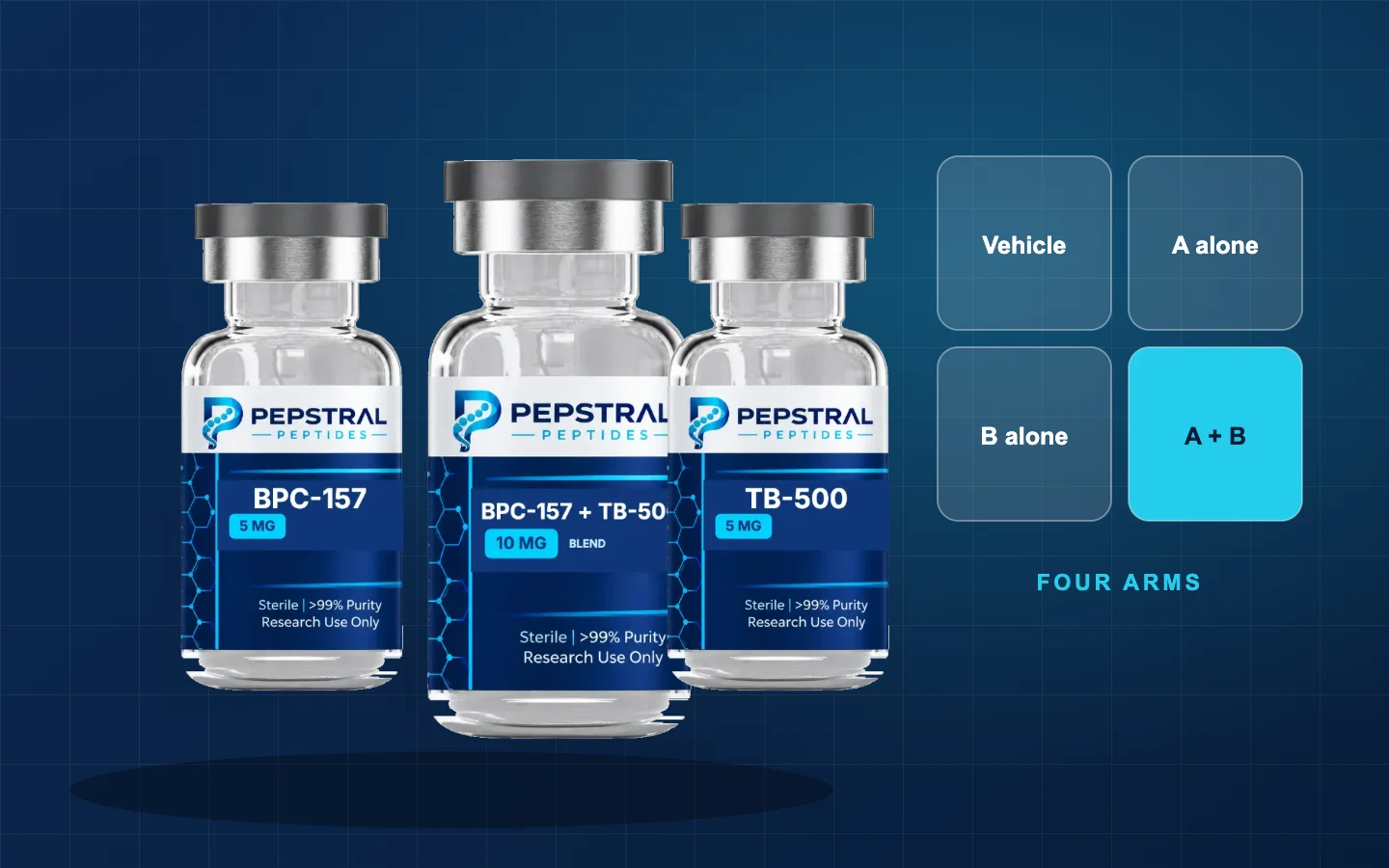
Choose a blend when the ratio between the two compounds is already settled by earlier work and you want fewer vials, fewer reconstitution steps and one certificate. Choose single compounds when the ratio is part of what you are testing, when you need each compound alone as a control arm, or when the two compounds want different storage or dilution handling. This post works through each case with the two blends in the catalog, then covers the arithmetic, the certificate and the write-up.
What is a blend, physically?
A blend is two peptides lyophilized together in one vial at a fixed mass ratio. They are synthesized and purified separately, combined in solution, and freeze-dried as one cake. Reconstitute it and every draw contains both compounds in that ratio.
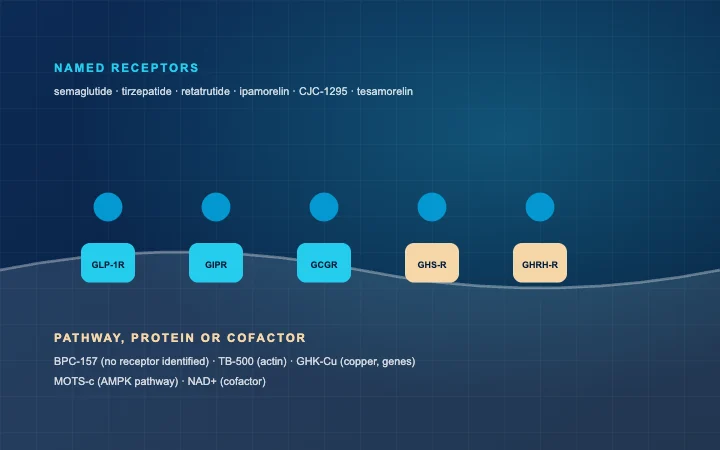
The BPC-157 + TB-500 blend pairs two repair peptides that appear together in the literature. The CJC-1295 + Ipamorelin blend pairs a GHRH analogue with a growth hormone secretagogue, a combination used because the two act on different receptors in the same axis.
When does the blend make sense?
- The ratio is a given. If the design copies a published protocol that used a fixed ratio, the blend reproduces it without weighing two powders.
- Vial count matters. Fewer vials means fewer reconstitutions, fewer freeze-thaw exposures and less chance of a labelling mix-up across a long study.
- One certificate. A blend certificate shows both peaks on the same chromatogram with both observed masses. That is a single document to file against the lot.
- Cost per study. A blend is filled and tested once, so it is priced below the two singles combined.
When do single compounds make sense?
- The ratio is the question. If you want to compare 1:1 against 2:1, you need the singles and a balance, not a fixed blend.
- You need single-compound arms. See the four-arm design below.
- Handling differs. Two compounds with different solubility, pH preference or light sensitivity are easier to manage in separate vials at separate concentrations.
- You are qualifying a new lot. Singles are easier to check against a reference standard, because each chromatogram has one main peak.
What does the four-arm design look like?
A two-compound study can only attribute an effect if it can separate the compounds. The minimum design has four arms:
| Arm | Contains | What it tells you |
|---|---|---|
| Vehicle | Reconstitution water only | Baseline and handling effects |
| A alone | BPC-157 | Effect of A |
| B alone | TB-500 | Effect of B |
| A plus B | Blend, or singles combined | Whether the combination differs from either alone |
The blend covers only the fourth arm. Buy BPC-157 and TB-500 as singles and you can run all four arms from two vials, combining measured volumes for the fourth. Buy the blend as well and the fourth arm has a certificate of its own, which is worth having in a long study.
How do you reconstitute a blend?
The same way as a single: bacteriostatic water added slowly down the inside of the vial, swirl, never shake. The difference is arithmetic. Work the concentration per component, not per vial, and write both on the label.
For a 10 mg blend at a 1:1 mass ratio, 5 mg of each component:
| Water added | Total peptide | Each component | Each component in a 0.1 mL draw |
|---|---|---|---|
| 1 mL | 10 mg/mL | 5 mg/mL | 500 mcg |
| 2 mL | 5 mg/mL | 2.5 mg/mL | 250 mcg |
| 3 mL | 3.33 mg/mL | 1.67 mg/mL | 167 mcg |
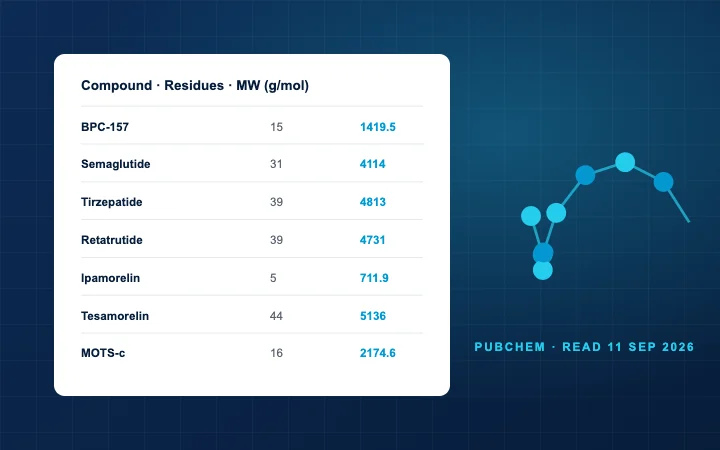
If the two components have very different molecular weights, a 1:1 mass ratio is not a 1:1 molar ratio. BPC-157 is 1419.5 g/mol and TB-500 is 889.0 g/mol, so 5 mg of each is 3.52 micromoles of BPC-157 and 5.62 micromoles of TB-500, a molar ratio of about 1:1.6. State which ratio you mean in the methods. The reference table has the molecular weight for every compound.
Does a blend complicate the certificate?
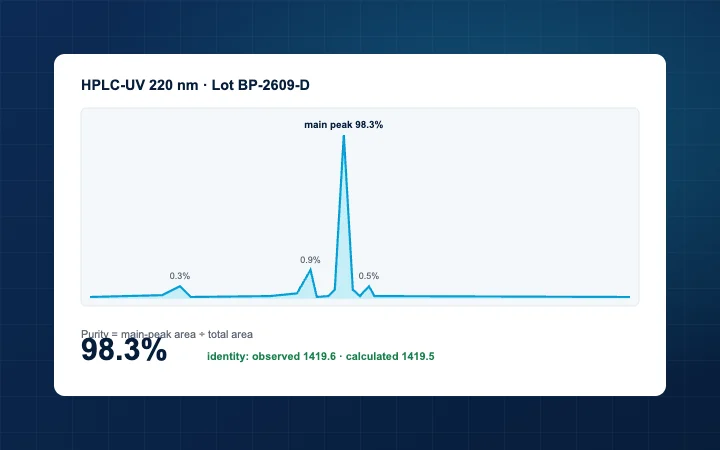
Slightly. Purity on a blend certificate is reported per component, with each main peak integrated against the total. Identity needs two observed masses. Net content should be stated per component, not just as a total.
Reading a blend certificate, look for:
- Both compounds named, with the ratio.
- Two observed masses, each within about a dalton of the calculated mass.
- Two purity figures, or one figure with both peaks identified as target.
- Net peptide content per component, or a total with the ratio confirmed by peak area.
- One endotoxin result for the vial.
A certificate that shows one mass and one purity figure for a two-compound vial has either tested only one component or reported the blend as if it were a single. Either way, ask. The certificate guide covers the single-compound case and everything there applies twice over.
How do you write a blend up in the methods?
State the supplier, the lot, the mass ratio and the molar ratio, the reconstitution volume, the concentration per component, and the storage window used. If the fourth arm was made from singles, state both lot numbers and the volumes combined. A reviewer who cannot reconstruct the per-component concentration from the methods will ask for it.
A decision table
| Situation | Blend | Singles |
|---|---|---|
| Copying a published fixed-ratio protocol | Yes | Works, more steps |
| Testing which ratio matters | No | Yes |
| Need A-alone and B-alone control arms | No | Yes |
| Long study, many reconstitutions | Yes | More vials to track |
| Compounds need different handling | No | Yes |
| One certificate to file | Yes | Two |
Most groups end up with both: the blend for the combined arm across a long study, and the singles for the control arms and any ratio work. Buying the ipamorelin single alongside the CJC blend, for instance, gives you the secretagogue-alone arm without a second blend.
Frequently asked questions
Can I make my own blend from two single vials?
Yes, by reconstituting each single and combining measured volumes. You control the ratio and can change it between arms. The cost is an extra pipetting step and a combined solution with no certificate of its own, so record the lot numbers of both singles against it.
Is the ratio in a blend always 1:1?
No. The ratio is set by the product and stated on the label and the certificate. Check it before working out concentrations, and treat a blend with no stated ratio as one you cannot dose per component.
Does one component degrade faster than the other in a blend?
It can. A blend inherits the shorter stability window of its two components. The storage guide lists windows by compound class; use the more conservative one for the blend.
Which is cheaper for a four-arm study?
Two singles. The blend only covers the combined arm, so a four-arm design that used the blend would still need both singles for the alone arms. Buying the singles and combining them for the fourth arm uses two vials instead of three.
References
- PubChem, National Library of Medicine. Compound records for BPC-157 (CID 9941957), TB-500 (CID 62707662), CJC-1295 (CID 91971820) and ipamorelin (CID 9831659), used for the molecular weights in the concentration table. pubchem.ncbi.nlm.nih.gov
Every product mentioned is sold for laboratory research use only and is not for human or animal use. Nothing on this page describes or recommends use of the material sold here in humans or animals.