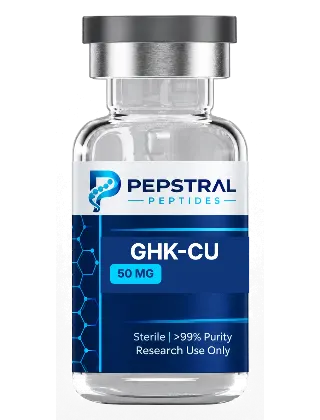
What is GHK-Cu, and what is it studied for?
GHK-Cu is the tripeptide glycyl-L-histidyl-L-lysine complexed with a copper(II) ion. It occurs naturally in human plasma at levels that fall with age, and it is studied for its effects on collagen and elastin synthesis, wound remodelling, antioxidant enzyme expression and the broad gene-expression changes it produces in fibroblasts.
What is the structure of GHK-Cu?
Three amino acids with a copper ion coordinated through the histidine imidazole, the N-terminal amine and the lysine backbone. The complex is blue in solution, which is the visual check that the copper is present. LC-MS confirms the complexed mass on every lot; HPLC-UV reports purity.
How is GHK-Cu thought to work?
GHK-Cu delivers copper to cells in a form that enzymes such as lysyl oxidase and superoxide dismutase can use, and independently of the copper it has been reported to modulate expression of thousands of genes, shifting fibroblasts toward a repair phenotype: increased collagen, decorin and elastin, decreased inflammatory signalling. It also chemoattracts immune and endothelial cells in wound models.
Which research areas use GHK-Cu?
| Area | Typical models and endpoints |
|---|---|
| Collagen and elastin synthesis | Fibroblast cultures measuring procollagen output and matrix deposition. |
| Wound remodelling | Dermal wound and skin-barrier models. |
| Gene expression | Transcriptome profiling of treated fibroblasts. |
| Hair follicle | Dermal papilla cell models. |
What does the published literature show?
Loren Pickart isolated GHK from plasma in 1973 and has published on the copper complex for five decades; reviews by Pickart and Margolina in the International Journal of Molecular Sciences summarise the collagen, wound-healing and gene-expression work. Much of the human-facing evidence is in topical cosmetic contexts. Research use of the compound sold here is in-vitro and preclinical.
How is GHK-Cu handled in the laboratory?
Dissolves readily; the solution should be blue. Avoid metal spatulas and chelating buffers such as EDTA, which strip the copper. Refrigerate at 2 to 8°C, 28-day window. The reconstitution guide covers volumes and syringe units; the storage guide covers stability by compound class.
What does the current certificate show?
Lot GK-2609-A tested at 99.8% purity by HPLC-UV, identity confirmed by LC-MS, endotoxin below 0.5 EU/mg. The certificate is in the COA library and the lot number on the vial matches it. Sold as 50 mg net peptide per vial at $50, for laboratory research only.
Frequently asked questions
Is the copper included?
Yes. The complexed mass is confirmed by LC-MS on lot GK-2609-A and the reconstituted solution is blue.
Why 50 mg rather than 5 mg?
GHK-Cu is used at higher concentrations in fibroblast and dermal work than signalling peptides, so the vial is sized for those protocols.
What purity does the certificate show?
99.8% by HPLC-UV, the highest in the current catalog, with endotoxin below 0.5 EU/mg.
References
- Pickart L, Margolina A. Regenerative and protective actions of the GHK-Cu peptide in the light of the new gene data. Int J Mol Sci. 2018.
- Pickart L, Vasquez-Soltero JM, Margolina A. GHK peptide as a natural modulator of multiple cellular pathways in skin regeneration. Biomed Res Int. 2015.
Clinical results cited above describe regulated trials of pharmaceutical products and are given as context for research interest only. Nothing on this page describes or recommends use of the material sold here in humans or animals.