
What is BPC-157, and what is it studied for?
BPC-157 is a synthetic pentadecapeptide, 15 amino acids long, whose sequence derives from a protective protein found in human gastric juice. It is studied in tissue-repair models: tendon, ligament and muscle healing, gut-lining integrity, angiogenesis and cell migration. It is the most-cited repair peptide in the preclinical literature.
What is the structure of BPC-157?
Sequence Gly-Glu-Pro-Pro-Pro-Gly-Lys-Pro-Ala-Asp-Asp-Ala-Gly-Leu-Val, supplied as the acetate salt in lyophilized form. It is stable in acidic conditions, which is consistent with its gastric origin and is why gastric-juice stability is often cited as a distinguishing property. Identity is confirmed by LC-MS and purity by HPLC-UV on every lot.
| Identifier | Value |
|---|---|
| Molecular formula | C62H98N16O22 |
| Molecular weight | 1419.5 g/mol |
| Residues | 15 |
| CAS number | 137525-51-0 |
| PubChem CID | 9941957 |
| Current lot | BP5-0803 |
How is BPC-157 thought to work?
Proposed mechanisms include upregulation of growth-factor receptor expression, modulation of nitric-oxide signalling, promotion of angiogenesis through VEGF-related pathways and effects on fibroblast migration. Most of the mechanistic evidence comes from rodent injury models rather than isolated receptor studies, and no single receptor has been established.
Which research areas use BPC-157?
| Area | Typical models and endpoints |
|---|---|
| Tendon and ligament repair | Transection and injury models measuring tensile strength, fibroblast outgrowth and healing time. |
| Gut-lining integrity | Colitis and gastric-lesion models; interaction with the gut-brain axis. |
| Angiogenesis | Endothelial tube formation and vessel-density endpoints in wound models. |
| Cell migration | Fibroblast and tendocyte migration assays in vitro. |
What does the published literature show?
The bulk of the published work comes from Predrag Sikiric's group at the University of Zagreb over three decades, spanning gastric, tendon, muscle and vascular models in rodents, with reviews summarising the field. Independent replication outside that group is more limited, and there are no completed human trials, which is the honest state of the evidence and the reason the compound sits firmly in the research category.
How is BPC-157 handled in the laboratory?
Dissolves readily. Standard reconstitution, 2 to 8°C after mixing, 28-day window. Stable across the pH range used in most assays. The concentration table covers dilution volumes and microlitre aliquots; the storage guide covers stability by compound class.
What does the current certificate show?
Lot BP5-0803 tested at 99.73% purity by RP-HPLC (214 nm), identity confirmed by LC-MS/MS, endotoxin <0.05 EU/mL. The certificate is in the COA library and the lot number on the vial matches it. Sold as 5 mg per vial at $60, for laboratory research only.
Certificate history for BPC-157
Every certificate the library holds for this compound, newest first. A replaced lot stays listed so the history can be read; the certificate dataset reads all 114 together.
| Lot | Issued | Size | Identity | Purity | Content | Status |
|---|---|---|---|---|---|---|
| BP5-0803 | Aug 17, 2026 | 5 mg | LC-MS/MS | 99.73% | 5.33 mg | Current |
| BP15-0803 | Aug 17, 2026 | 15 mg | LC-MS/MS | 99.84% | 15.75 mg | Current |
| BP10-0803 | Aug 17, 2026 | 10 mg | LC-MS/MS | 99.71% | 10.44 mg | Current |
| BP10-0318 | Apr 3, 2026 | 10 mg | MALDI-MS | 99.8% | 10.02 mg | Replaced |
| BP10-0318 | Apr 3, 2026 | 5 mg | MALDI-MS | 99.7% | 6.42 mg | Replaced |
Frequently asked questions
Is this the acetate or the arginate form?
Acetate. The certificate lists the counter-ion, and the label mass excludes it.
What does lot BP5-0803 report?
99.73% purity by RP-HPLC (214 nm), identity BPC-157 confirmed by LC-MS/MS, content 5.33 mg by HPLC quantitation, endotoxin <0.05 EU/mL, heavy metals <0.01 ppm. Certificate COA7609, issued 17 August 2026 by Bioviridian Inc.
Should BPC-157 be paired with TB-500?
Many recovery protocols pair them because they act through different mechanisms. The Repair pair bundle ships both as separate lot-matched vials; the blend co-lyophilizes them 1:1.
References
- Sikiric P et al. Stable gastric pentadecapeptide BPC 157: novel therapy in gastrointestinal tract. Curr Pharm Des. 2011.
- Seiwerth S et al. BPC 157 and standard angiogenic growth factors. Curr Pharm Des. 2018.
- Chang CH et al. The promoting effect of pentadecapeptide BPC 157 on tendon healing involves tendon outgrowth, cell survival, and cell migration. J Appl Physiol. 2011.
Clinical results cited above describe regulated trials of pharmaceutical products and are given as context for research interest only. Nothing on this page describes or recommends use of the material sold here in humans or animals.
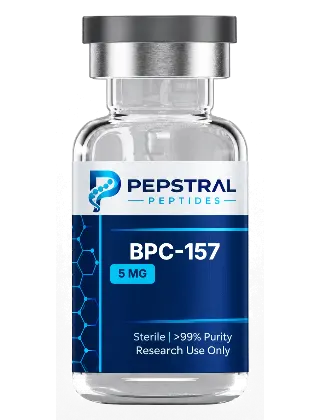 BPC-157 5 mg
$60 per vial
Lot BP5-0803 · 99.73% RP-HPLC (214 nm) · certificate published
View productRelated
- TB-500 research guide · TB-500 5 mg
- BPC-157 + TB-500 research guide · BPC-157 + TB-500 10 mg blend
- BPC-157 and TB-500 in one vial: what the blend certificate reports and how to check it adds up
- What BPC-157 is, where the sequence came from, and what a certificate can and cannot tell you about it
- What is in a GLOW blend: three molecular weights that identify the formulation exactly
- What is in a KLOW blend, and why two of its four masses are only two daltons apart
- Glossary of certificate terms