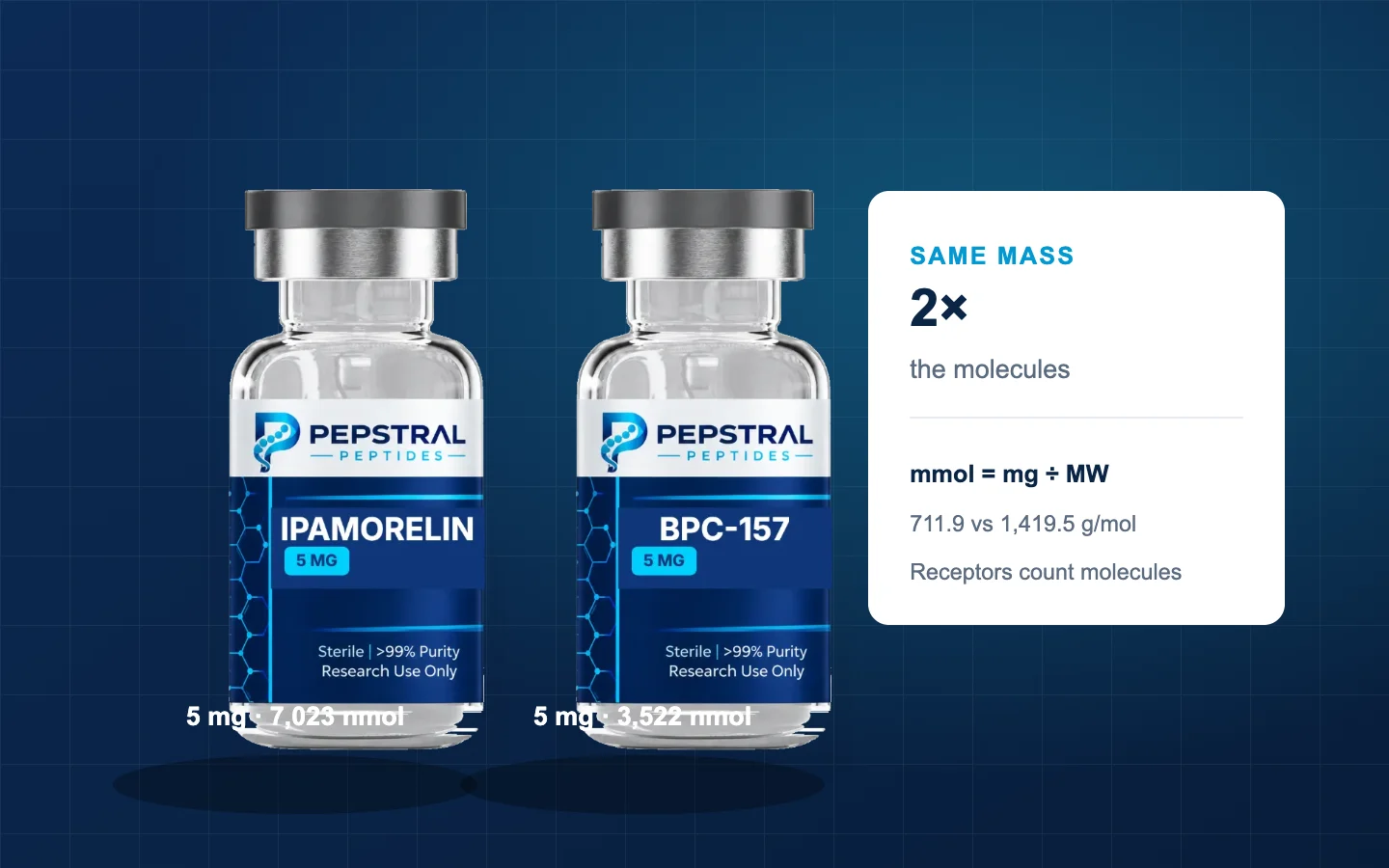
A 5 mg vial of ipamorelin and a 5 mg vial of BPC-157 contain the same mass and very different numbers of molecules — about 7,000 nanomoles against about 3,500. Ipamorelin is a five-residue peptide at 711.9 g/mol; BPC-157 is fifteen residues at 1,419.5. Twice the mass per molecule means half the molecules for the same weight. If you are comparing two compounds at "the same concentration" in milligrams per millilitre, you are not comparing them at the same concentration in any sense a receptor cares about.
Why does this matter?
Because binding is a molecular event. A receptor site is occupied by one molecule, not by one microgram. Any experiment whose readout depends on occupancy — competitive binding, dose-response, EC50 or IC50 determination, or a head-to-head between two compounds — has to be expressed in molar terms or the numbers cannot be interpreted.
This is not a pedantic distinction in this catalogue specifically, because the molecular weights span an enormous range. The smallest compound here is Vilon, a dipeptide at 275.3 g/mol. The largest is tesamorelin at 5,136. That is an eighteen-fold spread. Equal masses of those two differ eighteen-fold in molecule count.
What is the conversion?
One division, then a volume.
Millimoles = milligrams ÷ molecular weight
Then, since molarity is moles per litre:
Molar concentration = millimoles ÷ litres of solution
Worked through for a 5 mg vial of BPC-157 reconstituted in 2 mL:
- 5 mg ÷ 1,419.5 g/mol = 0.003522 mmol = 3,522 nanomoles in the vial
- 0.003522 mmol ÷ 0.002 L = 1.761 mmol/L = 1,761 µM
The same vial mass of ipamorelin in the same 2 mL gives 3,512 µM — nearly double, from identical milligrams.
Molar amounts for every vial in the catalogue
Computed from the labelled dose and the PubChem molecular weight for each compound. The final column assumes reconstitution in 2 mL.
| Compound | Vial | MW (g/mol) | nmol per vial | µM in 2 mL |
|---|---|---|---|---|
| Ipamorelin | 5 mg | 711.9 | 7,023 | 3,512 |
| TB-500 | 5 mg | 889.0 | 5,624 | 2,812 |
| Epithalon | 10 mg | 390.4 | 25,618 | 12,809 |
| GHK-Cu | 50 mg | 400.9 | 124,719 | 62,360 |
| BPC-157 | 5 mg | 1,419.5 | 3,522 | 1,761 |
| Semaglutide | 5 mg | 4,114.0 | 1,215 | 608 |
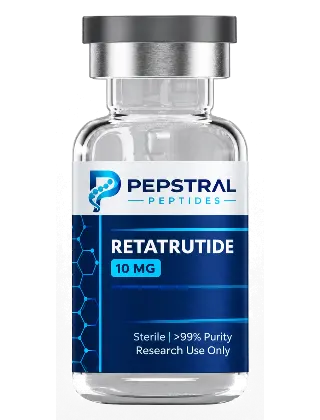
| Retatrutide | 10 mg | 4,731.0 | 2,114 | 1,057 |
Two things stand out. A 50 mg GHK-Cu vial holds more than a hundred times the molar amount of a 5 mg semaglutide vial — the mass ratio is ten to one, and the molecular weight ratio multiplies it. And retatrutide, at twice the labelled mass of semaglutide, delivers only 1.7 times the molecules, because it is the heavier molecule.
Where does the arithmetic go wrong?
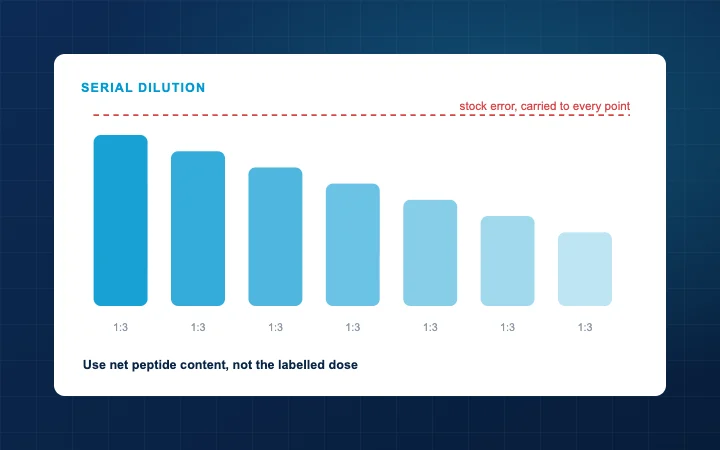
Using the label instead of the certificate. The labelled dose is a nominal fill. The certificate reports net peptide content — the actual milligrams of peptide, excluding counter-ion and residual water. A 5 mg vial reporting 4.7 mg net is 6% fewer molecules than you assumed, and that 6% carries through every subsequent dilution unchanged. The Bachem quality-control guide describes why net content and gross powder differ; our post on reading a certificate covers where to find it.
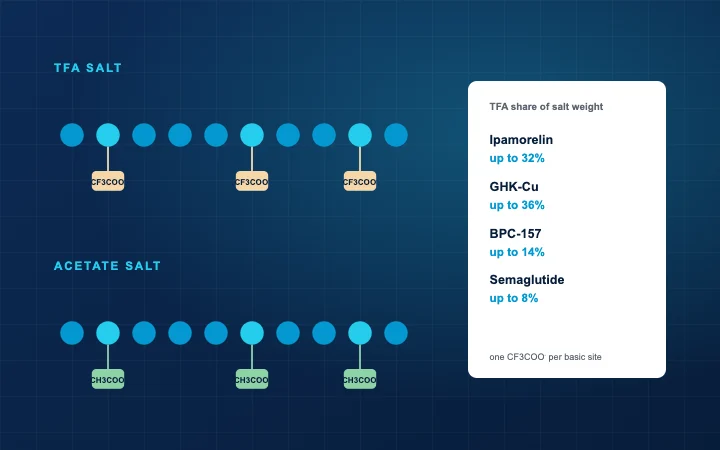
Ignoring the counter-ion. A peptide supplied as a TFA salt carries trifluoroacetate that contributes mass and no peptide. If a quoted molecular weight looks heavier than the sequence arithmetic predicts, it may be quoting the salt. Our TFA and acetate post covers the practical consequences.
Treating a blend as one compound. A co-lyophilized blend has two or more molecular weights and two or more molar amounts. A single molarity for the vial is not a number that means anything. Work each component separately, as the blends post argues.
Rounding the molecular weight early. Round at the end, not at the start. Using 1,400 instead of 1,419.5 for BPC-157 introduces a 1.4% error before you have done anything else.
When is mass the right unit?
When the question is about mass. Solubility limits, formulation, shipping quantities, and the practical question of how much powder is in the vial are all mass questions, and expressing them in molar terms would be affectation. The concentration table on our site is given in mg/mL and micrograms per unit precisely because that is what you read off a syringe.
The rule is straightforward: mass for handling, molarity for biology. A methods section should report both, which is why our methods-section post asks for the concentration and the net peptide content that lets a reader derive the molarity themselves.
Frequently asked questions
How do I get micromolar from a mg/mL figure?
Divide the mg/mL by the molecular weight to get millimolar, then multiply by 1,000. So 2.5 mg/mL of BPC-157 is 2.5 ÷ 1,419.5 = 0.00176 mmol/mL, which is 1.76 mM, which is 1,761 µM.
What is a nanomole in practical terms?
A nanomole is 10⁻⁹ moles — about 602 trillion molecules. It is the convenient unit for a single vial of research peptide, because whole vials land in the thousands of nanomoles rather than awkward fractions of a millimole.
Does the molecular weight on your product pages include the salt?
No. The molecular weights published on our product pages are the free-peptide values read from PubChem, and each page links the PubChem CID so you can check. Where a compound has no PubChem record we leave the field blank rather than publish an unverified number.
Should I use the average or monoisotopic mass?
Average mass, for anything involving weighing and dissolving. Monoisotopic masses are what a mass spectrometer reports for identity confirmation, and they differ slightly — for a peptide the size of BPC-157 the gap is around one dalton, which matters for interpreting a spectrum and not at all for making a solution.
References
- Bachem. Quality Control of Amino Acids and Peptides: A Guide. Net peptide content, counter-ions and moisture. www.bachem.com/knowledge-center/quality-control-of-amino-acids-peptides-a-guide
- PubChem, National Center for Biotechnology Information. Compound summaries — molecular weights used in the conversions below. pubchem.ncbi.nlm.nih.gov
- Niu CH, Chiu YY. FDA perspective on peptide formulation and stability issues. Journal of Pharmaceutical Sciences 1998;87(11):1331-1334. doi.org/10.1021/js9800782
Every product mentioned is sold for laboratory research use only and is not for human or animal use. Nothing on this page describes or recommends use of the material sold here in humans or animals.