There is no single answer, and any supplier who gives you one without asking which peptide you mean is guessing. A reconstituted peptide degrades by chemical routes that depend on which amino acids are in the sequence. A peptide with no asparagine, no glutamine, no methionine and no cysteine is a fundamentally more stable molecule in water than one carrying all four, and no amount of careful storage changes that. This post explains what is actually happening in the vial, why the sequence decides the window, what bacteriostatic water does and does not do, and how to set a defensible working window for your own material.
What actually degrades a peptide in solution?
Manning and colleagues' review of protein pharmaceutical stability groups the routes into chemical degradation, where covalent bonds change, and physical degradation, where the molecule stays intact but stops behaving. Four chemical routes account for most of what happens to a short research peptide in water.
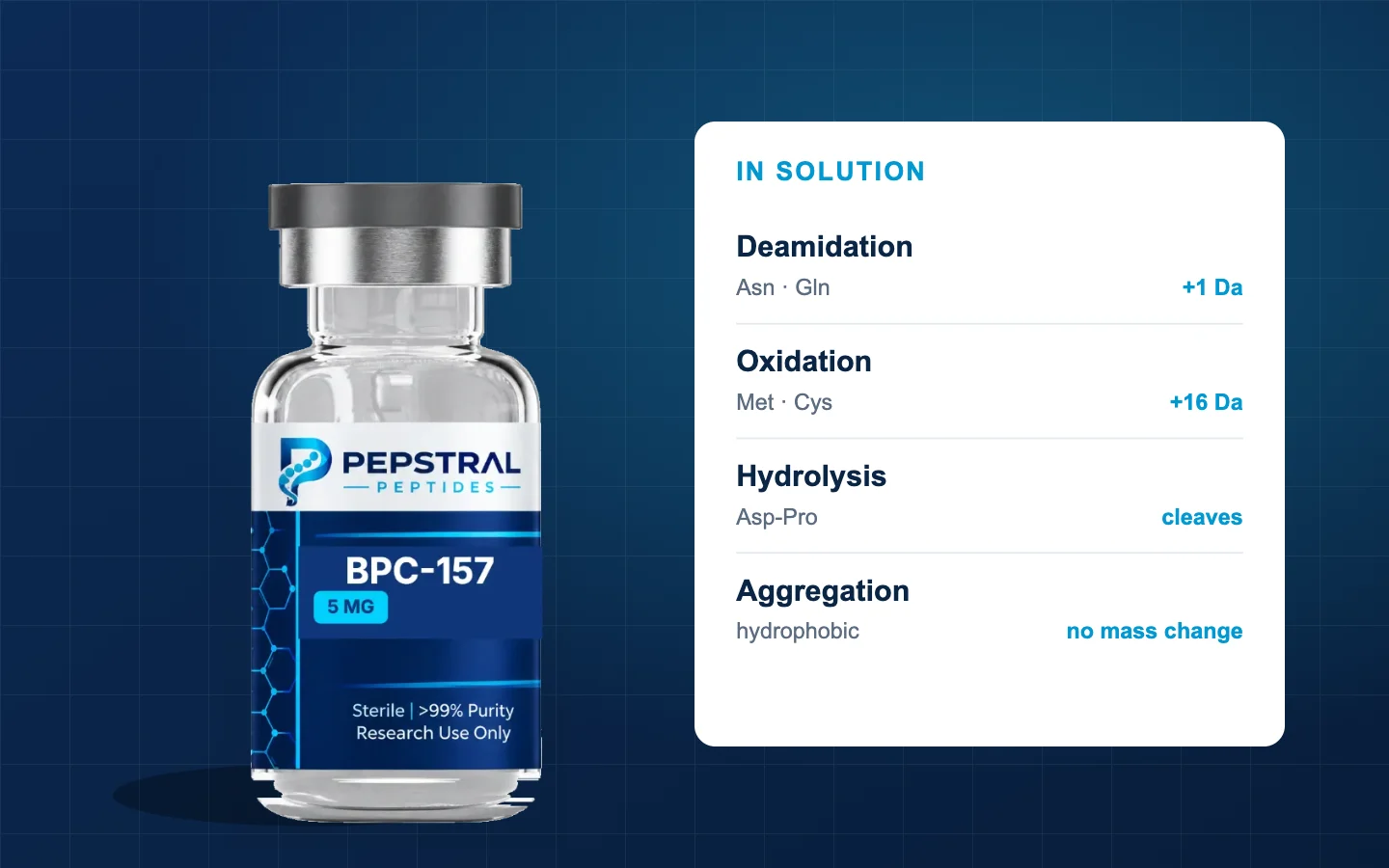
Deamidation. Asparagine and glutamine side chains lose their amide group and become aspartate or glutamate. This changes the mass by roughly +1 Da per event, changes the charge, and is the single most common route for peptides in neutral aqueous solution. It is faster at higher pH and higher temperature.
Oxidation. Methionine and cysteine are the vulnerable residues. Dissolved oxygen, trace metals and light all accelerate it. Methionine gains 16 Da as the sulfoxide; cysteines can pair into disulfides that were not in the original molecule.
Hydrolysis. The backbone can cleave, and some bonds are far more labile than others — aspartate-proline is the classic weak point, and it is acid-catalysed.
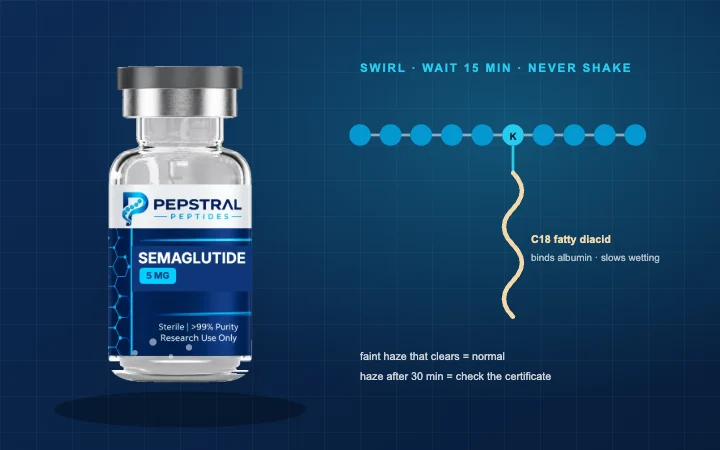
Aggregation. Physical rather than covalent: molecules associate, and at the extreme come out of solution. This is the one you can sometimes see, as haze or particles in a vial that was clear yesterday.
Why does the sequence decide the answer?
Because each of those routes needs a specific residue to act on. Friedman and colleagues studied exactly this in growth-hormone-releasing-factor analogues — the family sermorelin and the CJC-1295 variants belong to — and found that degradation in neutral aqueous solution tracked deamidation of asparagine residues. The molecule did not fall apart at random; it failed at a specific, predictable side chain.
Capasso's work on deamidation rates makes the same point quantitatively: the rate depends heavily on the residue immediately following the asparagine. Asn-Gly is among the fastest sequences; a bulkier neighbour slows it considerably. Two peptides of identical length and similar mass can differ several-fold in solution stability because of one adjacent residue.
This is why the honest answer to "how long does it last" is a question back: which peptide, at what concentration, in what diluent, at what temperature.
| Route | Residues at risk | Accelerated by | Typical mass change |
|---|---|---|---|
| Deamidation | Asn, Gln | Higher pH, heat, Asn-Gly sequence | +1 Da |
| Oxidation | Met, Cys | Dissolved oxygen, trace metals, light | +16 Da (Met sulfoxide) |
| Hydrolysis | Asp-Pro and other labile bonds | Low pH, heat | Fragmentation |
| Aggregation | Hydrophobic and acylated sequences | Concentration, agitation, freeze-thaw | None — mass unchanged |
Does bacteriostatic water make a peptide last longer?
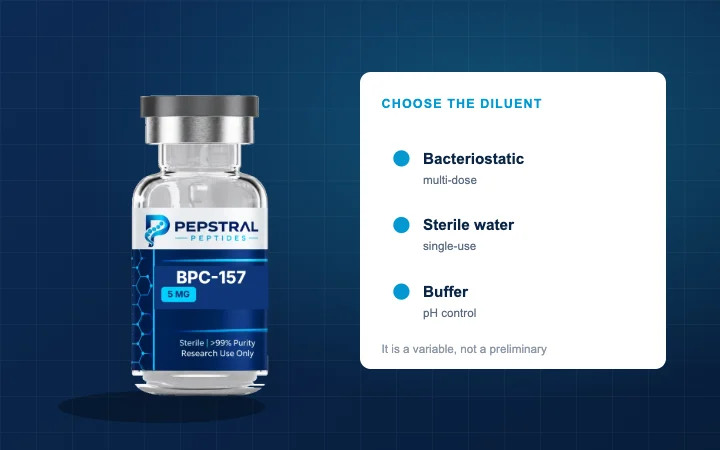
It makes the vial last longer, not the peptide. Bacteriostatic water is sterile water with roughly 0.9% benzyl alcohol added as an antimicrobial preservative. That preservative is what makes a vial multi-dose rather than single-use: it inhibits the growth of organisms introduced when the stopper is punctured repeatedly.
It does nothing about deamidation, oxidation or hydrolysis. Those are chemical reactions between the peptide and water, oxygen and heat, and a preservative does not participate in them. A vial reconstituted in bacteriostatic water and left at room temperature for a month is microbiologically protected and chemically degraded.
This distinction matters because it is routinely blurred. "Preserved" and "stable" are different claims about different failure modes.
What working window should you use?
Set one, write it down, and treat it as part of the method rather than folklore. A defensible default for research work:
- Refrigerate at 2-8°C immediately after reconstitution. Temperature is the lever with the largest effect on every chemical route above.
- Protect from light, particularly for sequences containing methionine, cysteine or tryptophan.
- Aliquot for single use and freeze at -20°C or below if the material must last. One freeze, one thaw. Repeated freeze-thaw cycles drive aggregation, which is precisely the failure mode freezing was meant to avoid.
- Prepare fresh where the readout is sensitive to concentration or to the presence of degradation products. For a binding assay, fresh is not fussiness; a 5% deamidated population is a 5% population of a different molecule.
- Never top up an old vial with fresh diluent. You now have a mixture of two ages and cannot report either.
Niu and Chiu's FDA-perspective paper on peptide formulation makes the underlying regulatory point: stability is established empirically for a given peptide in a given formulation, not inferred from the class. Nothing about "peptides" as a category tells you about the one in front of you.
How do you know if it has degraded?
Visually, you can only catch the extreme cases: haze, particles, colour change, a solution that will not clear on gentle swirling. Those mean stop. The absence of them means very little — deamidation and oxidation are invisible.
The honest answer is that you cannot tell by looking, which is why the window is set by policy rather than inspection. If a result depends on it, the material goes to an analytical laboratory: HPLC will resolve degradation products as new peaks, and mass spectrometry will show the +1 and +16 Da species directly. Our post on independent testing covers how to send a vial.
What should you record?
The reconstitution date, the diluent and its lot, the concentration, the storage temperature, and the date of each draw. That record is what lets you say later whether an anomalous result came from the biology or from a vial that had been open for six weeks. It costs a line in a notebook and it is the difference between an explainable result and a discarded experiment. Our methods-section post lists the full set of facts worth capturing.
Frequently asked questions
Does a higher concentration last longer or shorter?
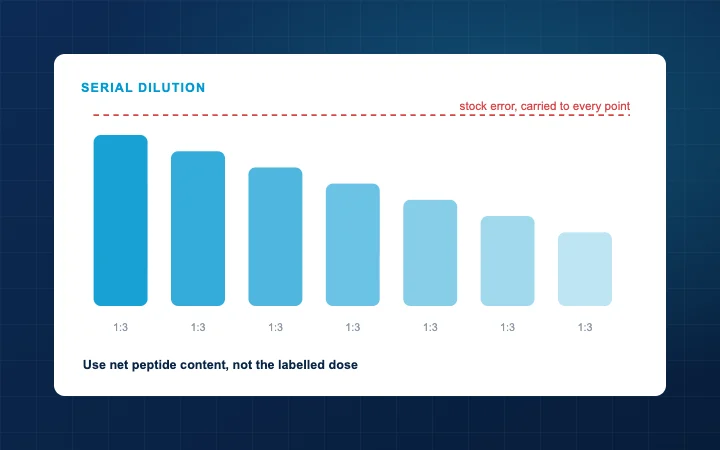
It depends on the route. Concentration has little effect on deamidation rate per molecule, but it raises the risk of aggregation, which is concentration-dependent. Very dilute solutions have their own problem: adsorption of peptide onto the container wall, which lowers the effective concentration without any chemical change at all.
Can I refreeze a thawed vial?
You can, but each cycle costs you. Freeze-thaw drives aggregation through the concentration and pH shifts that occur as ice forms. Aliquoting into single-use volumes before the first freeze avoids the question entirely.
Does the certificate tell me the solution stability?
No. A certificate reports the lyophilized material as released — identity, purity, net peptide content, endotoxin. It says nothing about what happens after you add water, because that depends on your diluent, concentration, temperature and handling.
Is lyophilized powder more stable than solution?
Substantially, yes. Chemical degradation needs water as a participant or a medium, and the dry state slows every route above by orders of magnitude. That is the entire reason research peptides are shipped freeze-dried rather than in solution.
References
- Manning MC, Chou DK, Murphy BM, Payne RW, Katayama DS. Stability of protein pharmaceuticals: an update. Pharmaceutical Research 2010;27(4):544-575. doi.org/10.1007/s11095-009-0045-6
- Friedman AR, Ichhpurani AK, Brown DM, et al. Degradation of growth hormone releasing factor analogs in neutral aqueous solution is related to deamidation of asparagine residues. International Journal of Peptide and Protein Research 1991;37(1):14-20. doi.org/10.1111/j.1399-3011.1991.tb00727.x
- Capasso S. Estimation of the deamidation rate of asparagine side chains. The Journal of Peptide Research 2000;55(3):224-229. doi.org/10.1034/j.1399-3011.2000.00172.x
- Niu CH, Chiu YY. FDA perspective on peptide formulation and stability issues. Journal of Pharmaceutical Sciences 1998;87(11):1331-1334. doi.org/10.1021/js9800782
Every product mentioned is sold for laboratory research use only and is not for human or animal use. Nothing on this page describes or recommends use of the material sold here in humans or animals.