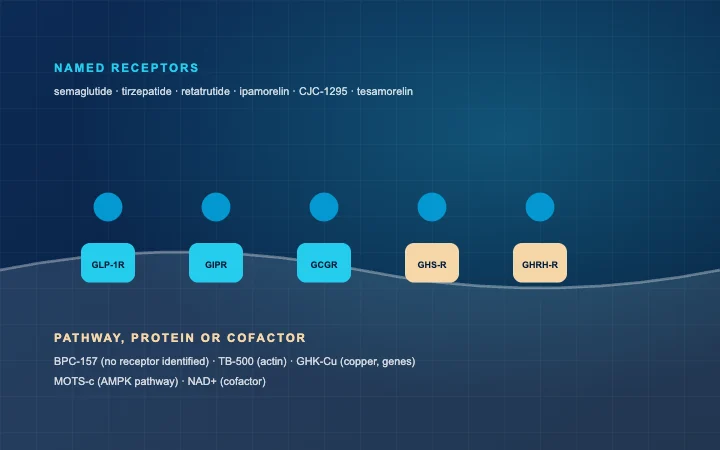
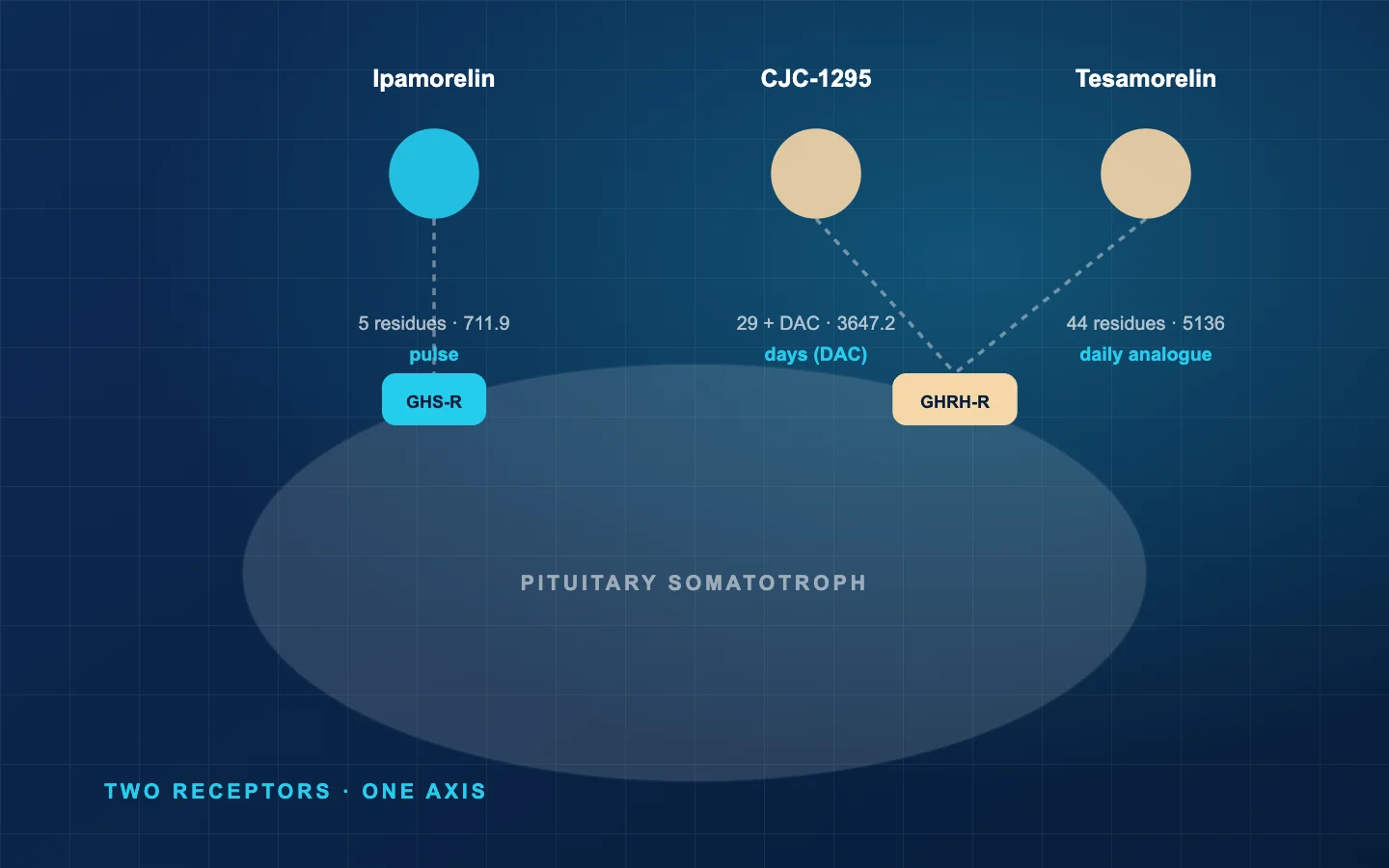
Three compounds in this catalog act on the growth hormone axis, and buyers regularly ask which one a design calls for. The answer starts with the receptor. Ipamorelin is a growth hormone secretagogue and acts at the secretagogue receptor. CJC-1295 and tesamorelin are analogues of growth hormone releasing hormone and act at the GHRH receptor. Two receptors on the same pituitary cell, two ways to stimulate the same output, and the differences in size, duration and literature follow from that.
This post compares the three and shows how they combine.
What are the three compounds?
| Ipamorelin | CJC-1295 (in the CJC + Ipamorelin blend) | Tesamorelin | |
|---|---|---|---|
| Class | Growth hormone secretagogue | GHRH analogue, residues 1 to 29 | GHRH analogue, residues 1 to 44 |
| Receptor | Growth hormone secretagogue receptor | GHRH receptor | GHRH receptor |
| Residues | 5 | 29 plus DAC linker in the DAC form | 44 |
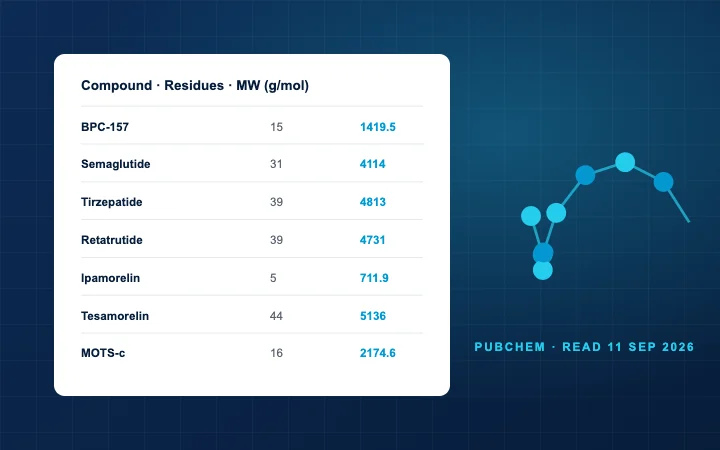
| Molecular weight (PubChem) | 711.9 g/mol | 3647.2 g/mol (DAC form) | 5136 g/mol |
| Stabilising modification | Non-natural residues in the sequence | Four substitutions; DAC linker binds albumin | Modified N-terminus to slow enzymatic cleavage |
| Duration in the literature | Short pulse | Days after one dose (DAC form) | Daily dosing in the clinical trial |
| Key papers | Raun 1998; Ankersen 1998 | Teichman 2006; Jetté 2005 | Falutz 2007 |
What does ipamorelin do that the others do not?
It acts through a different receptor. Raun and colleagues described ipamorelin in 1998 as the first selective growth hormone secretagogue: a pentapeptide that released growth hormone through the secretagogue receptor without the rise in cortisol and prolactin seen with earlier compounds of its class. Ankersen and colleagues in the same year used it as the starting point for a series of more potent analogues, which is a measure of how clean a starting point it was.
Because it works at the secretagogue receptor rather than the GHRH receptor, it can be combined with either GHRH analogue without competing for the same site. Its size is the other difference. At 711.9 g/mol, 5 mg of ipamorelin is 7.02 micromoles, seven times the molar quantity of 5 mg of tesamorelin. The concentration table has the arithmetic for each vial.
How do CJC-1295 and tesamorelin differ if both are GHRH analogues?
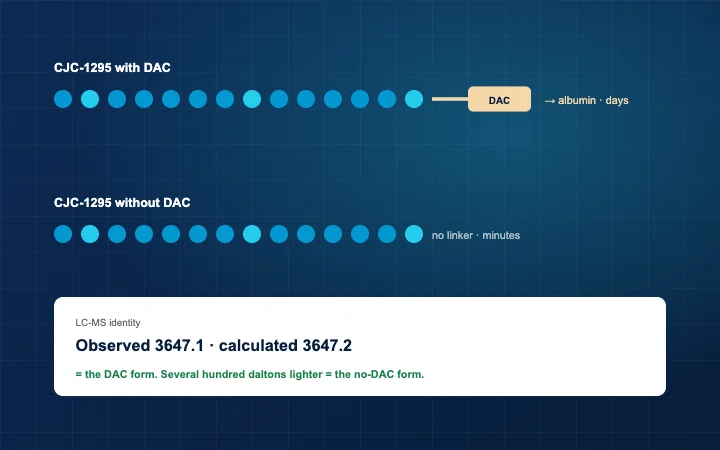
By length and by how each was made to last. CJC-1295 is the first 29 residues of GHRH, the fragment that carries full receptor activity, with four substitutions that protect it from enzymes. In the DAC form it also carries a linker that binds it covalently to albumin in circulation.
Jetté and colleagues showed in 2005 that such albumin conjugates still activate the GRF receptor, and Teichman and colleagues reported in 2006 that a single dose produced growth hormone and IGF-1 elevation lasting days. Without the linker it is a short-acting analogue, and the DAC post explains how to tell the two apart on a certificate.
Tesamorelin is the full 44-residue GHRH sequence with a modification at the N-terminus that slows enzymatic cleavage. Falutz and colleagues described it in 2007 as a growth hormone releasing factor analogue given daily in a clinical trial. It is the longest and heaviest of the three, which shows in the reference table and in the price per milligram the pricing post explains.
How do the three combine in a design?
Because the secretagogue receptor and the GHRH receptor are different, a secretagogue and a GHRH analogue act on the same cell through two routes, and the combination is a standard model for studying the axis. The pairing question is duration.
- Pulse with pulse. Ipamorelin with non-DAC CJC-1295 gives two short signals that can be timed together. This is the pairing the CJC + Ipamorelin blend is built for, and its certificate states which CJC form it contains.
- Pulse on a raised baseline. Ipamorelin with DAC-form CJC-1295 gives a secretagogue pulse against days of GHRH-receptor stimulation. Ionescu and Frohman's observation, cited in the DAC post, that pulsatility persists during DAC stimulation is the relevant background.
- Pulse with a daily analogue. Ipamorelin with tesamorelin pairs the secretagogue with a GHRH analogue whose literature uses daily administration.
A four-arm design applies to any of these, as the blends post describes: vehicle, each compound alone, and the pair.
What does an equimolar comparison look like?
Because the three differ sevenfold in molecular weight, comparing them by milligrams compares different numbers of molecules. A design that wants the same molar concentration of each has to work from the PubChem weights. For a 1 micromolar working concentration in 1 mL:
| Compound | Molecular weight | Mass for 1 µM in 1 mL | From a 2 mL reconstitution of the catalog vial | Draw for 1 mL of working solution |
|---|---|---|---|---|
| Ipamorelin 5 mg | 711.9 | 0.71 µg | 2.5 mg/mL stock | 0.28 µL, so dilute the stock 1:100 first |
| CJC-1295 (DAC form) | 3647.2 | 3.65 µg | Per component of the 10 mg blend, 2.5 mg/mL | 1.46 µL, so dilute 1:10 first |
| Tesamorelin 10 mg | 5136 | 5.14 µg | 5 mg/mL stock | 1.03 µL, so dilute 1:10 first |
The right-hand column shows the practical consequence: all three stocks are far too concentrated to pipette directly to 1 µM, so each needs an intermediate dilution, and the intermediate for ipamorelin is ten times larger than for the other two. Working the table before the experiment prevents a tenfold error on the smallest compound. The concentration table gives the stock figures for every vial.
Which certificate lines matter most for these three?
Identity, above all. The three have very different masses, and CJC-1295 has two forms under one name, so the LC-MS line settles which molecule is in the vial. For ipamorelin, net peptide content matters more than for the other two, because a five-residue peptide with several basic sites carries a large counter-ion share, as the TFA post works through. For tesamorelin, purity is the line to read closely, since a 44-residue synthesis leaves more room for deletion sequences.
Frequently asked questions
Can ipamorelin be used without a GHRH analogue?
In a design, yes. It acts at its own receptor and is studied alone in the literature. The pairing is a choice about stimulating the axis by two routes, not a requirement.
Which is the most potent of the three?
Potency depends on the receptor, the assay and the readout, and the three act at two different receptors, so a single ranking is not meaningful. Compare molar concentrations at the receptor each one targets, using the molecular weights above.
Are all three lyophilized peptides with the same handling?
Yes. All three follow the storage guide for their class and reconstitute per the reconstitution guide. None carries the fatty-acid chain that slows the GLP-1 class.
Where are the full research guides?
The compound guides cover each in depth: ipamorelin, the CJC + Ipamorelin blend and tesamorelin, with references.
References
- Raun K, Hansen BS, Johansen NL, et al. Ipamorelin, the first selective growth hormone secretagogue. European Journal of Endocrinology 1998;139(5):552-561. doi.org/10.1530/eje.0.1390552
- Ankersen M, Johansen NL, Madsen K, et al. A new series of highly potent growth hormone-releasing peptides derived from ipamorelin. Journal of Medicinal Chemistry 1998;41(19):3699-3704. doi.org/10.1021/jm9801962
- Teichman SL, Neale A, Lawrence B, et al. Prolonged stimulation of growth hormone and insulin-like growth factor I secretion by CJC-1295, a long-acting analog of GH-releasing hormone, in healthy adults. Journal of Clinical Endocrinology and Metabolism 2006;91(3):799-805. doi.org/10.1210/jc.2005-1536
- Jetté L, Léger R, Thibaudeau K, et al. Human growth hormone-releasing factor (hGRF)1-29-albumin bioconjugates activate the GRF receptor on the anterior pituitary in rats. Endocrinology 2005;146(7):3052-3058. doi.org/10.1210/en.2004-1286
- Falutz J, Allas S, Blot K, et al. Metabolic effects of a growth hormone-releasing factor in patients with HIV. New England Journal of Medicine 2007;357(23):2359-2370. doi.org/10.1056/NEJMoa072375
- PubChem, National Library of Medicine. Ipamorelin CID 9831659; CJC-1295 CID 91971820; tesamorelin CID 16137828. Read 11 September 2026. pubchem.ncbi.nlm.nih.gov
Every product mentioned is sold for laboratory research use only and is not for human or animal use. Nothing on this page describes or recommends use of the material sold here in humans or animals.