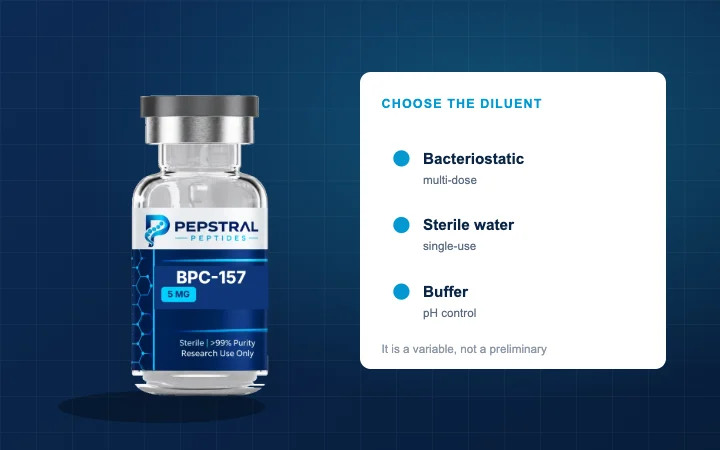
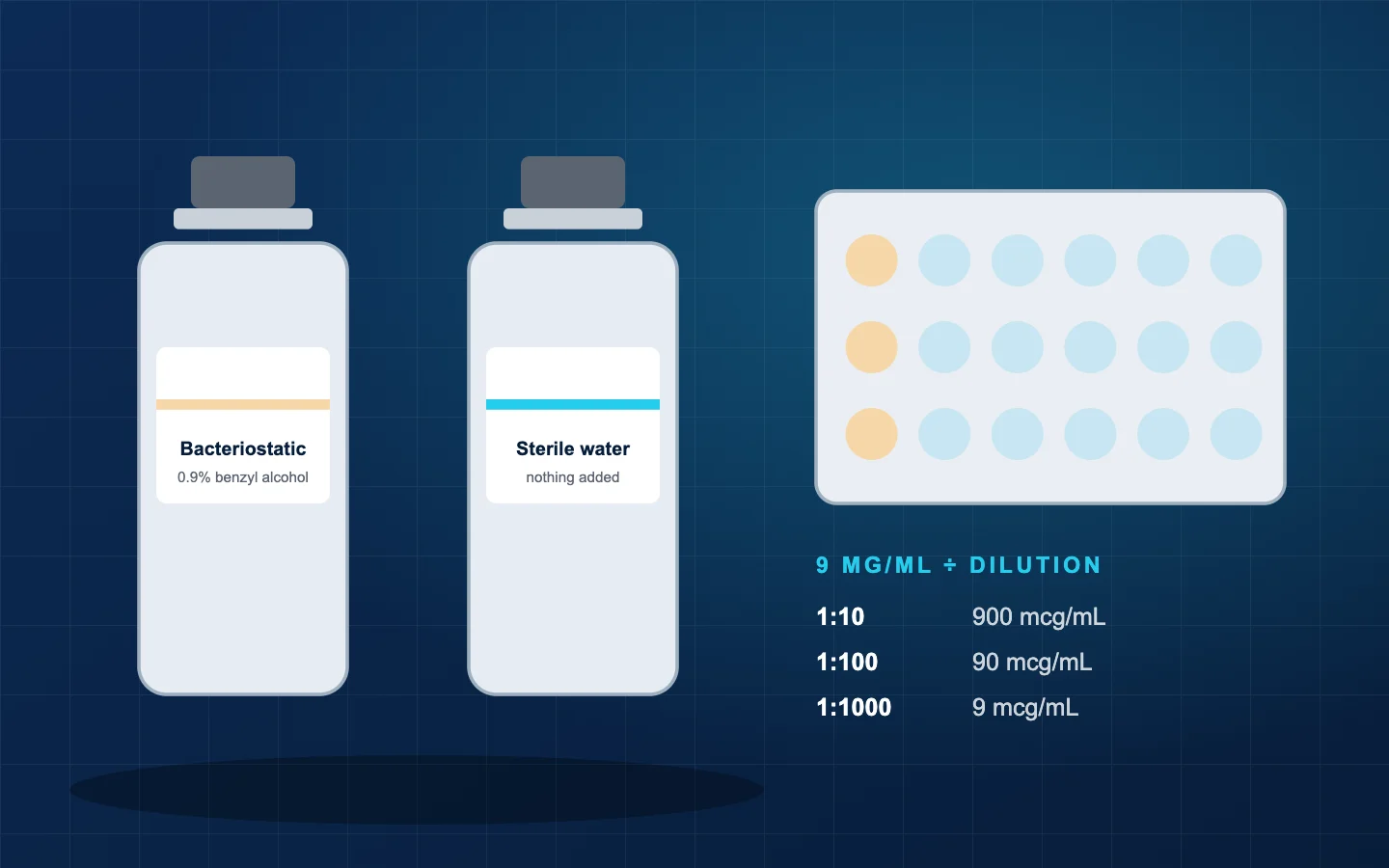
Bacteriostatic water is sterile water with 0.9% benzyl alcohol added as a preservative. The preservative is why a reconstituted vial can be drawn from over several weeks without growing bacteria, and it is why the reconstitution guide recommends bacteriostatic water for a vial that will be used more than once. It is also a compound that cultured cells respond to.
A peptide stock made in bacteriostatic water carries benzyl alcohol into every well it is added to, and whether that matters depends on the dilution and the cells. This post gives the arithmetic, the cases where it matters, and the two ways to handle it.
What is in bacteriostatic water?
Water for injection with 0.9% benzyl alcohol by volume, about 9 mg per millilitre, in a multi-dose vial. Benzyl alcohol is an aromatic alcohol that inhibits bacterial growth at that concentration and has been used as a parenteral preservative for decades. Sterile water for injection, by contrast, contains nothing but water and is intended for single use, because once opened it has no protection against contamination. The two look identical and are often stocked side by side, which is why the label matters.
Why does benzyl alcohol matter for cells?
Because a preservative that stops bacteria growing is not inert to mammalian cells. Chang and colleagues, studying the preservative in an ophthalmic formulation, found benzyl alcohol cytotoxic to cultured cells in vitro at concentrations comparable to those in preserved products. Messiha's earlier toxicology work in rats reached the same conclusion for parenteral use. The effect is concentration dependent, which is the point: at full strength it kills cells; diluted far enough it does nothing measurable; in between it can shift viability, proliferation or a stress readout by an amount that looks like a peptide effect.
How much reaches the culture?
Bacteriostatic water starts at 9 mg/mL benzyl alcohol. The stock you make from it has the same concentration, because the peptide adds almost no volume. From there the arithmetic is the dilution factor:
| Dilution of stock into medium | Benzyl alcohol in the well | As a percentage |
|---|---|---|
| 1:10 | 900 mcg/mL | 0.09% |
| 1:100 | 90 mcg/mL | 0.009% |
| 1:1000 | 9 mcg/mL | 0.0009% |
| 1:10,000 | 0.9 mcg/mL | 0.00009% |
A 1:10 dilution puts the preservative in the well at a tenth of its full formulation strength. A 1:1000 dilution takes it three orders of magnitude down. Whether a given level affects your cells is something only a vehicle control can answer, and the concentration table shows how the peptide concentration changes across the same dilutions, so the two can be planned together.
Which experiments are sensitive?
| Work | Sensitivity to benzyl alcohol | Reason |
|---|---|---|
| Proliferation and viability assays | High | The readout is the thing the preservative affects |
| Primary cells, stem cells, neurons | High | Less tolerant of solvent and preservative than established lines |
| Membrane, permeability and adhesion assays | Moderate to high | Benzyl alcohol interacts with membranes |
| Cytokine and stress-response assays | Moderate | Preservative stress can change the baseline |
| Receptor binding, enzyme kinetics | Low | No living cells, or short exposure |
| In vivo work | Handled separately | Vehicle composition is a design decision with its own literature |
Compounds studied in repair and migration assays, such as BPC-157, TB-500 and GHK-Cu, are exactly the ones whose readouts overlap with what a preservative can do.
A worked example
Take a BPC-157 5 mg vial reconstituted in 2 mL of bacteriostatic water, giving a 2.5 mg/mL peptide stock that also contains 9 mg/mL benzyl alcohol. Diluted 1:100 into a migration assay:
| Component in the well | Concentration | Source |
|---|---|---|
| BPC-157 | 25 mcg/mL (about 17.6 µM) | The peptide |
| Benzyl alcohol | 90 mcg/mL | The water |
The preservative outweighs the peptide in the well by more than three to one. At 1:1000 the peptide is 2.5 mcg/mL and the benzyl alcohol 9 mcg/mL, the same ratio. Dilution never changes the ratio; only the choice of water does. That is why, for a proliferation or migration readout, the question is not whether the benzyl alcohol is dilute but whether the vehicle control carries the same 90 mcg/mL.
What are the two ways to handle it?
Reconstitute without the preservative. For cell work, dissolve the peptide in sterile water for injection or directly in the assay buffer, pass the solution through a 0.22 micron filter into a sterile tube, aliquot, and freeze what you will not use that day. There is no preservative to control for, and the stability cost is small because each aliquot is opened once. The storage guide gives the window for a reconstituted, preservative-free solution.
Keep the preservative and control for it. If the stock must be bacteriostatic, for instance because it is shared with non-culture work, dilute it at least 1:1000 into the assay and include a vehicle control made from bacteriostatic water diluted identically, with no peptide. Any effect present in the vehicle control is the preservative's, not the peptide's. This is the minimum for any experiment where the stock will be diluted less than 1:1000.
Either approach is publishable. Failing to say which one you used is not, and the methods post covers what to write.
Does benzyl alcohol affect the peptide itself?
Not in the way that matters for stability. Benzyl alcohol does not hydrolyse peptide bonds or oxidise residues at 0.9%, and lipidated GLP-1 class peptides are routinely reconstituted in it. For those compounds the slow-dissolution post applies regardless of the water used. What benzyl alcohol does affect is what the peptide is added to.
Frequently asked questions
Can I sterile-filter bacteriostatic water to remove the benzyl alcohol?
No. Filtration removes particles and organisms, not dissolved molecules. Benzyl alcohol passes straight through a 0.22 micron filter. The only way to have no preservative in the stock is to start without it.
How long does an opened vial of bacteriostatic water last?
Multi-dose vial labels conventionally state a discard date some weeks after first puncture. Follow the label on the vial you have, and record the first-puncture date on it.
Is sterile water safe for a multi-use peptide vial?
It is safe for the peptide. It is not protected against contamination once opened, so a sterile-water stock should be aliquoted and frozen rather than drawn from over days. That is the trade: preservative and convenience, or no preservative and aliquots.
Does benzyl alcohol affect an endotoxin test?
Not the test itself, but the endotoxin arithmetic in the endotoxin post assumes the water is endotoxin-tested, which pharmaceutical-grade bacteriostatic and sterile water both are. Water from an uncertified source is a bigger endotoxin risk than the choice between the two.
References
- Chang YS, Wu CL, Tseng SH, et al. In vitro benzyl alcohol cytotoxicity: implications for intravitreal use of triamcinolone acetonide. Experimental Eye Research 2008;86(6):942-950. doi.org/10.1016/j.exer.2008.03.011
- Messiha FS. Benzyl alcohol adverse effects in the rat: implications for toxicity as a preservative in parenteral injectable solutions. Comparative Biochemistry and Physiology Part C 1991;99(3):445-449. doi.org/10.1016/0742-8413(91)90269-y
Every product mentioned is sold for laboratory research use only and is not for human or animal use. Nothing on this page describes or recommends use of the material sold here in humans or animals.