NAD+ is in this catalog because buyers ask for it alongside peptides, and it is the one compound here that is not a peptide. It is nicotinamide adenine dinucleotide, a 663.4 g/mol cofactor that dehydrogenases, sirtuins and PARP enzymes consume, and it is used in assays at concentrations a thousand times higher than a receptor ligand. Those two facts explain the 500 mg vial, the handling differences, and why its stability in solution is a question of buffer chemistry rather than of temperature alone.
This post covers what the current stability data show and how to keep a stock that still contains NAD+ when you use it.
Why is the vial 500 mg?
Because the working concentrations are millimolar. A receptor ligand is used at nanomolar to micromolar concentration, so a 5 mg vial of a peptide lasts through hundreds of experiments. An enzyme assay or a cell treatment with NAD+ commonly runs at 0.1 to 1 mM, which for a 663.4 g/mol molecule is 66 to 663 mg per litre of medium or buffer.
The concentration table shows the arithmetic: 500 mg in 5 mL is a 100 mg/mL stock, about 150 mM, which dilutes 1:150 to reach 1 mM. A 5 mg vial would make a single litre of working solution at the low end.
How stable is NAD+ in solution?
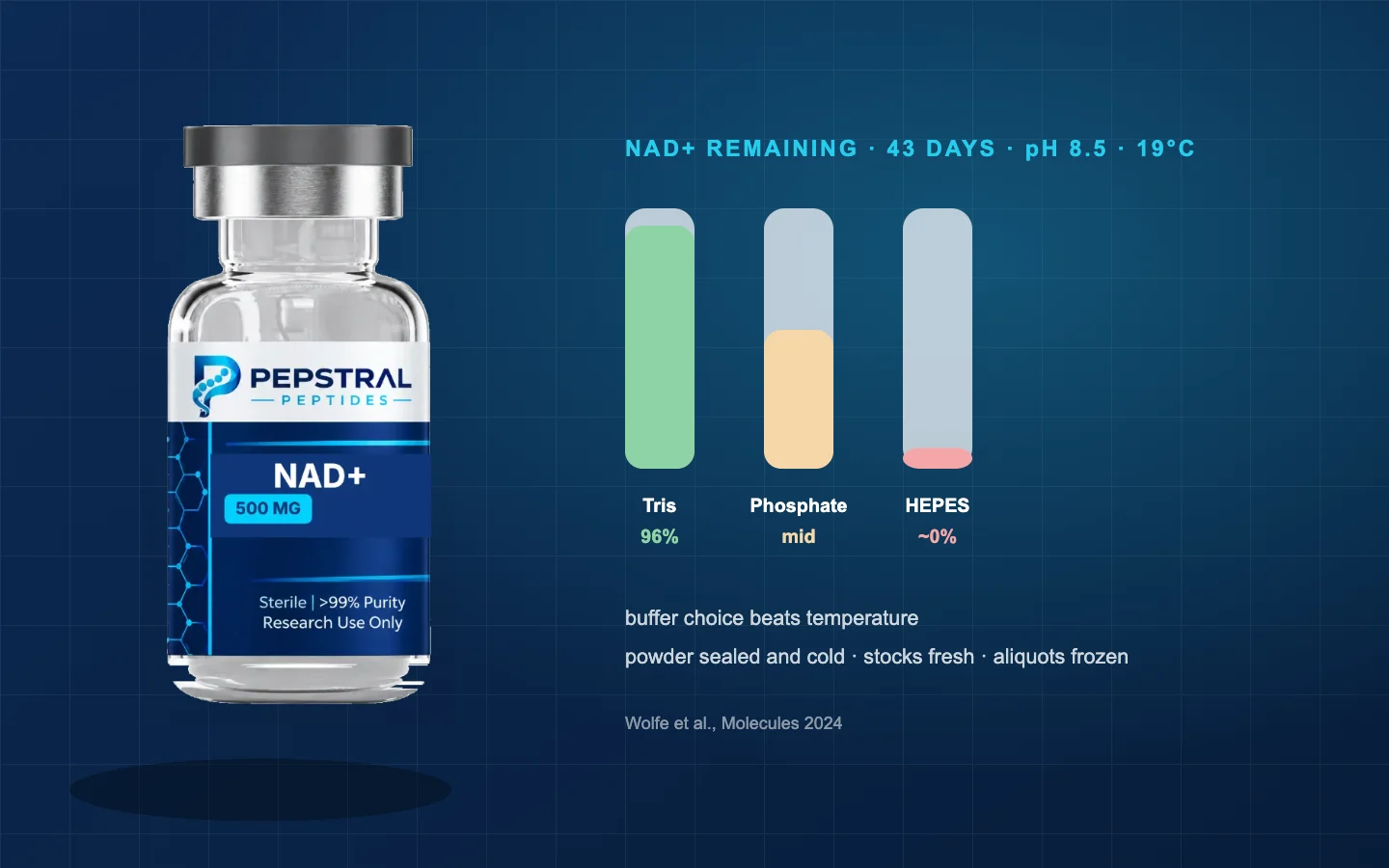
Less stable than its powder, and how much less depends on the buffer. Wolfe and colleagues measured the oxidised and reduced nicotinamide cofactors in common laboratory buffers over 43 days in 2024, with cell-free biocatalysis in mind. For NAD+ their findings were:
| Buffer | pH | Temperature | NAD+ remaining after 43 days |
|---|---|---|---|
| Tris | 8.5 | 19°C | About 96% (a 4% decrease) |
| Sodium phosphate | 8.5 | 19°C | Intermediate loss |
| HEPES | 8.5 | 19°C | Degraded nearly entirely |
The spread is the lesson. At the same pH and temperature, the choice of buffer moved the outcome from a few percent loss to almost total loss. Temperature mattered too, with faster degradation at 25°C than at 19°C, but the buffer effect was larger. The authors identified the likely degradation products as nicotinamide, ribose 5-phosphate, adenosine monophosphate and nicotinamide mononucleotide. None of them is the cofactor, so a solution that has degraded looks the same and does less.
NAD+ is also, as a general matter of its chemistry, more stable in mildly acidic solution than in alkaline solution, the reverse of its reduced form NADH. A stock made in water, which sits slightly acidic, is on the right side of that line; a stock made in an alkaline assay buffer is not, and should be made fresh.
How should the powder be stored?
Sealed, dry and cold. NAD+ powder is hygroscopic and takes up water from the air, which both starts hydrolysis and makes the weight unreliable. The storage guide conventions apply: -20°C in the original sealed vial, and let the vial reach room temperature before opening so that moisture does not condense on cold powder. The vial appearance post covers what condensation and moisture uptake look like; for NAD+ the sign is clumping or a gummy texture instead of a free-flowing powder.
How do you make and keep a stock?
- Weigh or use the whole vial. A 500 mg vial dissolved in 5 mL of water gives a 100 mg/mL stock. Weighing out smaller amounts is possible but exposes the rest of the powder to air each time; using the whole vial and aliquoting the solution is cleaner.
- Dissolve in water, not in alkaline buffer. Add the buffer at the working dilution, on the day, so the cofactor spends its storage time in the more stable condition.
- Aliquot and freeze. Single-use volumes at -20°C or below. Wolfe's data are for room temperature; freezing slows every pathway further and avoids repeated warming.
- Thaw once, use once. Discard the remainder of a thawed aliquot rather than refreezing.
- Record the date on every aliquot. A stock more than a few weeks old, even frozen, is worth checking by absorbance at 260 nm against a fresh one before a critical experiment.
How do milligrams, millimolar and vials convert?
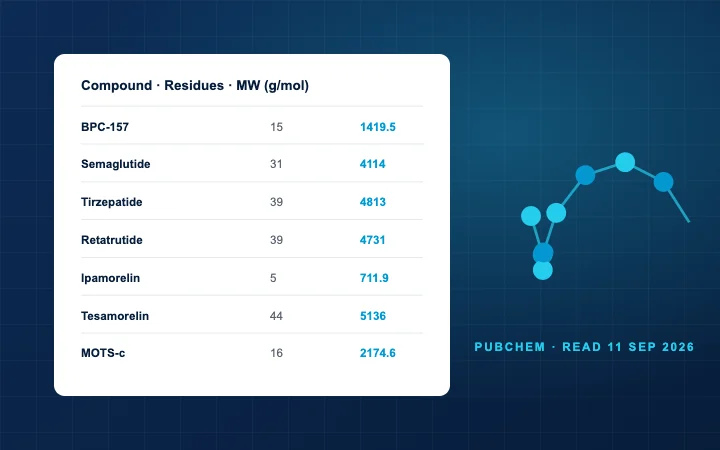
Because NAD+ is used at concentrations a thousand times higher than a peptide ligand, the arithmetic is worth having in one place. All figures use 663.4 g/mol.
| Working concentration | NAD+ per litre | NAD+ per 100 mL | Volume of a 100 mg/mL stock per 100 mL | Litres of working solution from one 500 mg vial |
|---|---|---|---|---|
| 0.1 mM | 66 mg | 6.6 mg | 66 microlitres | 7.5 L |
| 0.5 mM | 332 mg | 33 mg | 332 microlitres | 1.5 L |
| 1 mM | 663 mg | 66 mg | 663 microlitres | 0.75 L |
| 5 mM | 3.3 g | 332 mg | 3.3 mL | 0.15 L |
The last column is why a 5 mg vial would be impractical: at 1 mM it makes 7.5 mL of working solution. A 500 mg vial makes 750 mL, which is a sensible amount for a series of experiments, and the stock volumes in the fourth column are pipettable with ordinary equipment.
How do you know a stock has degraded?
Two practical checks. Absorbance at 260 nm, where the adenine ring absorbs, falls as the molecule breaks down; Wolfe and colleagues used the same measurement. And an enzyme assay with a known dehydrogenase gives a lower rate with a degraded stock than with a fresh one. If a set of experiments shows drifting NAD+-dependent activity over weeks, the stock is the first suspect.
What does the certificate show for NAD+?
The same lines as a peptide, with the identity line being an observed mass of about 663 rather than a peptide mass, and purity by HPLC. Because NAD+ is a small molecule, net content is closer to gross weight than for a basic peptide, but water content matters because the powder is hygroscopic; a certificate that reports water content or loss on drying is the one to prefer. The certificate guide applies.
Frequently asked questions
Should NAD+ powder be refrigerated or frozen?
Frozen, sealed, with desiccant if the carton provides it. Refrigeration is acceptable for short periods; the risk in either case is moisture on opening, which is avoided by warming the sealed vial first.
How long does NAD+ last after reconstitution?
In water at 2 to 8°C, days to a week or two is a reasonable working assumption; frozen aliquots last longer. In an alkaline buffer at room temperature, the Wolfe data say it depends entirely on which buffer, from weeks in Tris to days in HEPES. Make it fresh when it matters.
Does NAD+ degrade in the freezer?
Slowly. The pathways that break it down in solution still run, but far more slowly at -20°C and slower again at -80°C. Repeated freeze-thaw is worse than continuous cold, which is why aliquots are single use.
Is NAD+ related to MOTS-c?
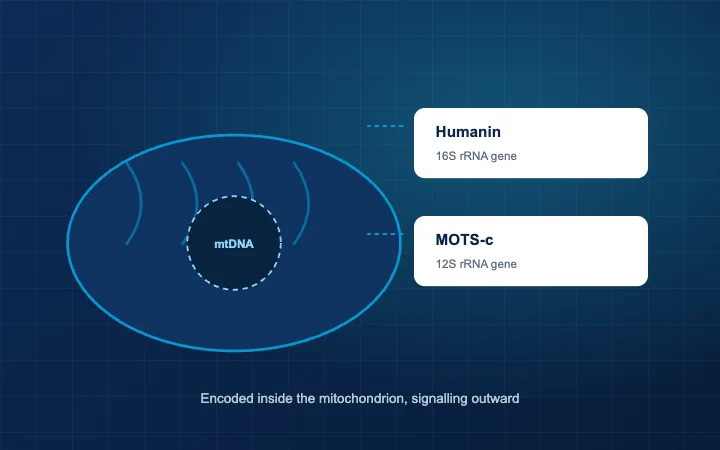
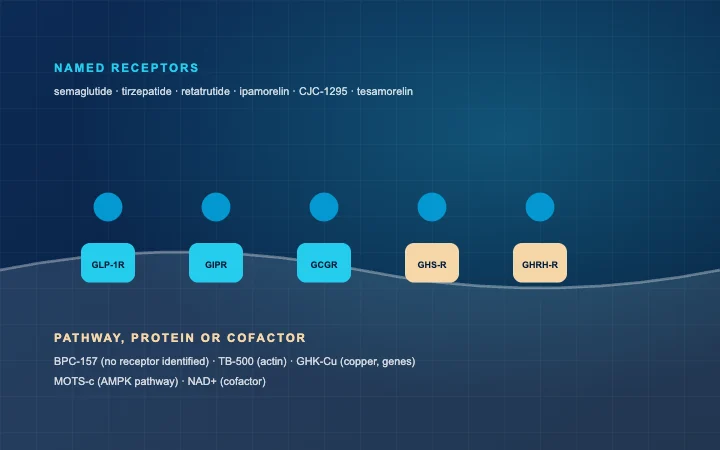
Only by the shelf they share. MOTS-c is a mitochondrial-derived peptide that signals through a metabolic pathway; NAD+ is the cofactor many of the enzymes in that pathway use. The receptor and target table places both.
References
- Wolfe KD, Alahuhta M, Himmel ME, et al. Long-Term Stability of Nicotinamide Cofactors in Common Aqueous Buffers: Implications for Cell-Free Biocatalysis. Molecules 2024;29(22):5453. doi.org/10.3390/molecules29225453
- PubChem, National Library of Medicine. NAD+, CID 5892, C21H27N7O14P2, 663.4 g/mol. Read 11 September 2026. pubchem.ncbi.nlm.nih.gov/compound/5892
Every product mentioned is sold for laboratory research use only and is not for human or animal use. Nothing on this page describes or recommends use of the material sold here in humans or animals.