How to reconstitute a lyophilized peptide
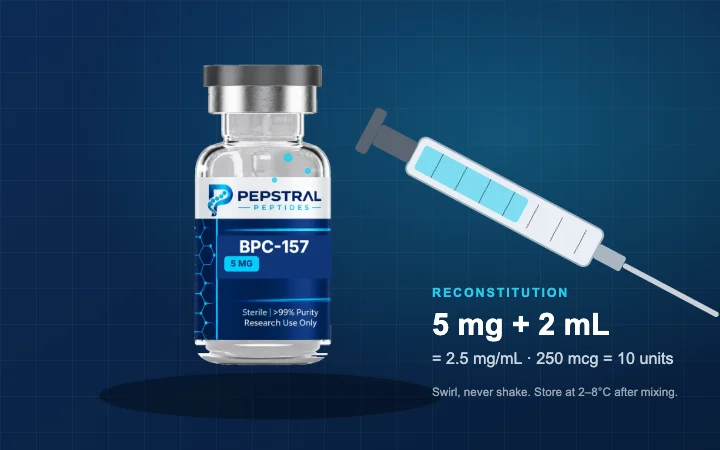
Add bacteriostatic water slowly down the inside wall of the vial, swirl until the powder dissolves, and store the solution at 2 to 8°C. Concentration is the peptide mass divided by the water volume: 5 mg in 2 mL is 2.5 mg/mL, so a 250 mcg draw is 10 units on a U-100 syringe.
Which water should you use?
Bacteriostatic water is sterile water with 0.9% benzyl alcohol added as a preservative. It is the standard choice when a reconstituted vial will be drawn from more than once, because the preservative limits microbial growth over the storage window on the certificate. Sterile water without preservative is appropriate for single-use preparations that will be consumed in one session. Do not use tap, distilled or deionised water from a bench supply: none are sterile, and the pH and mineral content are uncontrolled.
How much water do you add?
The volume sets the concentration, and the concentration sets how many syringe units a given draw takes. Larger volumes give smaller, easier-to-measure concentrations but fill the vial faster. The table gives common pairings; for any other pairing, divide milligrams by millilitres.
| Vial | Water added | Concentration | 250 mcg draw |
|---|---|---|---|
| 5 mg | 1 mL | 5 mg/mL | 5 units |
| 5 mg | 2 mL | 2.5 mg/mL | 10 units |
| 10 mg | 2 mL | 5 mg/mL | 5 units |
| 10 mg | 3 mL | 3.33 mg/mL | 7.5 units |
| 50 mg (GHK-Cu) | 5 mL | 10 mg/mL | 2.5 units |
What are the steps?
- Let the sealed vial stand at room temperature for 10 to 15 minutes so condensation does not form inside the cap when it is opened.
- Wipe the rubber stopper and the water vial with an alcohol swab and let both dry.
- Draw the chosen volume of bacteriostatic water into a sterile syringe.
- Insert the needle through the stopper at an angle and release the water slowly against the inside wall of the vial, not onto the powder.
- Swirl the vial gently or roll it between the palms until the solution is clear. Never shake; shearing denatures peptides.
- Label the vial with the date, the concentration and the lot number, then refrigerate at 2 to 8°C.
How do you convert a draw into syringe units?
A U-100 insulin syringe holds 100 units per millilitre, so one unit is 0.01 mL. Divide the draw in milligrams by the concentration in mg/mL to get millilitres, then multiply by 100. For a 250 mcg draw from a 2.5 mg/mL solution: 0.25 ÷ 2.5 = 0.1 mL, which is 10 units. Work in the same mass unit throughout; mixing micrograms and milligrams is the most common arithmetic error.
What goes wrong most often?
- Shaking the vial. Foam and cloudiness are the visible signs; the invisible one is lost activity.
- Warm water. Room-temperature water is correct. Heated water accelerates hydrolysis.
- Water sprayed onto the cake. The jet breaks the lyophilized structure and traps undissolved powder. Run it down the wall.
- Freezing the solution. Reconstituted peptides are refrigerated, not frozen. Freeze-thaw cycles cause aggregation.
- Unlabelled vials. Two clear solutions look identical. Date, concentration and lot number go on every vial.
Frequently asked questions
Can sterile water be used instead of bacteriostatic water?
Yes for single-use preparations. Sterile water has no preservative, so a vial opened with it should be used the same day rather than stored for the 28-day window.
Why does the solution look cloudy?
Cloudiness after gentle swirling usually means aggregation from shaking, warm water, or water sprayed directly onto the cake. A cloudy vial should not be used.
Does the vial need to reach room temperature first?
Yes. Let a vial taken from the freezer stand for 10 to 15 minutes before opening so condensation does not form inside the cap.
For laboratory research use only. Nothing on this page describes use in humans or animals.