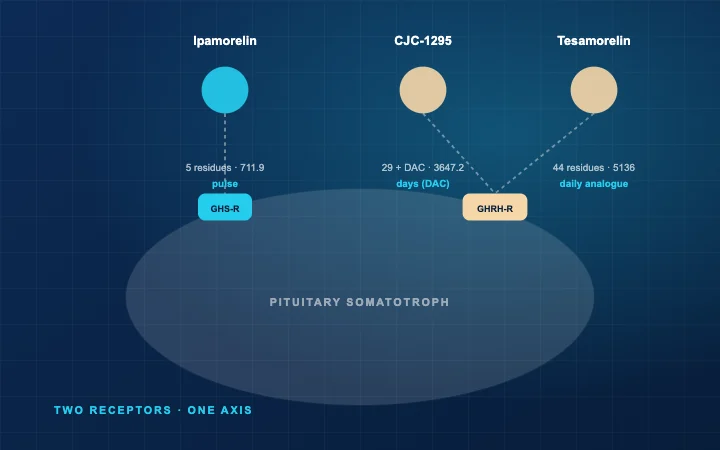
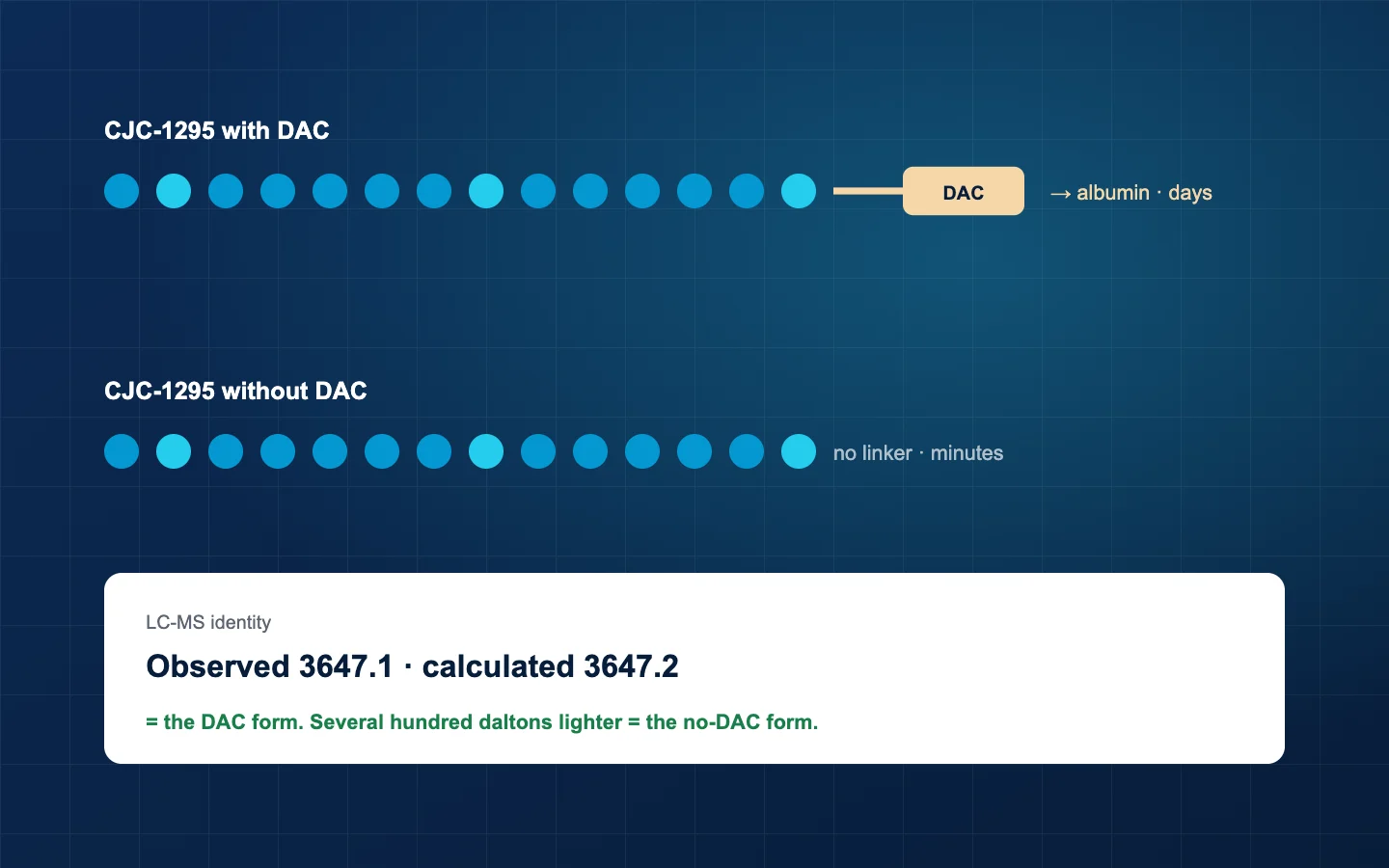
Two different molecules are sold under the name CJC-1295. Both are analogues of the first 29 residues of growth hormone releasing hormone, with four substitutions that protect the chain from enzymatic breakdown. One of them also carries a Drug Affinity Complex, a reactive group on the end of the chain that binds the peptide covalently to albumin in circulation, so that it acts for days. The other has no such group and acts for minutes, like the native hormone.
Suppliers, labels and forum posts use "CJC-1295" for both, which is why the certificate, not the name, has to settle which one is in the vial.
What does DAC mean?
Drug Affinity Complex is the name given to a linker, a maleimidopropionic acid on a lysine at the end of the peptide, that reacts with a free thiol on serum albumin to form a covalent bond. Once bound, the peptide travels with albumin and is protected from clearance. Teichman and colleagues reported in 2006 that a single dose of the DAC form in healthy adults produced sustained increases in growth hormone and IGF-1 lasting days, and Ionescu and Frohman reported the same year that the normal pulsatile pattern of growth hormone secretion persisted during that sustained stimulation. Both papers describe the DAC form under the name CJC-1295.
The form without DAC is the same 29-residue backbone with the same four protective substitutions and no linker. It is often sold as "CJC-1295 no DAC" or "modified GRF (1-29)". Without the albumin bond it behaves like the parent hormone: a short pulse of stimulation, then rapid clearance.
How do the two compare?
| Feature | CJC-1295 with DAC | CJC-1295 without DAC (modified GRF 1-29) |
|---|---|---|
| Backbone | 29-residue GRF analogue, four substitutions | Same |
| Linker | Maleimidopropionyl group on a terminal lysine | None |
| Binds albumin | Covalently | No |
| Duration of action in the literature | Days after a single dose (Teichman 2006) | Minutes, as for native GRF |
| Pattern of stimulation | Sustained baseline with pulses preserved (Ionescu 2006) | Pulsatile, one pulse per dose |
| Molecular weight | 3647.2 g/mol (PubChem CID 91971820) | Lighter, by the mass of the linker; see the note below |
| Typical study role | Sustained exposure models | Pulsatile stimulation models, often paired with a secretagogue |
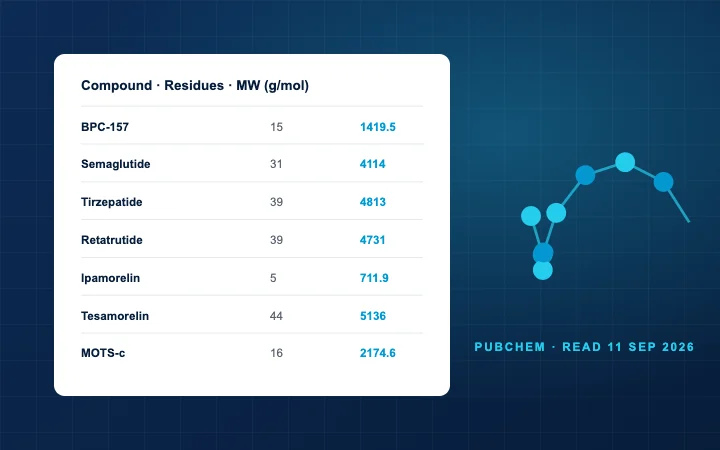
For comparison, the unmodified 29-residue parent sequence, sermorelin, is 3357.9 g/mol in PubChem. The no-DAC CJC-1295 sits close to that figure, with the four substitutions accounting for a small difference, and the DAC form sits about 290 daltons above sermorelin, most of that being the linker. The precise no-DAC figure is left to the reviewer to add from a verified record, because no PubChem entry answers to that name.
How does the certificate tell them apart?
The LC-MS identity line. The reference table gives the DAC form's calculated mass as 3647.2; an observed mass close to that is the DAC form. An observed mass close to the sermorelin figure, several hundred daltons lighter, is the no-DAC form. A certificate that gives only a purity percentage cannot distinguish them, which is one of the clearest cases for insisting on the identity line before ordering, as the vetting checklist recommends.
Two other clues help. A DAC-form certificate often reports the linker's reactive group or a note about albumin conjugation. And the product name on a careful supplier's page says which form it is. A page that says only "CJC-1295" is a page to ask about.
Which form does the design call for?
The two forms answer different questions, and the choice is a design decision rather than a preference.
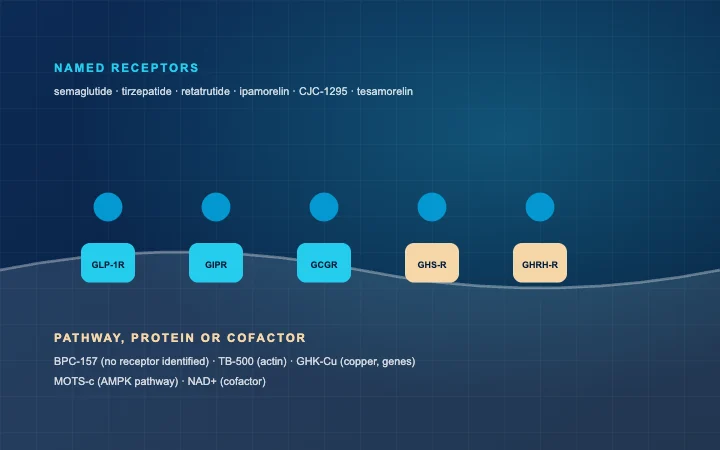
- Pulsatile stimulation. The no-DAC form produces a short pulse, which is why it is commonly paired with a growth hormone secretagogue such as ipamorelin: the GRF analogue and the secretagogue act on different receptors in the same axis, and a pulse from each can be timed together. The CJC-1295 + Ipamorelin blend is built for that pairing, and its certificate states which CJC form it contains.
- Sustained exposure. The DAC form gives a raised baseline for days, which suits models of continuous stimulation and is harder to time against a secretagogue pulse.
- A different long-acting analogue. Tesamorelin is a 44-residue GRF analogue with a different stabilising modification and its own literature, and is the third option in this catalog for the same axis. The tesamorelin research guide covers it.
Whichever form a study uses, it should be named in full in the methods, with the lot and the observed mass, so that a reader knows which molecule was in the vial. The blends post covers writing up a combination.
What goes wrong when the forms are confused?
A study designed for pulsatile stimulation that receives the DAC form gets a sustained baseline instead, and the timing against the secretagogue is lost. A study designed for sustained exposure that receives the no-DAC form gets a series of short pulses and a baseline that returns to normal between them. In both cases the result looks like a failed or odd response from the compound, when the compound was simply the other one. Reading the identity line before the first experiment prevents it.
Frequently asked questions
Is "modified GRF (1-29)" the same as CJC-1295 without DAC?
Yes, in the usage of most suppliers. Both names refer to the 29-residue GRF analogue with the four protective substitutions and no linker. Check the certificate mass regardless of the name.
Does the DAC form need different storage?
Both are lyophilized peptides and follow the storage guide windows for their class. The DAC form's reactive linker is a reason to keep the reconstituted solution cold and to use it within its window, since the maleimide group can react with thiols in solution over time.
Can the two forms be told apart on HPLC alone?
They elute at different retention times, so a laboratory with a reference for each could distinguish them. Without a reference, the mass spectrum is the unambiguous test.
Why do some suppliers not say which form they sell?
Because the name is used loosely and many buyers do not ask. A supplier who states the form, the mass and the lot certificate is answering the question before it is asked, which is the behaviour the pricing post and the vetting checklist both reward.
References
- Teichman SL, Neale A, Lawrence B, et al. Prolonged stimulation of growth hormone (GH) and insulin-like growth factor I secretion by CJC-1295, a long-acting analog of GH-releasing hormone, in healthy adults. Journal of Clinical Endocrinology and Metabolism 2006;91(3):799-805. doi.org/10.1210/jc.2005-1536
- Ionescu M, Frohman LA. Pulsatile secretion of growth hormone (GH) persists during continuous stimulation by CJC-1295, a long-acting GH-releasing hormone analog. Journal of Clinical Endocrinology and Metabolism 2006;91(12):4792-4797. doi.org/10.1210/jc.2006-1702
- PubChem, National Library of Medicine. CJC-1295 (DAC form), CID 91971820, C165H269N47O46, 3647.2 g/mol; sermorelin (GRF 1-29), CID 16132413, 3357.9 g/mol. Read 11 September 2026. pubchem.ncbi.nlm.nih.gov/compound/91971820
Every product mentioned is sold for laboratory research use only and is not for human or animal use. Nothing on this page describes or recommends use of the material sold here in humans or animals.