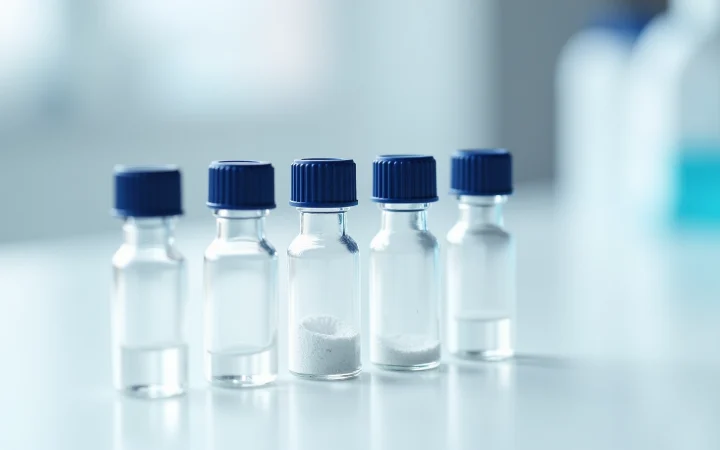

Pinealon is three amino acids long: glutamic acid, aspartic acid, arginine, written Glu-Asp-Arg or EDR. That is the whole molecule. It has a formula of C15H26N6O8, a mass of 418.4, and a PubChem entry, CID 10273502, under CAS 175175-23-2. It is sold here as a 20 mg lyophilized vial with a certificate of analysis for the lot, and this post is the long version of what that certificate says, what the molecule is, and what the literature on it does and does not contain.
It belongs to the family of short synthetic peptides that came out of the St Petersburg bioregulator programme, which the Khavinson series comparison sets side by side in one table. This page is the deep version for one of them.
What is the sequence, and why does it look like that?
Glu-Asp-Arg. Two acidic residues followed by a basic one. At neutral pH the two side-chain carboxyls and the C-terminal carboxyl carry negative charges, the arginine guanidinium and the N-terminal amine carry positive ones, and the molecule is a small zwitterion with a net charge near minus one. That charge pattern is why it dissolves instantly in water and why it has no chromophore to speak of beyond the peptide bonds themselves, which matters for how its purity is measured.
The sequence was not found in a natural protein. The Khavinson group's method, described across their reviews, was to take an organ extract, in this case a pineal polypeptide preparation, and design very short peptides that reproduced the amino-acid composition of the extract's active fractions. Pinealon is one result of that design process, as is epithalon, the tetrapeptide from the same pineal programme. The pinealon versus epithalon post compares the two directly.
What does the certificate for lot PINE20-0803 report?
Every vial of pinealon on sale carries lot PINE20-0803, and the certificate for that lot is COA7610, issued by Bioviridian Inc. on 17 August 2026. It reports five tests.
| Test | Method | Result | What it establishes |
|---|---|---|---|
| Identity | LC-MS/MS | 418.4 observed | The molecule in the vial has the mass Glu-Asp-Arg should have |
| Purity | RP-HPLC, 214 nm | 99.68% | 99.68% of the UV-absorbing material is the main peak |
| Content | Gravimetric against label | 20.80 mg | The vial holds slightly more than the 20 mg on the label |
| Endotoxin | LAL | < 0.05 EU/mL | Below the assay's reporting limit at the dilution tested |
| Heavy metals | ICP | < 0.01 ppm | Below the reporting limit |
The identity line is the one to read first. The formula C15H26N6O8 predicts an average mass of 418.40. The certificate observed 418.4. For a tripeptide that match is close to a fingerprint: there are very few other combinations of three common residues with that exact mass, and none of them are things a synthesis of EDR would produce by accident.
The purity figure is by area at 214 nm, where the peptide bond absorbs. The HPLC area-percent post explains why that is a ratio of peak areas rather than a weight, and the net content post explains why 99.68% purity and 20.80 mg content are two different measurements of two different things. Both are consistent here: a high-purity lot that was filled a little over label.
The certificate can be checked against the laboratory's own copy using the code printed on it, at the verification page linked from every certificate in the COA library.
How many molecules are in a 20 mg vial?
Divide the content by the mass. 20.80 mg at 418.4 g/mol is 49.7 micromoles; the label's 20 mg is 47.8. Dissolved in 1 mL that is a 47.8 millimolar stock, which is far more concentrated than most assays use and the reason the concentration table treats the bioregulator vials separately.
That is also the answer to why these vials are 20 mg when BPC-157 is 5 or 10. Molar amount, not mass, is what an experiment consumes. A 5 mg vial of a 1,400-dalton peptide is 3.6 micromoles. A 20 mg vial of a 418-dalton tripeptide is thirteen times that, for a compound whose published in-vitro concentrations are in the same range. The molarity post has the arithmetic for every vial in the catalogue.
What has actually been published?
Less than the name suggests, and nearly all of it from one group. The Khavinson laboratory reported, in Rejuvenation Research in 2011, that pinealon increased viability and reduced measured free-radical levels in cultured cells, and described proliferative effects in the same system. The group's reviews, including Anisimov and Khavinson's 2010 account of the programme in Biogerontology, place pinealon among the pineal-derived short peptides and summarise rodent work on it.
Three things about that literature are worth stating plainly, because the product pages of other suppliers tend not to.
- It is in cells and rodents. The pinealon papers report what happened in culture and in animals. There is no controlled human trial of pinealon, and a search of ClinicalTrials.gov on 2 October 2026 found no registered study.
- It is largely from one laboratory. Independent replication of the Khavinson results is sparse. The bioregulator evidence post goes through what that means for a study design.
- The proposed mechanism is unusual. The group proposes that these short peptides interact with DNA directly and alter gene expression. That is a model, argued in their papers; it is not an established receptor pharmacology, and a tripeptide has no identified receptor.
None of that makes pinealon uninteresting as a research reagent. It makes it a reagent whose literature a researcher should read before designing around it, which is what the research guide page is for.
How is a tripeptide handled?
More easily than almost anything else in the catalogue.
- Solubility. Water, instantly. Pinealon has three carboxyl groups and a guanidinium. It will not need organic co-solvent, sonication or warming.
- Stability in solution. Short peptides with no cysteine, methionine, tryptophan or asparagine-glycine motif have few of the usual degradation routes. The reconstituted shelf-life post explains which sequences degrade fast and why this one does not. Aspartic acid can undergo slow isomerisation at acidic pH, so hold stocks near neutral.
- Storage. Lyophilized at minus 20 °C. In solution, aliquot and freeze; avoid repeated freeze-thaw as a matter of habit even though a tripeptide tolerates it better than a protein would.
- Adsorption. Small charged peptides stick to plastic less than hydrophobic ones do, but at the nanomolar end use low-binding tubes anyway. The adsorption post explains the mechanism.
- Diluent. For most in-vitro work, sterile water or the assay's own buffer. Reconstitution solution is for multi-entry vials where a preservative is wanted; the diluent post sets out when it is and is not appropriate.
What does it cost, and what does that buy?
At the time of writing the 20 mg vial is listed at $60, which is $3.00 per milligram, or about $1.25 per micromole. Vials of 5 mg peptides in the same catalogue run from $8 to $30 per milligram. The per-milligram comparison is misleading for a tripeptide, for the molar reason above; the vial-size post explains how to compare across sizes properly. What the price buys is the certificate: a lot tested for identity, purity, content, endotoxin and heavy metals before it was listed.
Frequently asked questions
Is pinealon the same as epithalon?
No. Pinealon is Glu-Asp-Arg, three residues, mass 418.4. Epithalon is Ala-Glu-Asp-Gly, four residues, mass 390.3. They come from the same pineal-peptide programme and share the Glu-Asp pair, and that is where the similarity ends. The comparison post sets them side by side.
Does the certificate give a sequence?
It gives an observed mass by LC-MS/MS, 418.4, which matches the formula for Glu-Asp-Arg. Tandem MS fragments the ion and the fragment pattern is sequence-dependent, so an LC-MS/MS identity is stronger than a single mass. The certificate reports the mass; the LC-MS post explains what the method can and cannot settle.
Why is content 20.80 mg when the label says 20 mg?
Because fills are set to meet or exceed the label, and the certificate reports the measured value rather than the nominal one. Four percent over is ordinary. Use the measured figure in your arithmetic, as the lot-to-lot post recommends.
Is there a human trial of pinealon?
Not a registered one. The published work is in cells and rodents and comes mainly from the Khavinson group. Anything that describes pinealon's effect in people is describing something the literature does not contain.
What is pinealon sold for?
Laboratory research. Every product on this site is for in-vitro research use only and is not for human or animal use; the research-use post explains what that designation means and why it is not boilerplate.
References
- PubChem, National Library of Medicine. Pinealon, CID 10273502, C15H26N6O8, 418.4 g/mol, CAS 175175-23-2. Read 2 October 2026. pubchem.ncbi.nlm.nih.gov/compound/10273502
- Khavinson V, Ribakova Y, Kulebiakin K, et al. Pinealon increases cell viability by suppression of free radical levels and activating proliferative processes. Rejuvenation Research 2011;14(5):535-541. doi.org/10.1089/rej.2011.1172
- Anisimov VN, Khavinson VK. Peptide bioregulation of aging: results and prospects. Biogerontology 2010;11(2):139-149. doi.org/10.1007/s10522-009-9249-8
- Bioviridian Inc. Certificate of analysis COA7610, lot PINE20-0803, issued 17 August 2026. Verification code on the certificate. bioviridians.com/coa-search.html
Every product mentioned is sold for laboratory research use only and is not for human or animal use. Nothing on this page describes or recommends use of the material sold here in humans or animals.