
Order the same compound twice and the two certificates will not match. Purity will differ in the second decimal, content will differ by a few per cent, retention time may differ by minutes, and a field filled in on one may be blank on the other. Almost none of that means anything has gone wrong — but you cannot tell which part does without knowing what a certificate is actually claiming.
This post separates two things: what genuinely varies between lots of the same peptide, and what varies because the reporting changed rather than the material. Every figure below is read from our own certificate library on 29 September 2026 — 114 certificates across 47 compounds, from one laboratory.
A specification is a range, not a number
Start here, because most confusion about lot variation is really confusion about this.
ICH Q6A, the guideline that governs how specifications are set, defines a specification as a list of tests, references to analytical procedures, and appropriate acceptance criteria — and it describes those acceptance criteria as numerical limits, ranges, or other criteria. A specification is the boundary the material has to fall inside. A certificate is a measurement of where inside it one particular lot landed.
So "≥99% purity" is not a promise that every lot reports 99.0%. It is a floor. A lot at 99.2% and a lot at 99.9% are both in specification, both correctly described by the same claim, and genuinely different materials.
Across the whole library the observed purity runs from 99.55% — certificate COA7588, the 1 mg IGF-1 LR3 lot — to 99.9%. That is the real spread sitting behind a single site-wide purity claim, and it is why our post on whether 98% purity is good enough argues for reading the lot figure rather than the badge.
Q6A also states that it does not apply to the regulation of preclinical or clinical research material, so the framework that would compel a tight specification sits outside research-grade supply entirely. Niu and Chiu's FDA-perspective paper makes the same point from the other direction: quality is established for a specific product by specific methods, not inherited from a class. The certificate in front of you is the evidence, and a sibling lot's certificate is not evidence about it.
What genuinely varies between two lots
Four things, in rough order of how much they move.
Content. This is the largest real variation and the one that most affects an experiment. Three 10 mg tesamorelin lots report 10.18 mg (COA7630), 10.66 mg (COA4849) and 11.71 mg (COA3376) — a spread of about 15% between the extremes. The 5 mg BPC-157 lots report 5.33 mg (COA7609) and 6.42 mg (COA3402). And it is not always an overage: the 20 mg Pinealon lot on COA3386 reports 19.12 mg, below the labelled amount. The label is a fill target, not a measurement, which is the argument our net peptide content post makes in full.
Purity, within the band. Three current BPC-157 lots, analysed on the same date by the same method, report 99.71% (COA7603), 99.73% (COA7609) and 99.84% (COA7581). Across dates the movement is larger and not directional: TB-500 reports 99.8% on COA3404 and 99.68% on COA7595; Selank runs 99.6% (COA3382), 99.8% (COA4847), 99.83% (COA7627). A synthesis and purification run is a process with variance in it, and Jones's account of solid-phase synthesis explains why — the yield of correct chains depends on how completely each coupling step went, and that is not identical between runs.
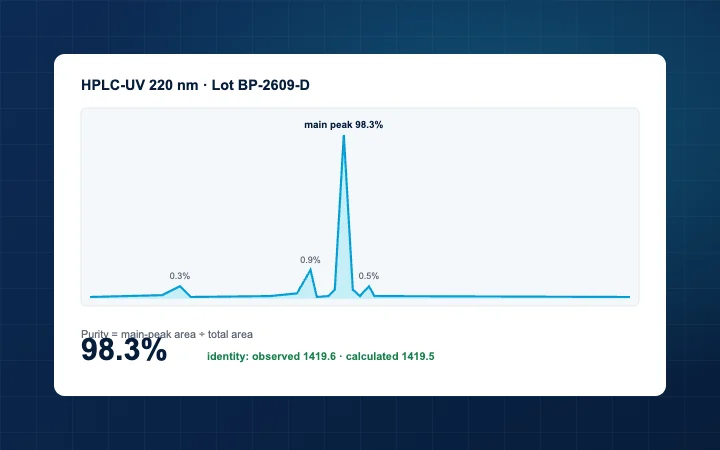
The impurity profile. Two lots at the same purity figure can carry a different mix of deletion sequences, truncations and oxidised forms, because the total is one number and the profile is many. This is the variation a percentage cannot show, and it is the one most likely to matter in an assay, since a deletion sequence may still bind a receptor. What is in the other 1% covers the species involved; the chromatogram is what actually shows the difference.
Non-peptide mass. Counter-ion content and residual water vary with the purification run and the drying, and they are a real share of what you weigh out. Neither is measured on these certificates at all, which is the subject of what a certificate does not test for.
Two lots, line by line
Four compounds where the library holds more than one lot, read on 29 September 2026:
| Compound | Earlier certificate | Later certificate | What moved |
|---|---|---|---|
| BPC-157, 10 mg | COA3400 · 99.8% · 10.02 mg · MW 1419.2 · RT 5.975 | COA7603 · 99.71% · 10.44 mg · MW 1419.5 · RT 9.196 | Purity down 0.09, content up 4%, retention time up 3.2 min |
| TB-500, 10 mg | COA3404 · 99.8% · 12.12 mg · RT 5.767 | COA7595 · 99.68% · 10.23 mg · RT 9.122 | Content down 16%, retention time up 3.4 min |
| Tesamorelin, 10 mg | COA3376 · 99.8% · 11.71 mg · MW 5135.3 | COA7630 · 99.79% · 10.18 mg · MW 5135.9 | Content down 13%, printed mass up 0.6 |
| Selank, 10 mg | COA3382 · 99.6% · 10.72 mg · RT 2.492 | COA7627 · 99.83% · 10.93 mg · RT 2.291 | Purity up 0.23, retention time down 0.2 min |
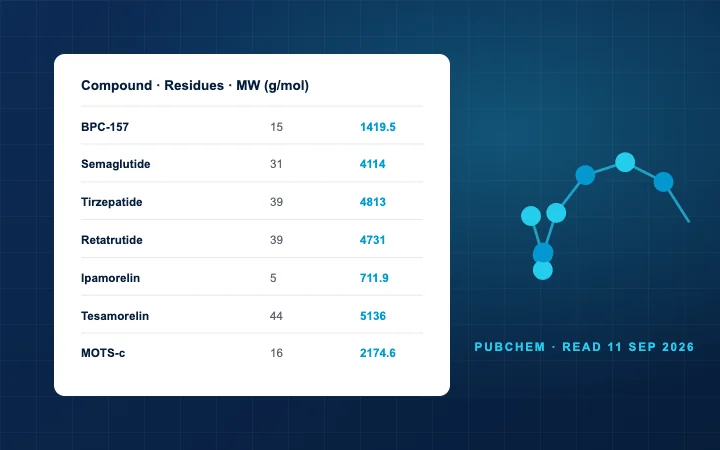
Note the printed molecular weight moving between lots — 1419.2 to 1419.5 for BPC-157, 5135.3 to 5135.9 for tesamorelin. The molecule did not change. That is a rounding convention, and the reference table carries the PubChem values to compare against.
What changed that is not the material
This is the part that trips people up, because it looks like lot variation and is not.
The identity method changed. All 60 certificates issued in April and June 2026 confirm identity by MALDI-MS. All 54 issued on 17 August 2026 use LC-MS/MS. Both are mass methods and both answer the identity question, but they are not the same measurement, and a difference between an April certificate and an August one is partly a difference in instrument. What LC-MS confirms covers what each establishes.
The purity precision changed. Sixty certificates quote purity to one decimal place; 54 quote two. The two-decimal ones are the August set. Worth noticing: 38 of the 114 report exactly 99.9% — the top of a one-decimal scale. A figure reported as 99.9% and a figure reported as 99.85% may describe closer materials than the numerals suggest, because the first has been rounded and the second has not. Comparing 99.9% against 99.84% as though it were a 0.06-point difference reads more into the number than the number contains.
Retention time moved, with the method string unchanged. Every certificate in the library prints the same purity method: RP-HPLC at 214 nm. Yet BPC-157 eluted at 5.975 minutes on COA3400 and 9.196 minutes on COA7603; TB-500 at 5.767 and 9.122; thymosin alpha-1 at 6.033 and 9.310. A three-minute shift is a different gradient, column or system — not a different compound. The certificates do not print the gradient, so retention time cannot be compared between certificates and is useful only as an internal consistency check within one chromatogram. Treating it as an identity check across lots would be a mistake.
Fields appear and disappear. Heavy metals is blank on 21 certificates, all in the earliest set. Sterility is reported on 26 of the 114 and absent on the other 88. The endotoxin limit is printed with two different operators, <0.05 EU/mL on most and ≤0.05 EU/mL on the earliest. A blank field means the test is not reported on that certificate — not that it was run and passed. What the endotoxin line means and the sterility post cover what each of those tests does and does not establish.
Lot number or certificate code?
They are not the same identifier, and where they come apart it matters.
The lot number identifies the material. The certificate code identifies the analysis. Usually one maps to one. Three times in this library they do not:
- BP10-0318 appears on COA3400, a 10 mg BPC-157 fill at 99.8%, and on COA3402, a 5 mg fill at 99.7%, both issued the same day.
- KPV10-0318 appears on COA3368 at 99.9%, issued 3 April 2026, and on COA7614 at 99.73%, issued 17 August 2026 — the same lot number, four months apart, with different figures.
- P21-5-0318 appears on COA3388 at 99.6% and COA4866 at 99.8%.
The certificates do not say why, and rather than guess, the practical rule is the safe one: cite the certificate code, not only the lot number. If you record "KPV10-0318" in a methods section you have not identified which of two analyses you are relying on. If you record "COA7614" you have.
How to read two certificates side by side
In this order, because the order is what keeps you from over-reading a small number.
- Identity first. Does the observed mass match, and by which method? If one is MALDI-MS and the other LC-MS/MS, note it. A purity comparison is meaningless if the two vials are not the same compound.
- Compare precision before values. One decimal against two is not a like-for-like comparison. Round both to the coarser scale before you call one lot better.
- Read content as its own number. It moves independently of purity, and it is the figure your concentration arithmetic depends on. Recompute from the lot you actually hold; the concentration table shows the effect.
- Check which fields are populated. A blank is an absence of data, not a result.
- Ignore retention time across certificates. Unless the gradient is stated and identical, it carries no cross-lot information.
- Ask for the chromatograms if the profile matters. Two identical percentages can hide different impurity mixes, and only the trace shows it.
Our guide to reading a certificate covers each line in isolation, and the monthly lot report collects a period's certificates in one place, which is the easiest way to see a set of lots together.
What it means for an experiment
Three consequences, all of them about not letting a lot change pass unrecorded.
Do not pool lots silently. If a concentration-response series is built from one lot and extended with another, the mass you weighed means something slightly different in the second half. Re-derive the stock concentration from the new certificate rather than reusing the old figure. Our experiment design post covers the arithmetic.
Record the certificate code in your methods. Compound, supplier, lot and certificate code, plus purity and content as reported, and the method behind each. Reporting research peptides in a methods section has the full field list; the reason the code belongs in it is the three duplicate lot numbers above.
Treat a lot change as a variable. When a result shifts after a restock, the lot is a candidate explanation, and having both certificates on file is what lets you rule it in or out — which is the argument for archiving the PDFs rather than relying on a page that updates.
Everything sold here is for in-vitro laboratory research only, and the reason to care about which lot you have is that an experiment is only as reproducible as the material it was run on.
Frequently asked questions
Is a lot at 99.68% worse than a lot at 99.9%?
Not in any way you can establish from those two numbers. The lower figure was quoted to two decimals and the higher one to a single decimal at the top of its scale, so part of the gap is reporting precision. Both sit above a 99% floor, and which is preferable for your work depends on the impurity profile rather than the total — which neither number shows.
Why does the content line vary so much more than purity?
Because they are different kinds of measurement. Purity is a ratio produced by one chromatographic run and is tightly controlled by the purification. Content is a mass, and it inherits variation from filling, from residual water and from counter-ion, none of which the purity method can see. A 10% spread in content with a 0.1-point spread in purity is an ordinary pattern, not a contradiction.
Should I expect the same certificate fields every time?
No. Fields populated on one certificate may be blank on another, as heavy metals and sterility are in this library. Read the test list on the certificate in front of you rather than assuming the shape of the last one.
Does a superseded certificate stop being valid?
No. It stops being the current lot. A vial carrying that lot number is still described by the certificate that was issued for it, which is why earlier certificates stay published rather than being removed. Our COA library keeps the earlier lots below the current ones for that reason.
References
- ICH Q6A, Specifications: Test Procedures and Acceptance Criteria for New Drug Substances and New Drug Products: Chemical Substances. Defines a specification as a list of tests, references to analytical procedures and appropriate acceptance criteria which are numerical limits, ranges or other criteria; states that it does not apply to the regulation of preclinical or clinical research material. database.ich.org/sites/default/files/Q6A_Guideline.pdf
- Niu CH, Chiu YY. FDA perspective on peptide formulation and stability issues. Journal of Pharmaceutical Sciences 1998;87(11):1331-1334. doi.org/10.1021/js9800782
- Bachem. Quality Control of Amino Acids and Peptides: A Guide. Impurity profiles, chromatographic purity and net peptide content. www.bachem.com/knowledge-center/quality-control-of-amino-acids-peptides-a-guide
- Jones J. Solid phase peptide synthesis. In: Amino Acid and Peptide Synthesis. Oxford University Press, 2002. doi.org/10.1093/hesc/9780199257386.003.0009
- Pepstral certificate library, src/coa.json. Point-in-time read of all 114 certificates on 29 September 2026, covering 47 compounds. Every figure quoted in this post is from that read. coa.html
Every product mentioned is sold for laboratory research use only and is not for human or animal use. Nothing on this page describes or recommends use of the material sold here in humans or animals.