"Reconstitute in bacteriostatic water" is the default instruction, and for most vials in this catalogue it is the right one. It is not the only answer, and treating it as automatic causes two distinct problems: preservative interference in sensitive assays, and stubborn peptides that will not clear no matter how long you swirl. This post covers how to choose, and why the choice is part of the experiment rather than a preliminary to it.
What are the three common diluents?
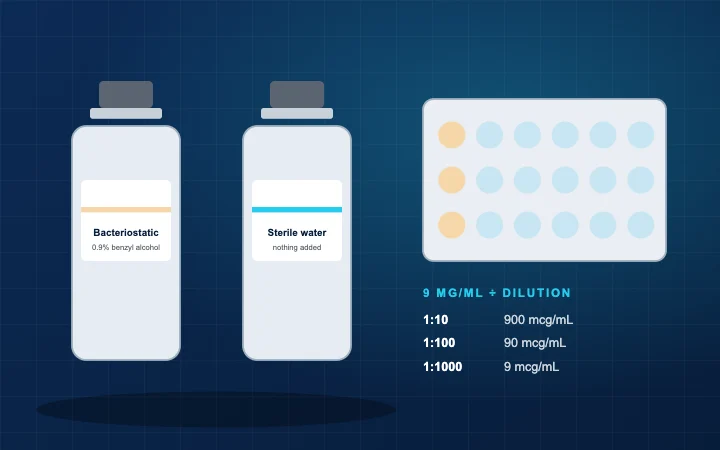
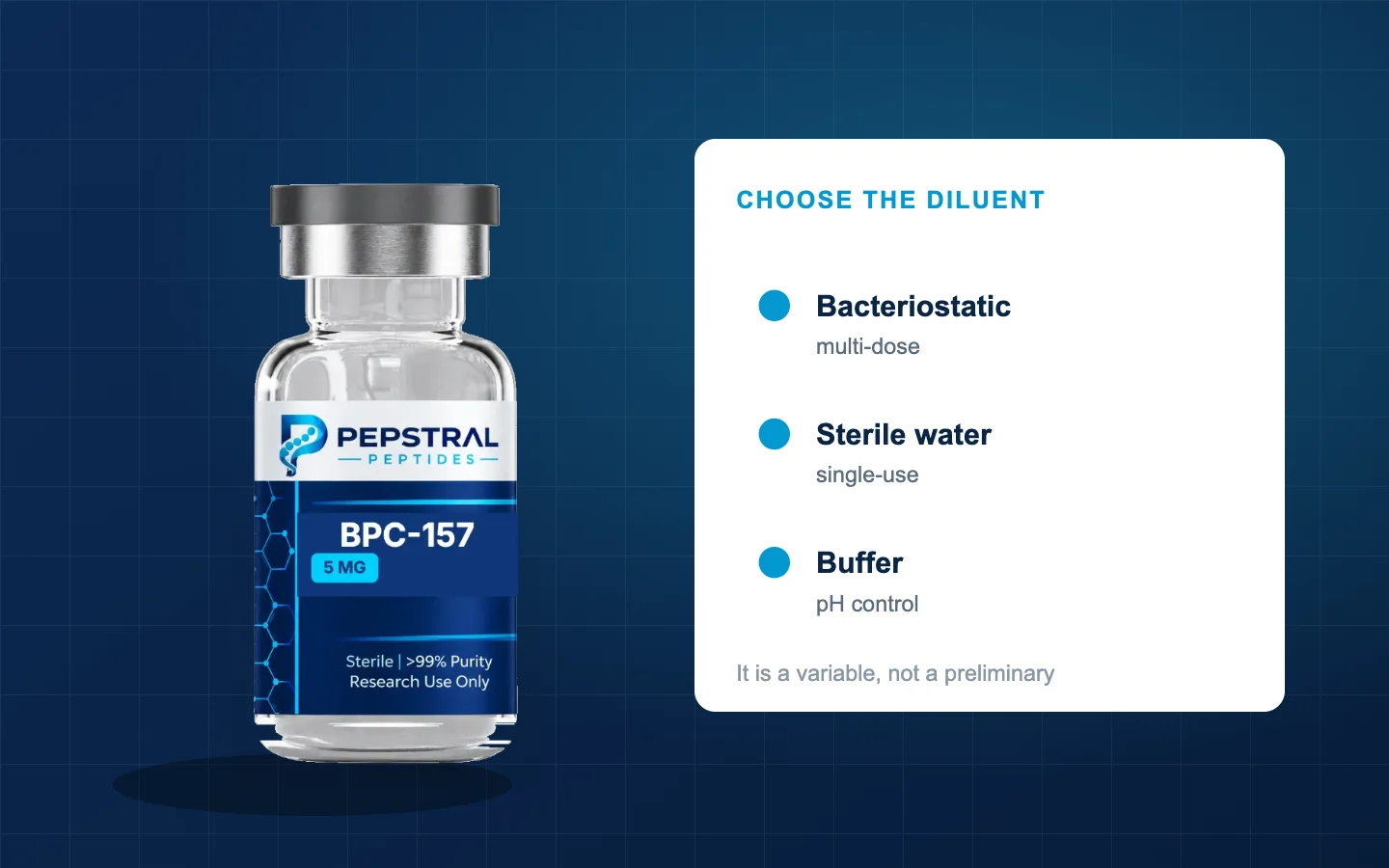
Bacteriostatic water — sterile water with roughly 0.9% benzyl alcohol added as an antimicrobial preservative. The preservative is what makes a vial multi-dose: it inhibits organisms introduced when the stopper is punctured repeatedly. This is the default for exactly that reason.
Sterile water for injection — no preservative. Chemically cleaner, and correct wherever benzyl alcohol would interfere. The trade is that the vial is now effectively single-use; there is nothing inhibiting growth after the first puncture.
Buffer — phosphate-buffered saline, Tris, or an acetate buffer, where pH control matters to solubility or to the assay.
| Bacteriostatic water | Sterile water | Buffer | |
|---|---|---|---|
| Preservative | 0.9% benzyl alcohol | None | Usually none |
| Vial becomes | Multi-dose | Single-use | Depends |
| pH control | No | No | Yes |
| Best for | General handling, repeated draws | Sensitive cell work | Solubility or pH-dependent assays |
| Watch for | Preservative interference | Contamination after first use | Buffer components in your readout |
When is the preservative a problem?
Benzyl alcohol is not inert. In cell culture it can affect viability at concentrations that arrive with a large enough volume of diluent, which is the case our bacteriostatic water and cell culture post works through with the dilution arithmetic.
The rule of thumb: if your readout is cell viability, membrane integrity, or anything where a small-molecule solvent effect could masquerade as biology, use plain sterile water and accept single-use. If you are preparing a stock for chemical work, or drawing repeatedly over days, the preservative is doing a useful job.
What if the peptide will not dissolve?
Swirling for longer is the first answer and often the only one needed — the acylated GLP-1 class is simply slow, as our dissolution post explains. Beyond that, two mechanisms account for most genuine failures.
It is hydrophobic. A sequence rich in leucine, isoleucine, valine, phenylalanine or tryptophan resists water. The standard approach is to dissolve in a small volume of an organic solvent first — DMSO or acetonitrile — then dilute into aqueous. Keep the final organic concentration low enough that your assay tolerates it, and carry a vehicle control at the same concentration, because otherwise you cannot separate the solvent's effect from the peptide's.
It is near its isoelectric point. A peptide is least soluble at the pH where its net charge is zero. Moving pH away from that point in either direction usually helps: dilute acetic acid for a basic peptide, dilute ammonium bicarbonate for an acidic one. Manning and colleagues treat this as a core formulation lever, and it is the cheapest thing to try before reaching for solvents.
What not to do: heat it, or shake it hard. Both accelerate the degradation routes covered in our stability post, and shear plus air is the classic recipe for aggregation.
GHK-Cu is the exception worth naming
Copper complexes bring their own consideration. The compound is a coordinated metal, and buffers containing chelators — EDTA most obviously, but also some media formulations — will compete for the copper. That can change what you are actually dosing without any visible sign. Our GHK-Cu post covers why the metal is integral rather than incidental.
Record it
The diluent is a variable, not a preliminary. A methods section that says "reconstituted in water" has omitted something a reader needs: which water, with what preservative, at what concentration, held how long before use. Our methods post lists the full set of facts, and the concentration table covers the volumes.
Frequently asked questions
Can I use tap or deionised water?
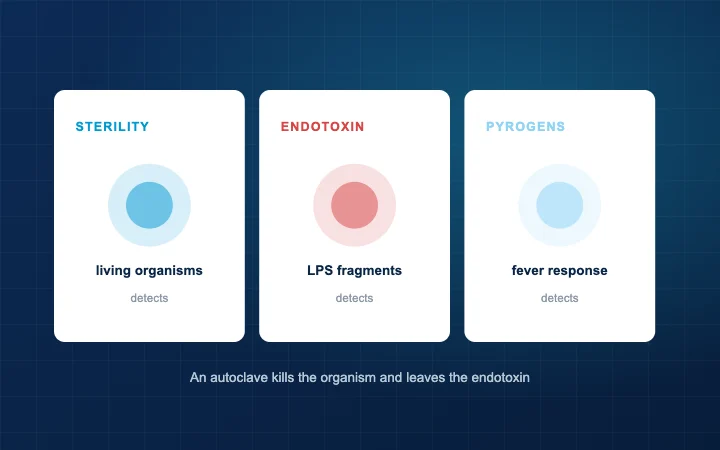
No. Neither is sterile and deionised water can carry endotoxin, which defeats the point of buying a vial with an endotoxin figure on its certificate — see our endotoxin post.
How much DMSO is too much?
That depends entirely on your system, and it is an empirical question for your assay rather than a number anyone can give you generically. The important discipline is the vehicle control at matched concentration.
Does the diluent affect how long the solution lasts?
Yes, in two separate ways. The preservative affects microbiological stability; pH and buffer composition affect chemical stability. They are different failure modes and bacteriostatic water only addresses the first.
Should I filter after reconstitution?
If the solution is clear, filtering mostly costs you material — peptides adsorb to filter membranes, and at low concentrations that loss is meaningful. If it is hazy, filtering hides a problem rather than solving it. Investigate the haze instead.
References
- Manning MC, Chou DK, Murphy BM, Payne RW, Katayama DS. Stability of protein pharmaceuticals: an update. Pharmaceutical Research 2010;27(4):544-575. doi.org/10.1007/s11095-009-0045-6
- Niu CH, Chiu YY. FDA perspective on peptide formulation and stability issues. Journal of Pharmaceutical Sciences 1998;87(11):1331-1334. doi.org/10.1021/js9800782
- Bachem. Quality Control of Amino Acids and Peptides: A Guide. www.bachem.com/knowledge-center/quality-control-of-amino-acids-peptides-a-guide
Every product mentioned is sold for laboratory research use only and is not for human or animal use. Nothing on this page describes or recommends use of the material sold here in humans or animals.