Several compounds in this catalogue now come in four or five vial sizes, and the bigger ones are cheaper per milligram. That is a real saving and it is not automatically the right choice. The cost per milligram is only the first half of the calculation; the second half is that a vial you have opened is a vial whose stability clock has started, on all of it.
What does each vial actually cost per milligram?
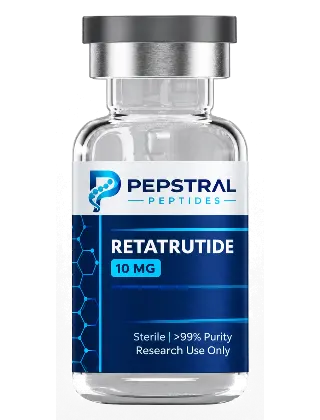
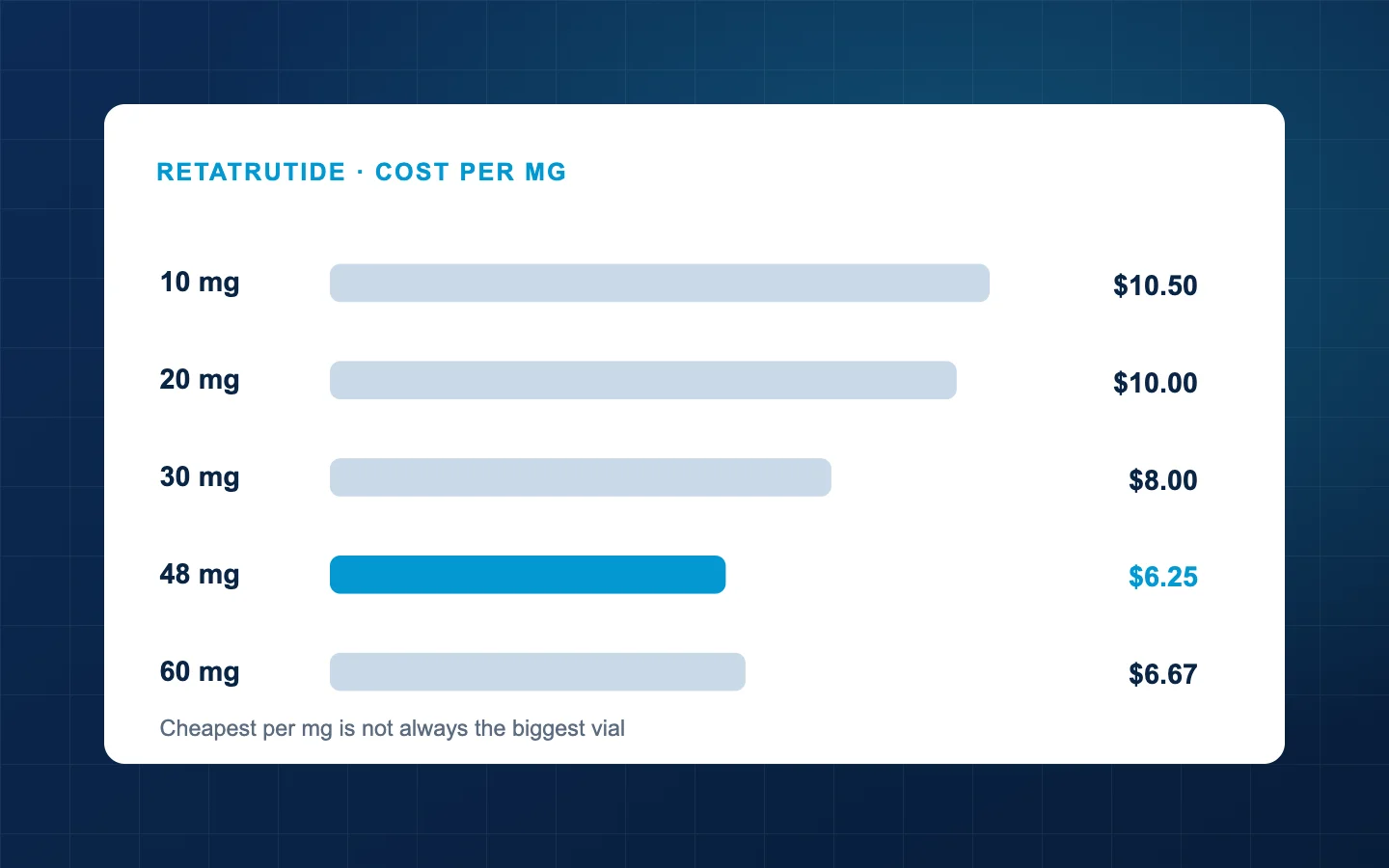
Take retatrutide as the clearest case:
| Vial | Price | Per mg |
|---|---|---|
| 10 mg | $105 | $10.50 |
| 20 mg | $200 | $10.00 |
| 30 mg | $240 | $8.00 |
| 48 mg | $300 | $6.25 |
| 60 mg | $400 | $6.67 |
The 48 mg vial is the best unit price at $6.25/mg — 40% below the 10 mg vial. Note that the curve is not monotonic: 60 mg is slightly worse per milligram than 48 mg, so "biggest is cheapest" is not a rule you can apply blind.
Semaglutide runs the same way: $12.00/mg at 5 mg, down to $6.00/mg at 50 mg. Tirzepatide goes further still: $10.00/mg at 10 mg down to $4.28/mg at 100 mg, the lowest unit price in the catalogue.
Why is the saving conditional?
Because it is a saving per milligram bought, not per milligram used. A 48 mg vial at $6.25/mg is only cheaper than five 10 mg vials if you use enough of it.
The constraint is what happens after reconstitution. Lai and Topp's work on solid-state stability is the reason peptides ship freeze-dried: in the dry state, molecular mobility is drastically reduced and degradation slows by orders of magnitude. Add water and that protection ends — for the whole vial at once, not for the fraction you have drawn. The routes are the ones covered in our solution-stability post: deamidation, oxidation, hydrolysis, aggregation.
So the real question is not "what is cheapest per milligram" but "how much can I use inside a defensible working window".
How do you get the discount without the risk?
There is a way to have most of both, and it is standard practice rather than a trick:
- Reconstitute the large vial once, to a known concentration.
- Split immediately into single-use aliquots in clean tubes.
- Freeze them at −20°C or below, one freeze.
- Thaw one aliquot per session. Never refreeze it.
This converts one large vial into many small ones and sidesteps the failure mode that a big vial otherwise invites: returning to the same vial repeatedly over weeks. Manning and colleagues treat freeze-thaw cycling as a driver of aggregation — the concentration and pH shifts as ice forms are what does the damage — so the discipline is one cycle, not "freezing is fine".
Two practical notes. Aliquoting costs you a little material to tube walls, which matters most at low concentrations. And every aliquot needs the same label as the parent: compound, concentration, lot, date.
Which size suits which study?
| Situation | Size to take |
|---|---|
| Pilot, method development, single condition | Smallest available |
| Comparing two compounds at matched molarity | Whatever gives comparable molar amounts, not matched mass |
| Long dose-response series, one compound | Largest, aliquoted on day one |
| Several researchers sharing | Largest, aliquoted and distributed |
| Compound you have not used before | Smallest — buy the big vial after it has earned it |
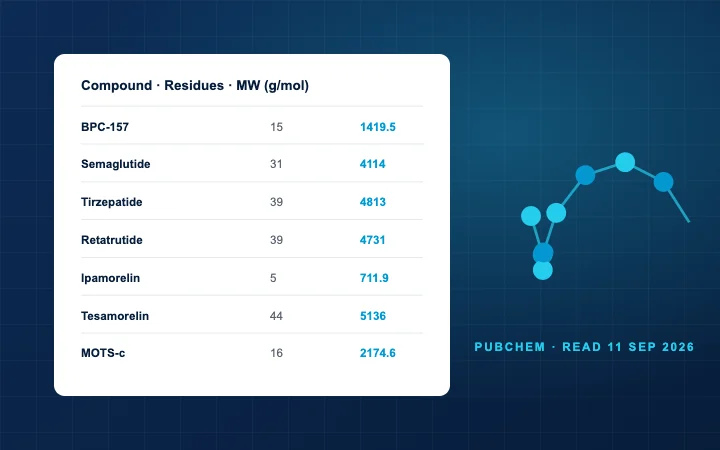
That second row is the one people get wrong. Matching mass across two compounds does not match the number of molecules, which our molarity post works through — a 5 mg ipamorelin vial holds roughly twice the molar amount of a 5 mg BPC-157 vial.
One more thing the certificate changes
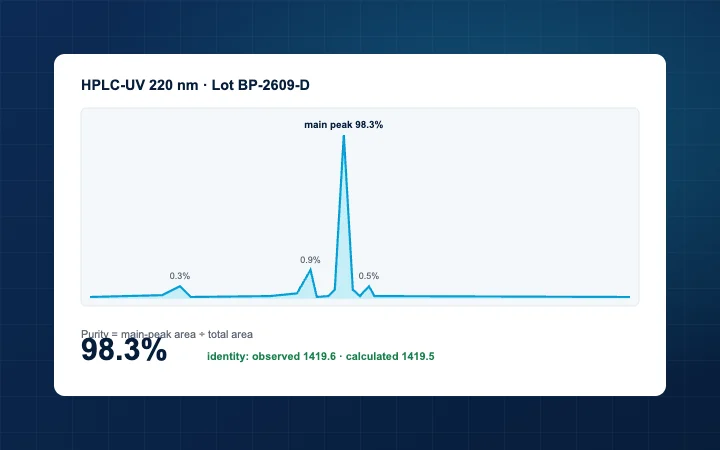
Plan against net peptide content, not the labelled dose. A 48 mg vial reporting 45 mg net is 6% less material than the price list implies, and that 6% moves the true cost per milligram. Our net content post explains why the two numbers differ and which belongs in your arithmetic.
Frequently asked questions
Is the largest vial always the best value?
No — retatrutide's 48 mg beats its 60 mg per milligram. Check the arithmetic rather than assuming the curve keeps falling.
Can I reconstitute only part of a vial?
Not practically. The powder is a single cake and you cannot weigh out a portion accurately without specialist equipment. Reconstitute the whole vial and aliquot the solution instead.
How long can aliquots sit frozen?
Longer than a vial in the fridge, but it is still a solution and the clock still runs. Set a window, record it and stick to it rather than treating frozen as indefinite.
Does a larger vial cost more to ship?
Not meaningfully here — the vials are small and light either way, and free shipping applies over $300, which a large vial usually clears on its own.
References
- Manning MC, Chou DK, Murphy BM, Payne RW, Katayama DS. Stability of protein pharmaceuticals: an update. Pharmaceutical Research 2010;27(4):544-575. doi.org/10.1007/s11095-009-0045-6
- Lai MC, Topp EM. Solid-state chemical stability of proteins and peptides. Journal of Pharmaceutical Sciences 1999;88(5):489-500. doi.org/10.1021/js980374e
- Bachem. Quality Control of Amino Acids and Peptides: A Guide. Net peptide content and moisture. www.bachem.com/knowledge-center/quality-control-of-amino-acids-peptides-a-guide
Every product mentioned is sold for laboratory research use only and is not for human or animal use. Nothing on this page describes or recommends use of the material sold here in humans or animals.