
The bioregulator category is the one where being straight with a reader matters most. These compounds have a real literature, a coherent theory behind them, and a structural feature that makes independent assessment harder than usual. A supplier that presents the findings without the caveat is misleading you; one that dismisses the whole thing is ignoring published work. This post tries to put both halves in front of you.
Where do they come from?
The programme originated in the Soviet Union in the early 1970s, led by Vladimir Khavinson, and continued at the St Petersburg Institute of Bioregulation and Gerontology.
The original materials were tissue extracts — preparations from thymus, pineal and other tissues, on the hypothesis that each tissue contains short peptides regulating its own function. Thymalin, from thymus, is one of these.
The later and more interesting step was identifying short defined sequences and making them synthetically. That gives compounds you can actually specify:
| Compound | Sequence | Residues | Associated with |
|---|---|---|---|
| Vilon | Lys-Glu | 2 | Immune parameters |
| Pinealon | Glu-Asp-Arg | 3 | Neuronal tissue |
| Vesugen | Lys-Glu-Asp | 3 | Vascular tissue |
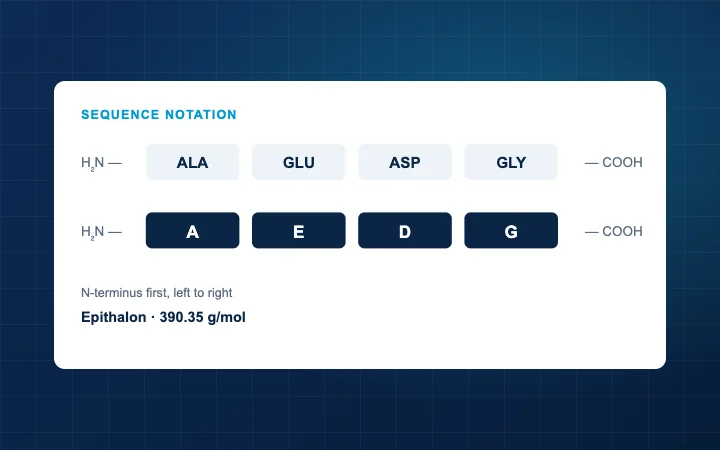
| Epithalon | Ala-Glu-Asp-Gly | 4 | Pineal, telomerase |
| Testagen | Lys-Glu-Asp-Gly | 4 | Endocrine tissue |
| Thymalin | Preparation | — | Thymic, immune |
| Prostamax | Preparation | — | Prostate tissue |
Two things are worth noticing. The defined ones are extraordinarily short — Vilon is a dipeptide, the smallest compound in this catalogue. And the series turns on tiny differences: Vesugen is Lys-Glu-Asp and Testagen is Lys-Glu-Asp-Gly. One residue apart, different claimed tissue associations.
What does the published work report?
The central proposal is that these short peptides interact with DNA and influence gene expression — a mechanism that would explain how a two-residue molecule could do anything specific at all.
Khavinson and colleagues (2020) reported that the AEDG peptide — epithalon — stimulated gene expression and protein synthesis in a neurogenesis model. This is the most recent of the three cited here and the most mechanistically specific.
Malinin and Khavinson (2005) reported effects of epitalon on telomerase activity, telomere elongation and proliferative potential in cell culture. This is the source of most of the telomerase discussion that follows the compound around.
Khavinson and Malinin (2000) reported inhibition of apoptosis by peptide bioregulators.
These are cell and animal studies. They describe neither the material sold here nor any human use of it, and everything in this catalogue is for in-vitro laboratory research only.
What is the problem with the evidence?
Look at the author list on all three references above. That is the issue, and it is not a rhetorical device — a large share of the bioregulator literature originates with one research group and its close collaborators.
Concentrated authorship is not evidence of error. Specialised fields often have a small number of productive groups, and a programme running since the 1970s will naturally dominate its own subject. But it removes the thing science normally relies on: independent replication by people with no stake in the result. When findings are reproduced by unrelated laboratories, confidence rises for reasons that have nothing to do with the original authors' competence.
A second difficulty is plausibility friction. A dipeptide with tissue-specific gene-regulatory effects is a strong claim from a small molecule, and strong claims want strong, independent evidence.
The honest position: there is real published work here, it is interesting, and it has not been independently replicated to the standard the claims would warrant. That is a different statement from "it does not work" and a different statement from "it works". Our editorial policy explains why we publish it that way.
What does this mean for a study design?
Cite primary sources directly. Read the papers rather than a summary of them. The details — species, concentration, model — are frequently lost in secondary retellings.
Record supplier and lot, especially for preparations. Thymalin and Prostamax are described as preparations rather than single sequences, so composition is not standardised across sources. Our product pages say so, and their spec blocks are blank rather than carrying an unverified formula.
Treat findings as preliminary. That is the appropriate weight for results with this replication profile.
Do not carry handling assumptions across. A dipeptide is not a 39-residue acylated peptide. Solubility, stability and adsorption all behave differently at this size, and our diluent post covers why the choice matters.
Frequently asked questions
Is epithalon the same as epitalon or epithalamin?
Epithalon and epitalon are spelling variants of the same synthetic tetrapeptide, Ala-Glu-Asp-Gly. Epithalamin is different — it is the pineal tissue extract the synthetic peptide was derived from. Our naming post covers why this kind of confusion is endemic.
Can I verify the molecular weights myself?
Yes, and it is worth doing. Add the residue masses and add 18.02 for the water released. Epithalon calculates to 390.35 against PubChem's 390.35; Vilon, Pinealon and Vesugen all check to within 0.01 Da. The method is in our sequence post.
Why does this catalogue stock them at all?
Because researchers ask for them and the literature exists. The commitment is to describe the evidence accurately, including its weaknesses — which is what the bioregulators category page does.
Are there bioregulators outside this series?
The term gets used loosely. In this catalogue it means the Khavinson series specifically, and the category page says so rather than letting the word do vague work.
References
- Khavinson VKh, Linkova NS, Kvetnoy IM, et al. AEDG peptide (epitalon) stimulates gene expression and protein synthesis during neurogenesis. Molecules 2020;25(3):609. doi.org/10.3390/molecules25030609
- Malinin VV, Khavinson VKh. Effect of epitalon on telomerase activity, telomere elongation and proliferative potential. In: Gerontological Aspects of Genome Peptide Regulation. Karger, 2005. doi.org/10.1159/000085319
- Khavinson VKh, Malinin VV. Peptide bioregulators inhibit apoptosis. Bulletin of Experimental Biology and Medicine 2000;130(12):1175-1176. doi.org/10.1007/bf02682019
Every product mentioned is sold for laboratory research use only and is not for human or animal use. Nothing on this page describes or recommends use of the material sold here in humans or animals.