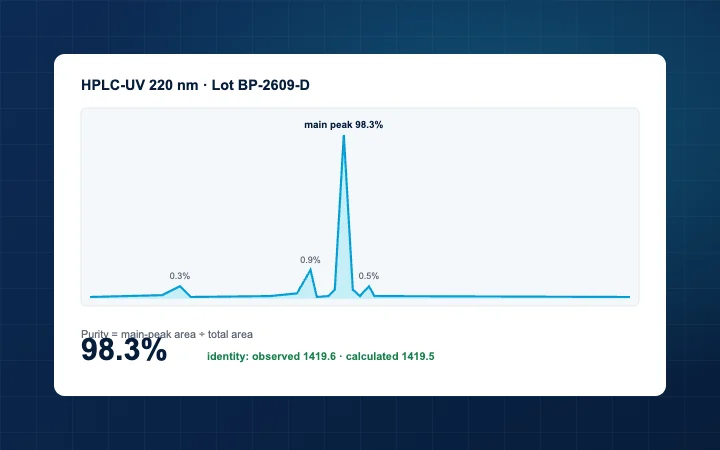

Every certificate on this site has a line that reads something like "Purity, RP-HPLC (214 nm), 99.71%". The chromatogram post explains what the trace behind that line looks like and what the shapes of the peaks mean. This post explains the arithmetic that turns the trace into the number: what is divided by what, what the division assumes, and what it cannot see. The net peptide content post picks up where this one ends, with the question of how much of the vial's mass is peptide at all.
What is the formula?
Area percent. The integrator draws a baseline under the trace, measures the area of each peak above it, and reports the main peak as a fraction of the total:
purity (%) = area of main peak ÷ sum of areas of all integrated peaks × 100
That is the entire calculation. No weighing, no reference standard, no calibration curve. It is a ratio of one absorbance integral to the sum of all of them, at one wavelength, over one run. USP <621> calls this the area normalisation procedure and lists its assumptions, which are the subject of the next section.
A worked illustration, using the certificate for the BPC-157 lot on sale, BP10-0803, which reports 99.71%. Suppose the integrator found a main peak and three small ones:
| Peak | Retention, min | Area, arbitrary units | Share |
|---|---|---|---|
| Main peak | 8.42 | 997,100 | 99.71% |
| Impurity 1 | 7.95 | 1,400 | 0.14% |
| Impurity 2 | 8.80 | 900 | 0.09% |
| Impurity 3 | 9.31 | 600 | 0.06% |
| Total | 1,000,000 | 100% |
The areas here are round numbers chosen to reproduce the certificate's figure, not the laboratory's integration report, which prints the real ones. The point is the structure: the number on the certificate is the first row divided by the last.
Why 214 nm?
Because that is where the peptide bond absorbs. Every peptide has at least one, so every peptide gives a signal there, including those with no aromatic residues, which is most of the short bioregulators. Pinealon and vilon have no tyrosine, tryptophan or phenylalanine and would be nearly invisible at 280 nm; at 214 nm they are measured like any other.
The choice has a consequence. At 214 nm the signal is roughly proportional to the number of peptide bonds, so a deletion sequence missing one residue absorbs slightly less than the full peptide and an addition sequence slightly more. That is what makes the next assumption approximately true for peptide impurities and false for everything else.
What does the ratio assume?
That every integrated peak has the same response factor: the same absorbance per unit mass at the wavelength used. If that holds, area percent equals mass percent. It holds, approximately, when the impurities are peptides closely related to the main compound, which is the usual case for a synthetic peptide whose impurities are deletion, truncation and incompletely deprotected sequences. The synthesis post explains where each of those comes from.
It does not hold when:
- an impurity has more or fewer chromophores per unit mass. An aromatic protecting group left on a residue absorbs strongly and is over-counted; a small fragment with one peptide bond is under-counted;
- an impurity has no absorbance at the wavelength. Acetate, trifluoroacetate, water and sodium ions do not absorb at 214 nm and do not appear as peaks at all. They are part of the vial's mass and no part of the purity figure. The TFA versus acetate post and the content post deal with that;
- material did not elute. Aggregates that stayed on the column or precipitated in the injector are not in the total;
- material co-eluted under the main peak. Two species with the same retention time integrate as one. A diastereomer from racemisation at one residue is the classic case, and it is the reason a second method, usually mass spectrometry, sits beside HPLC on every certificate. The LC-MS post explains what it adds.
So the honest statement of a certificate's purity line is: of the UV-absorbing, eluting, resolved material in this run, this percentage was the main peak. That is a strong statement about peptide-related impurities and a silent one about everything else.
Why does retention time change what the number is worth?
Because resolution depends on it. A peptide that holds on a reversed-phase column until well into the gradient, like MOTS-c at 10.02 minutes on its certificate run, has had time to separate from its deletion sequences, which differ from it by a residue and elute a little earlier or later. On that lot, 99.84% is a figure that could have been lower if impurities were present, because they would have been seen.
A dipeptide like vilon elutes at 1.56 minutes, near the solvent front, in the region where every polar species comes off together. Its 99.9% is still true of what was resolved, but less could be resolved. For early-eluting peptides the identity-by-mass line carries more of the certificate's weight, which is why the chromatogram post reads retention time before it reads purity.
Gradient, column and flow rate all shift retention times, so the minutes on one laboratory's certificate are not comparable with another's. The percentage is comparable only within the assumptions above.
How does this relate to net peptide content?
They answer different questions. Area percent asks: of the peptide-like material, how much is the right peptide? Content asks: of the vial's mass, how much is peptide? A lot can be 99.7% pure by area and 80% peptide by mass, because 20% of the mass is counter-ion and water that the chromatogram never saw. The net content post is the full treatment; the certificates on this site report content gravimetrically against the label, which is the measurement that answers the second question. Both lines are needed before the molarity arithmetic is right.
What should a reader do with the number?
Three things.
- Read the retention time with it. A high purity on a well-retained peak means more than the same figure near the solvent front.
- Read the identity line with it. Area percent cannot distinguish co-eluting species; the mass spectrometer can. A certificate with both has covered the gap that each leaves alone.
- Do not use it as a weight. For a calculation, use the content figure, and treat the purity figure as the answer to a different question. The is 98% good post covers how much purity a given experiment needs.
Frequently asked questions
Is 99.7% by HPLC the same as 99.7% by weight?
No. It is 99.7% of the UV-absorbing area at 214 nm. It becomes a mass percentage only if every peak absorbs equally per unit mass, which is roughly true for related peptide impurities and not true for salts, water or non-peptide material.
Why do certificates use 214 nm rather than 280 nm?
Because the peptide bond absorbs at 214 nm and every peptide has one. At 280 nm only tyrosine, tryptophan and cystine absorb, and many short peptides have none.
What can area percent not see?
Anything that does not absorb at the wavelength, anything that did not elute, and anything that co-eluted under the main peak. Salts and water are the first; aggregates the second; diastereomers the third.
Can two laboratories' purity figures be compared?
The percentages, approximately, if both ran the same method family. The retention times, no: gradient, column and flow rate change them.
Where does the number on this site's certificates come from?
From the laboratory's integration of its own run, reported as RP-HPLC at 214 nm on every certificate, with the retention time beside it. Each certificate is in the COA library with its verification code.
References
- United States Pharmacopeia. General Chapter <621> Chromatography. www.usp.org
- Mant CT, Chen Y, Yan Z, et al. HPLC analysis and purification of peptides. Methods in Molecular Biology 2007;386:3-55. doi.org/10.1007/978-1-59745-430-8_1
- Bioviridian Inc. Certificate of analysis COA7603, lot BP10-0803, issued 17 August 2026. Verification code on the certificate. bioviridians.com/coa-search.html
Every product mentioned is sold for laboratory research use only and is not for human or animal use. Nothing on this page describes or recommends use of the material sold here in humans or animals.