
A stability study asks two questions: how much of the peptide is still present after a defined time under defined conditions, and what the fraction that is gone turned into. Most bench attempts answer the first badly and skip the second entirely, which is how a solution that has lost a third of its material can still report 99% purity. This post covers the difference between real-time, accelerated and forced-degradation conditions, which degradation routes a peptide actually takes, what to measure at each timepoint, and how to lay the timepoints out so the result means something.
What is the study actually measuring?
Two quantities, and they are independent.
Content is how much intact peptide is in the container: an absolute measurement, in micrograms or as a percentage of what you started with, requiring a reference you trust. Purity is what fraction of the peptide-related material in the sample is the peptide you want: a relative measurement, normally a peak-area percentage from a chromatogram.
A sample can lose content without losing purity. If a tenth of the peptide adsorbs to the container wall or falls out of solution as an aggregate, what remains dissolved is just as pure as it was, the chromatogram looks unchanged, and the experiment runs at a concentration you no longer know. This is the commonest failure in informal stability work, and it is why the aggregation post calls aggregation the degradation route no certificate can catch.
Real-time, accelerated, or forced?
Three different experiments with three different purposes, routinely conflated.
| Purpose | Conditions | What it tells you | |
|---|---|---|---|
| Real-time | What happens in the storage you actually use | The intended storage condition | The answer you want, on the timescale you cannot wait for |
| Accelerated | Compress the timeline | A defined, harsher condition than storage | An early signal, and a basis for extrapolation that has to be justified |
| Forced degradation | Find the routes; prove the method sees them | Deliberately harsher than any storage | Which degradants exist and whether your assay can detect them |
ICH Q1A(R2) is the reference framework for the first two. It is written for pharmaceutical drug substances and products rather than laboratory reagents, but it is where the conditions everyone quotes come from: long-term storage at 25 °C ± 2 °C and 60% ± 5% relative humidity, an intermediate condition at 30 °C ± 2 °C and 65% ± 5% RH, and accelerated at 40 °C ± 2 °C and 75% ± 5% RH, with refrigerated and frozen alternatives for substances stored that way. Borrowing the structure is reasonable; borrowing the extrapolation is not, because ICH's shelf-life reasoning depends on batch numbers, statistical treatment and a commitment to continue real-time testing that a single bench study does not have.
Forced degradation is the one most often misunderstood. Its conditions are supposed to be harsher than anything the material will ever see, because its purpose is not to predict shelf life. Hawe and colleagues' review sets out the logic for therapeutic proteins, and it transfers to peptides: you stress a sample hard enough to generate each plausible degradant in detectable quantity, then check that your analytical method resolves that degradant from the intact molecule. A method that cannot see the degradant will report a stable product no matter how much degrades. The usual stress conditions are elevated temperature, acid and base, an oxidant such as hydrogen peroxide, light, and mechanical stress from shaking, with repeated freezing and thawing where a frozen stock is the intended storage.
A forced-degradation result is never a storage recommendation. If a peptide survives an hour in hot base it does not mean it tolerates base; it means your method saw what base does to it.
Which routes matter for a peptide?
Four, and knowing which apply to your sequence tells you what to look for before you run anything.
| Route | Trigger | Sequences at risk | Mass change | Seen by |
|---|---|---|---|---|
| Backbone hydrolysis | Water, pH extremes, heat | Aspartate-proline and aspartate-glycine bonds especially | Fragments, so yes | HPLC (new earlier peaks), MS |
| Oxidation | Air, metal ions, peroxide, light | Methionine, cysteine, tryptophan | +16 Da per oxygen | MS; HPLC shift is often small |
| Deamidation | Neutral to alkaline pH, heat | Asparagine, glutamine | +1 Da, or none for the isoaspartate rearrangement | MS is marginal; needs a resolving separation |
| Aggregation | Concentration, agitation, freeze-thaw, hydrophobicity | Hydrophobic and acylated sequences | None | Size-based methods, appearance, content loss |
Manning and colleagues' review is the standard map of these routes and Niu and Chiu's paper is the peptide-specific formulation view. Two consequences are worth sitting with. Deamidation can change the mass by one dalton or not at all, so a mass-spectrometry identity check is not a stability-indicating method on its own. And aggregation changes no mass and produces no new peak, so a chromatogram is not one either.
Which routes apply is a property of the sequence. Semax carries a methionine and therefore an oxidation route that an all-aliphatic tripeptide such as KPV does not have; the oxidation post covers which residues to look for and what they turn into. L-glutathione has a free thiol and oxidises readily enough that its own post is mostly about that one route. GHRH analogues such as tesamorelin have the asparagine deamidation route the reconstituted shelf-life post covers. Read your sequence first; the sequence post explains how.
The dry state is a separate question. Lai and Topp's review covers solid-state chemistry in lyophilised peptides, where residual moisture rather than bulk water sets the rate — which is why a stability study on a powder needs humidity control and one on a solution does not.
What to measure at each timepoint
Not one assay. The minimum honest set is five things, and four of them are cheap.
- Appearance. Look at the container against light and dark backgrounds and write down what you see. Cloudiness, a film, a ring at the meniscus or visible particles are aggregation, and they are information the instruments will not give you as directly.
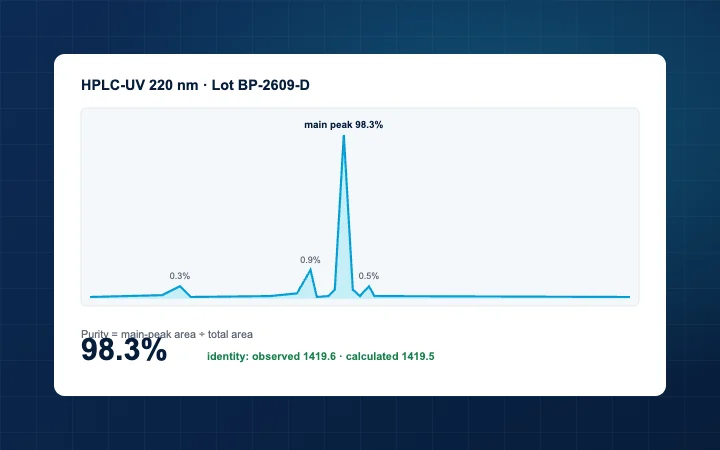
- Relative purity by RP-HPLC. The area percentage, at a stated wavelength. Every certificate in the COA library reports purity by RP-HPLC at 214 nm, and using the same wavelength as your starting certificate makes the two numbers comparable. The chromatogram post covers how to read the trace, and the one percent post covers what the non-main peaks are.
- Absolute content. Against a reference standard, or by a quantification method you have validated. This is the measurement that catches loss to walls and to aggregates, and it is the one informal studies skip. The A280 post covers why UV quantification works for some sequences and is impossible for others, and the surface adsorption post covers where the missing material went.
- Identity by mass spectrometry. The certificates in this catalogue use MALDI-MS or LC-MS/MS for identity, and the same techniques applied to a stressed sample tell you whether the mass has moved by 16 (oxidation), by 1 (deamidation), or into fragments. The LC-MS post covers what the technique does and does not prove.
- A size-based method for aggregates, if aggregation is plausible for your sequence — size-exclusion chromatography, or light scattering. This is the one genuinely specialised addition, and for a short hydrophilic peptide it is often not needed.
Recording pH and the actual storage temperature, with a logger rather than a thermostat setting, costs nothing and prevents the most common reason a stability study cannot be interpreted.
Designing the timepoints
The shape matters more than the number of points.
Measure t = 0. Do not assume it. The certificate figure was measured on the powder by the testing laboratory, possibly months earlier, on a different instrument. Your t = 0 is your own measurement on your own solution on the day you made it, and it is what every later point is compared against.
Keep a frozen retain of t = 0. A small aliquot at −80 °C, unopened, gives you the ability to re-run the starting material on the same instrument on the same day as the final timepoint. Instrument drift across a six-month study is otherwise indistinguishable from degradation.
One container per timepoint. Never re-open the same container. Every puncture introduces air, organisms and an opportunity for the stopper to shed, and a re-sampled container conflates degradation with handling. If the study will have six timepoints, fill six containers on day zero.
Space the points logarithmically, not evenly. Degradation is fastest at the start, so points clustered early and spread late capture the curve with fewer samples than an even spacing does. An illustrative design for a solution-state study — this is a design pattern, not a sourced schedule — would be day 0, day 1, day 3, week 1, week 2, month 1, month 3, with a duplicate at the final point.
Include the controls that isolate the variable. A container of diluent with no peptide, held under the same conditions, catches contamination and leachables. A parallel set at a colder temperature separates chemistry from handling. If you are stressing something, an unstressed sibling run on the same day is what makes the stressed result mean anything.
Decide in advance what counts as a change. A purity figure that moves from 99.8% to 99.5% between two runs may be the instrument rather than the peptide, and the lot variability post covers how much of a reported figure is reporting. Run your t = 0 in triplicate, calculate the spread, and write the threshold down before you see the data.
Reporting it
A stability result that cannot be reproduced is an anecdote. State the lot and its certificate, the diluent and its grade, the concentration, the container and closure, the storage condition as measured, the timepoints, every method with its wavelength or mass range, and the threshold you set in advance. The methods-section post gives the wording for the material itself.
Frequently asked questions
Can I extrapolate an accelerated result to a shelf life?
Not from a single bench study. Accelerated data supports extrapolation only inside a framework that specifies the number of batches, the statistical treatment and a commitment to continue real-time testing, which is what ICH Q1A(R2) sets out and what a laboratory study does not have. Accelerated conditions are excellent at telling you that a formulation has a problem and poor at telling you how many months it has.
Is forced degradation the same as accelerated stability?
No, and treating them as the same is the error the two terms invite. Accelerated conditions are a harsher version of real storage, chosen so the result relates to storage. Forced degradation is harsher than any storage on purpose, and it exists to generate degradants and test whether your method can see them. A forced-degradation condition should never appear in a storage recommendation.
How much degradation should a forced-degradation study produce?
Enough for the degradant to be measurable, and not so much that the sample becomes a soup of secondary products. Practitioners aim for partial loss of the parent peak rather than its disappearance, because a completely degraded sample says nothing about the first step. Hawe and colleagues discuss condition selection in detail.
Why is HPLC purity not enough on its own?
Because it is a ratio. It compares the peaks that reached the detector against each other, so it cannot see peptide that precipitated, adsorbed to the container, or aggregated into something that never eluted. Two samples can report identical purity while one has half the content of the other. Purity plus an absolute content measurement answers the question; purity alone does not.
Does the certificate that came with my vial count as a stability study?
No. A certificate is one measurement of one lot on one day, describing the powder as tested; it is the right starting point and says nothing about what your solution will be next month. The certificate guide covers what each line does cover, and the post on what a certificate does not test for covers the gaps.
What temperature should a solution study be run at?
Whatever you actually store at, plus at least one harsher condition. A single condition tells you something changed; a pair or a series tells you how strongly temperature drives it. Record the measured temperature, not the setting.
References
- International Council for Harmonisation. ICH Q1A(R2): Stability Testing of New Drug Substances and Products, Step 4 version, February 2003. Read 29 September 2026. database.ich.org/sites/default/files/Q1A(R2)%20Guideline.pdf
- Hawe A, Wiggenhorn M, van de Weert M, Garbe JHO, Mahler HC, Jiskoot W. Forced degradation of therapeutic proteins. Journal of Pharmaceutical Sciences 2012;101(3):895-913. doi.org/10.1002/jps.22812
- Manning MC, Chou DK, Murphy BM, Payne RW, Katayama DS. Stability of protein pharmaceuticals: an update. Pharmaceutical Research 2010;27(4):544-575. doi.org/10.1007/s11095-009-0045-6
- Niu CH, Chiu YY. FDA perspective on peptide formulation and stability issues. Journal of Pharmaceutical Sciences 1998;87(11):1331-1334. doi.org/10.1021/js9800782
- Lai MC, Topp EM. Solid-state chemical stability of proteins and peptides. Journal of Pharmaceutical Sciences 1999;88(5):489-500. doi.org/10.1021/js980374e
Every product mentioned is sold for laboratory research use only and is not for human or animal use. Nothing on this page describes or recommends use of the material sold here in humans or animals.