A methods section has one job for a reagent: to let another laboratory obtain the same material and treat it the same way. For a research peptide that means more than a name and a supplier, because two vials with the same name can differ in purity, in the compound they actually contain, in how much of the powder is peptide, in the counter-ion, and in what they were dissolved in.
NIH's guidance on rigor and transparency names specialty chemicals among the key resources whose quality must be documented because it can influence the data. A synthetic peptide is exactly that.
This post lists the eleven facts that do the job, explains where each comes from, and gives a template.
The eleven facts
| Fact | Where it comes from | Why it is reported |
|---|---|---|
| Supplier and location | Product page | Identifies the source |
| Product name, catalog form and dose | Label | Names the compound and the vial |
| Lot number | Label and certificate | Ties the vial to one test report |
| Purity, with method | Certificate | HPLC percentage and wavelength or method name |
| Identity, with method | Certificate | Observed mass by LC-MS against calculated |
| Net peptide content | Certificate | The milligrams that were actually peptide |
| Salt form or counter-ion | Certificate | TFA or acetate; a variable in cell work |
| Endotoxin, with method | Certificate | Relevant for any cell-based assay |
| Storage before use | Lab record | Sealed temperature and time; reconstituted window |
| Reconstitution | Lab record | Solvent, volume, resulting concentration, date |
| Vehicle for controls | Lab record | What the control arm received, including preservative and counter-ion |
Bachem's quality guide describes the methods behind the certificate lines: HPLC purity at 210 to 220 nm, identity by mass spectrometry, and net peptide content by amino acid analysis, elemental analysis or a reference standard. Naming the method alongside the number is what makes the number comparable across papers.
Why each one is worth the words
- Lot number is the single most useful fact. With it, a reader can request the certificate and see everything else. Without it, "99% pure" is unverifiable. The label post explains why the lot is the only field that links vial to report.
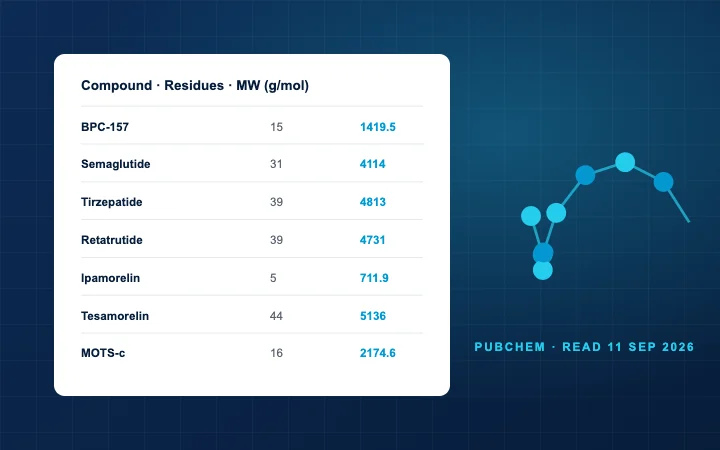
- Identity is what proves the vial contained the named compound. The reference table gives the calculated mass for every catalog compound, so "observed 1419.6, calculated 1419.5" is a one-line statement that the reagent was BPC-157.
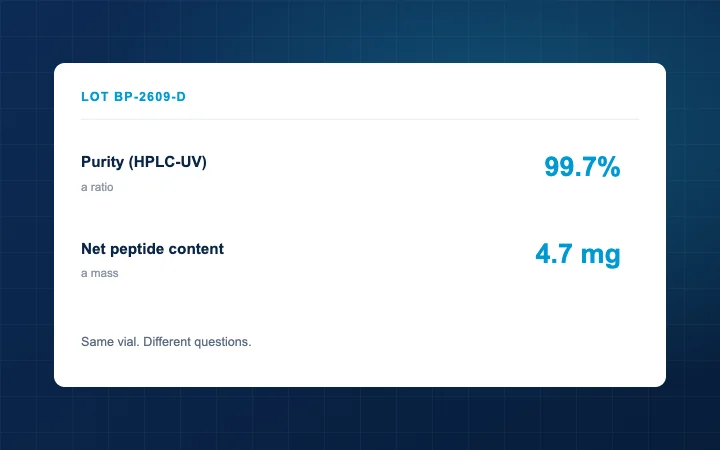
- Net peptide content is what the concentrations were built on. If a 5 mg label held 4.6 mg of peptide, a concentration reported from 5 mg is 9% high. The pricing post works through why the gap exists.
- Salt form and vehicle are the two facts most often omitted and most often the explanation for a result that does not replicate. The TFA post and the bacteriostatic water post explain what each can do to a cell assay.
- Endotoxin matters for immune, endothelial and stem cell work, as the endotoxin post sets out, and a reader in those fields will look for it.
- Storage and reconstitution are where a replicating laboratory most often diverges. Solvent, volume and the date reconstituted define the concentration and the age of the solution; the storage guide and the concentration table supply the conventions.
A template paragraph
The placeholders in brackets are the eleven facts. The example uses this catalog's BPC-157:
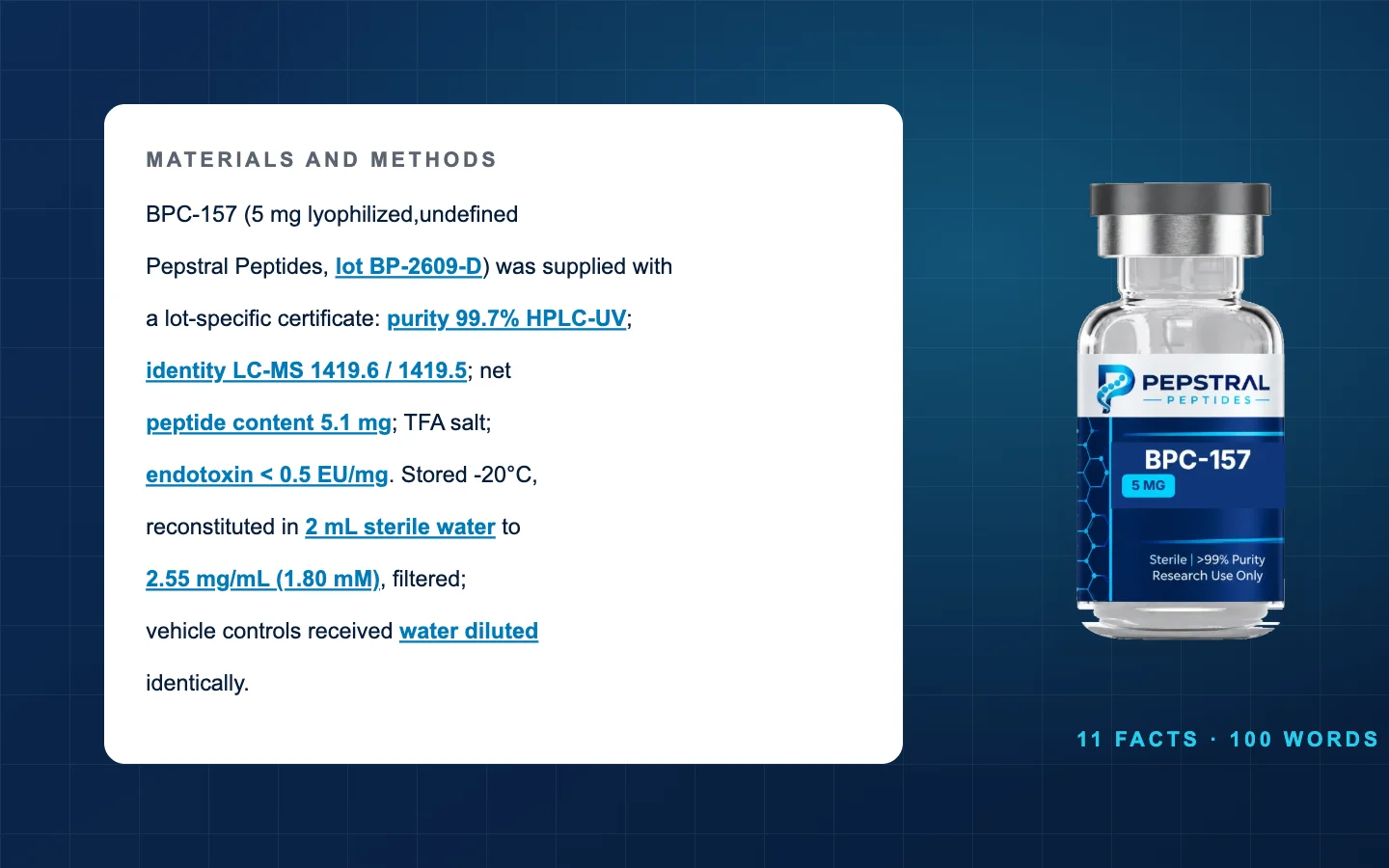
BPC-157 (5 mg lyophilized, [Pepstral Peptides, city, state], lot BP-2609-D) was supplied with a lot-specific certificate of analysis: purity 99.7% by HPLC-UV at 220 nm; identity confirmed by LC-MS (observed 1419.6, calculated 1419.5); net peptide content 5.1 mg per vial; trifluoroacetate salt; endotoxin below 0.5 EU/mg by chromogenic LAL. Vials were stored sealed at -20°C and reconstituted on the day of use in 2 mL sterile water for injection to 2.55 mg/mL (1.80 mM), sterile-filtered, and diluted into assay medium to the stated final concentrations. Vehicle controls received sterile water diluted identically.
About a hundred words, and a reader can reconstruct the reagent from it. For a GLP-1 class peptide such as semaglutide, add the reconstitution time and the light protection the slow-dissolution post describes. For a blend, report each component's net content and the ratio, as the blends post explains. For a small basic peptide such as ipamorelin, the salt form line carries more weight, because the counter-ion share is largest.
A checklist for the lab record
Fill this in on the day the vial is opened, from the certificate and the bench, and the methods paragraph writes itself at submission:
- Supplier and location: ____
- Product, form and labelled dose: ____
- Lot number: ____
- Purity: ____ % by ____ (method, wavelength)
- Identity: observed ____ against calculated ____ by ____
- Net peptide content: ____ mg per vial (or "not reported")
- Salt form: ____
- Endotoxin: ____ EU/mg by ____ (or "not reported")
- Storage before use: ____ °C sealed, ____ days; reconstituted at ____ °C
- Reconstitution: ____ mL of ____ on ____ (date), giving ____ mg/mL and ____ mM
- Vehicle control: ____, diluted identically
Items 4 to 8 come from the certificate and items 9 to 11 from the bench. If the certificate is the supplier's own template rather than an independent laboratory's report, note that at item 4.
What if the certificate does not have a line?
Report that it does not. "Net peptide content was not reported by the supplier; concentrations are calculated from the labelled mass" is an honest sentence, and it tells a reader which numbers carry that uncertainty. It is also a finding about the supplier that the vetting checklist would have surfaced before the order. If the peptide is the variable under test and the certificate is thin, the independent testing post describes how to fill the gap with a report you can cite.
How does this fit NIH's authentication expectation?
NIH asks applicants to identify the key biological and chemical resources in a plan and to describe how they will be authenticated, noting that such resources can vary between laboratories and over time in ways that influence the data. A lot-matched certificate with identity, purity and content lines is the authentication for a synthetic peptide, and the eleven facts are how that authentication is reported. Writing the paragraph at the time of the experiment, from the certificate and the lab record, is far easier than reconstructing it at submission.
Frequently asked questions
Should I cite the certificate of analysis?
Cite the lot number in the methods and keep the certificate with the lab record. Some journals accept it as supplementary material; whether or not they do, the lot number lets anyone request it.
How do I cite the compound itself?
By name and, where a record exists, by PubChem compound identifier, so that the sequence and mass are unambiguous. The reference table lists the identifiers for every catalog compound.
Is a supplier's own certificate enough, or must it be third-party?
Report which it is. A certificate from a named independent laboratory carries more weight than a supplier template, and saying so lets the reader judge. The vetting checklist explains the difference.
What about in vivo studies?
The same eleven facts, plus the vehicle composition and route, which have their own reporting conventions. The counter-ion and preservative lines matter more, not less, in vivo.
References
- National Institutes of Health. Enhancing Reproducibility through Rigor and Transparency: guidance on authentication of key biological and/or chemical resources. grants.nih.gov/policy-and-compliance/policy-topics/reproducibility/guidance
- Bachem. Quality Control of Amino Acids and Peptides: A Guide. Purity, identity and net peptide content methods. www.bachem.com/knowledge-center/quality-control-of-amino-acids-peptides-a-guide
- PubChem, National Library of Medicine. Compound records for the catalog, listed in the reference table post. pubchem.ncbi.nlm.nih.gov
Every product mentioned is sold for laboratory research use only and is not for human or animal use. Nothing on this page describes or recommends use of the material sold here in humans or animals.