
Glutathione is a tripeptide — glutamate, cysteine, glycine — and almost everything awkward about handling it comes from one atom in the middle residue. The cysteine carries a thiol, an S–H group, and thiols are reducing agents by nature. Their whole chemistry is a willingness to give up an electron.
That is what makes glutathione biologically interesting. It is also what makes a bottle of it in solution a moving target.
The reaction that matters
Two molecules of reduced glutathione, conventionally written GSH, can join at their sulphur atoms. The two thiols give up a hydrogen each and form a sulphur–sulphur bond, producing one molecule of GSSG — glutathione disulphide, the oxidised form.
Three things follow from that, and they are worth separating because they are often blurred together.
Nothing leaves the bottle. This is not degradation in the sense of a peptide bond breaking and fragments appearing. The atoms are all still there, rearranged.
The material is still glutathione. GSSG is a legitimate, named form of the compound. Any assay that measures "glutathione" without specifying which form will happily count it.
The reaction is reversible in principle. In a cell, enzymes push it back. In a bottle on a shelf, nothing does.
Why a purity figure can mislead here
This is the part worth slowing down on, because it catches people out.
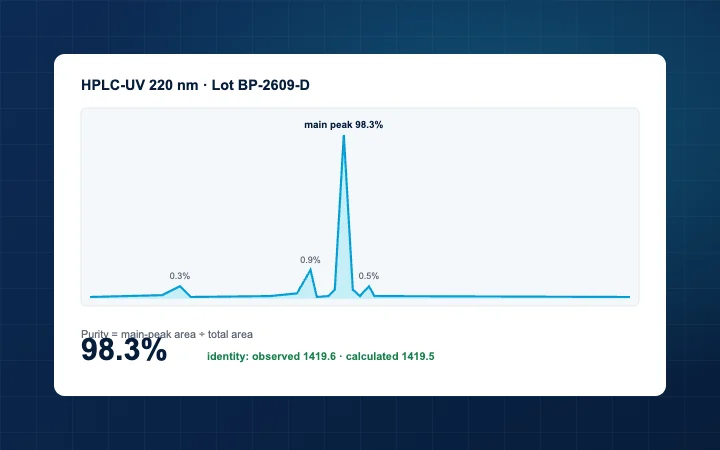
A certificate reporting 99% purity is telling you that 99% of what is present is the compound and 1% is something else — process impurities, truncated sequences, residual solvent. It is a statement about contamination.
It is not automatically a statement about which form the compound is in. If a bottle has shifted substantially from GSH to GSSG, a purity assay that recognises both will still report a high number, because both are glutathione.
So the question to ask of a glutathione certificate is not only how pure but what was measured:
| The assay says | What it tells you |
|---|---|
| Purity, by HPLC | How much of the sample is glutathione in any form |
| Reduced glutathione, GSH | How much is in the reduced form specifically |
| Total glutathione | GSH plus GSSG, usually after a reduction step |
| GSH:GSSG ratio | The redox state of the material — the most informative of the four |
For work that depends on the reducing capacity of the material, the ratio is the number that matters, and it is the one least often printed.
What speeds the reaction up
Five factors, all of them controllable, and all of them the reason the handling instruction is what it is.
Dissolved oxygen. The obvious one. Oxygen is the electron acceptor, and a bottle with a large air headspace oxidises faster than one without. This is why solution products are filled to limit headspace.
Trace metal ions. Copper and iron catalyse thiol oxidation efficiently, at concentrations far below anything visible. Contaminated glassware or a metal-bearing diluent will accelerate the process out of proportion to how much metal is present.
Warmth. Standard kinetics. Every few degrees of additional temperature buys a meaningfully faster reaction.
Light. Contributes indirectly, by generating reactive species that then do the oxidising.
Alkaline pH. The thiol is more reactive in its deprotonated thiolate form, and raising pH pushes the equilibrium towards it. Glutathione solutions are formulated acidic for exactly this reason.
Cold, dark, closed, and slightly acidic. That is the entire handling instruction, and every part of it is doing specific work.
In practice
The glutathione liquid spray is 500 mg in 10 mL at 50 mg/mL, and the same rules apply to it as to any thiol in solution: refrigerate on arrival, keep it closed, keep it dark.
If you are working from the lyophilised powder instead, the powder is the more stable form for the reasons in why some peptides ship as solutions — but the moment it is reconstituted it becomes the same problem, and the clock starts then rather than at manufacture.
One practical habit worth adopting: note the date a bottle was first opened, separately from its manufacture date. For a thiol, cumulative air exposure matters more than calendar age, and nothing on the label records how many times a bottle has been opened.
Every product referenced here is supplied for laboratory research use only and is not for human or animal use.
References
- Meister A, Anderson ME. Glutathione. Annual Review of Biochemistry 1983;52:711-760.
- Rossi R, Milzani A, Dalle-Donne I, et al. Blood glutathione disulfide: in vivo factor or in vitro artifact? Clinical Chemistry 2002;48(5):742-753.
- Manning MC, Chou DK, Murphy BM, Payne RW, Katayama DS. Stability of protein pharmaceuticals: an update. Pharmaceutical Research 2010;27(4):544-575. doi.org/10.1007/s11095-009-0045-6
Every product mentioned is sold for laboratory research use only and is not for human or animal use. Nothing on this page describes or recommends use of the material sold here in humans or animals.