
A certificate of analysis is the most useful document a peptide supplier publishes, and the fastest way to misread one is to assume it covers everything that could be measured. It does not. It covers what was tested, and a research-grade certificate tests a specific and fairly short list.
This post starts with that list, read from our own certificate library, and then covers the three things most often assumed to be on it that are not: water content, residual solvents and counter-ion content. None of those absences is a defect. They are the ordinary scope of a research-grade certificate, and knowing which figures are missing is what lets you ask for them.
What is actually on these certificates?
Every certificate in our COA library carries the same set of lines. Read across all 114 certificates on 29 September 2026, covering 47 compounds, the reported fields are:
| Line | What it reports | Method named on the certificate |
|---|---|---|
| Sample and sample type | The compound name and the physical form, such as a white lyophilized powder | — |
| Molecular weight | The mass the identity result was checked against | — |
| Identity | Whether the observed mass matches the compound | LC-MS/MS on current lots, MALDI-MS on earlier ones |
| Content | Milligrams of material in the vial | — |
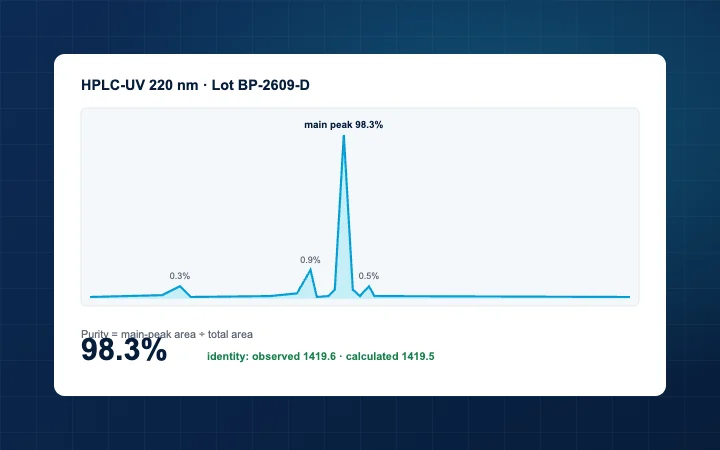
| Purity | Share of the peptide-related material that is the target sequence | RP-HPLC at 214 nm |
| Retention time | Where the main peak eluted in that run | — |
| Endotoxin | Bacterial endotoxin screen, as a limit | — |
| Heavy metals | Elemental screen, as a limit | — |
| Sterility | Reported on some lots, absent on others | — |
| Lot, certificate code, dates, laboratory, verification link | Traceability back to the analysis | — |
That is the whole of it. Our guide to reading a certificate works through each line, and what LC-MS confirms covers the identity line in particular.
Now the three that are not there.
Water content
A lyophilized peptide is freeze-dried, not anhydrous. Some water stays bound in the cake, and the amount matters for more than bookkeeping.
Residual moisture is a reactant. The chemical routes that degrade a peptide in the dry state — hydrolysis of the backbone, deamidation of asparagine and glutamine, and the mobility that lets a solid-state reaction proceed at all — depend on how much water is present. Manning and colleagues' review of protein stability treats the dried state as its own problem for exactly this reason: a dried solid is not an inert solid, and its water content is one of the variables that sets how it ages. Our post on why the vial looks empty covers the physical side of the cake, and the storage guide covers what we do say about handling.
There is a compendial method for this. USP General Chapter 921, Water Determination, exists because, in the chapter's own words, determination of the water content is important in demonstrating compliance with the Pharmacopeial standards. Its Method I is the Karl Fischer titrimetric determination, which measures water through a stoichiometric chemical reaction, so it reports water specifically. The cruder alternative, loss on drying, reports everything volatile that leaves the sample when it is heated, water and solvent together, without separating them.
Our certificates do not report water content, and no Karl Fischer result accompanies them. There is no moisture field on any of the 114 entries in the library. If you need the figure, it is a separate assay.
What follows practically: the mass on the label and the content line both refer to powder that includes some water, so an unstated share of what you weigh out is not peptide. That is the same arithmetic problem net peptide content addresses, and water is one of the two things sitting in the gap.
Residual solvents
Solid-phase synthesis and reversed-phase purification are wet processes. The chain is built and cleaved in organic solvent, the crude material is separated on a column in a water and organic gradient, and the collected fractions are dried. Traces of the organics survive that drying.
USP General Chapter 467 gives the definition used in a pharmacopoeial setting: residual solvents are organic volatile chemicals used or produced in the manufacture of drug substances, excipients or dietary ingredients. The chapter sorts them into classes by toxicological concern, and acetonitrile — the standard organic component of a peptide purification gradient — sits in Class 2, alongside methanol, toluene and chloroform. ICH Q3C(R8), the international guideline the compendial chapters draw on, sets exposure limits for each solvent it lists.
Two things about that framework are worth stating plainly. It is built for pharmaceuticals, and the limits are expressed as human exposure, which is not the question in front of a laboratory buyer. What is relevant on a bench is narrower and more practical: an unstated residual organic is an unstated component of your vehicle. A trace of acetonitrile carried into a cell-based assay is a variable you did not put in your protocol, in the same way the benzyl alcohol in bacteriostatic water is — the problem our post on bacteriostatic water in cell work works through in full.
Our certificates do not report residual solvents. There is no solvent field, no gas-chromatography result, and no statement that a residual-solvent screen was run.
Why a counter-ion is not a residual solvent
These get conflated because trifluoroacetic acid appears in both conversations, and the distinction is worth holding onto.
A residual solvent is a volatile organic left over from a process. It is present in trace amounts, it is not chemically bound to the peptide, and it is measured by a volatiles method such as gas chromatography.
A counter-ion is part of the salt. The peptide's basic sites carry a positive charge and are paired with an anion; that anion is stoichiometric, non-volatile, and a real fraction of the powder's mass. You cannot drive it off by drying.
Trifluoroacetic acid is used as the ion-pairing additive in reversed-phase purification, and what it leaves behind is not a solvent trace — it is trifluoroacetate, the counter-ion. Different thing, different measurement, different consequence.
Counter-ion content
Which brings us to the third gap. The certificates name the compound and its molecular weight, but they do not state the salt form, and they do not quantify the counter-ion.
The consequence is a mass one. Roux and colleagues' evaluation of counter-ion exchange describes how tenaciously trifluoroacetate holds on to cationic peptides and what it takes to remove or exchange it. A sequence with several basic residues carries proportionally more of it, so the share of powder mass that is counter-ion varies by compound rather than being a constant you can subtract. The Bachem quality-control guide treats counter-ion and moisture together for this reason: both are non-peptide mass in the vial, and neither is visible to the purity method.
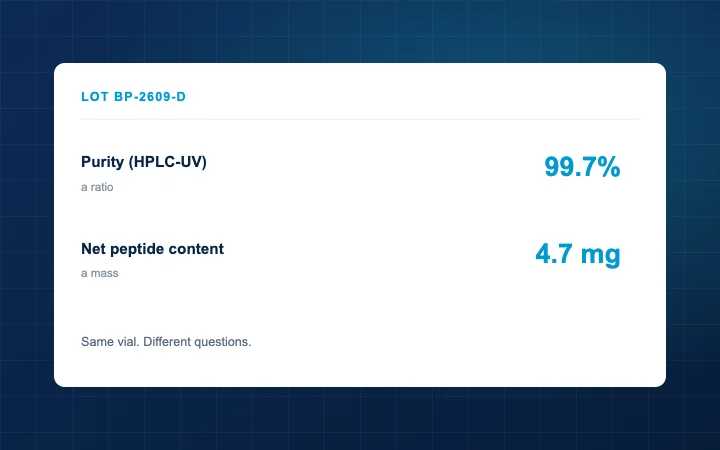
That last point deserves emphasis, because it is the commonest misreading of a certificate. Purity here is RP-HPLC at 214 nm, which detects the peptide bond. Counter-ion, water and inorganic salts are invisible to it. A 99.8% purity figure is entirely consistent with a powder in which a meaningful share of the mass is not peptide at all. Purity and quantity are independent, and our net peptide content post is the long version of that argument, with the salt form post covering what trifluoroacetate versus acetate changes on the bench.
Our certificates state neither the salt form nor a counter-ion percentage.
Why a research-grade certificate stops where it does
Because each of these figures is a separate assay with a separate cost, and because the framework that would require them is a pharmaceutical one.
ICH Q6A, the guideline that governs how specifications are set for new drug substances, is explicit that it does not apply to preclinical or clinical research material. Material supplied for laboratory research is outside the regime that would mandate a water-content limit or a residual-solvent screen. Identity, purity, content, endotoxin and heavy metals run on every lot is a real test list, and the honest way to describe its edges is to name the tests that are not on it, which is what this post is for.
Everything sold here is for in-vitro laboratory research only, and a certificate that reports the tests it ran and does not imply the ones it did not is the more useful document.
What to do about it
Three things, in order of effort.
- Ask the question in its specific form. "Do you have more data on this lot?" gets a vague answer. "Do you have a Karl Fischer water result for lot BP10-0803?" or "was a residual-solvent screen run on this lot, and by what method?" or "is this material the trifluoroacetate salt or the acetate salt?" are answerable questions, and the answer — including a plain no — is information.
- Record the absence rather than filling it in. In a methods section, "water content not reported" and "salt form not stated by the supplier" are legitimate entries, and far better than an assumed figure. Our post on reporting research peptides in a methods section treats "not reported" as a real value.
- Measure it yourself where the experiment turns on it. Water content and salt form are both measurable on material you already hold, and how to test your own peptides covers the route to an independent laboratory.
The general principle is the one our supplier vetting post argues at length: a certificate that names its methods and its limits can be reasoned about. A certificate that implies completeness cannot.
Frequently asked questions
Does a missing water-content figure mean the peptide is wet?
No. It means the figure was not measured on that lot. A properly freeze-dried peptide holds a small amount of residual water either way; without a result you do not know the number, which is different from knowing it is high.
Is trifluoroacetate a contaminant?
Not in the sense of a failed synthesis. It is the counter-ion of the salt as purified, it is expected, and it is not counted in the purity figure because the purity method cannot see it. Whether it matters depends on your assay — the salt form post sets out where it does.
Could a residual solvent show up on the chromatogram?
Sometimes, and it would not be identified as one. Small volatile organics can absorb at the detection wavelength and appear as an early peak near the solvent front, which is also where genuine peptide-related material can elute. Reading peaks at the front of a run is covered in how to read an HPLC chromatogram. Confirming a solvent's identity needs gas chromatography, not the purity run.
Which of the three matters most?
It depends entirely on the experiment. For molar arithmetic and any concentration you intend to publish, counter-ion and water content both matter, because both inflate the mass you weigh. For a cell-based assay with a sensitive readout, an unstated residual solvent in the vehicle is the one that can quietly produce an effect. For a handling step, none of them will change what you do.
Are there other things a certificate does not test for?
Yes — several. These certificates do not characterise the individual impurity peaks, which is the subject of what is in the other 1%; they do not establish stability over time; and with sterility reported on some lots and not others, that line has to be read per certificate rather than assumed. The general point holds: read the test list, not the letterhead.
References
- USP-NF General Chapter 921, Water Determination. Read 29 September 2026; the chapter states that determination of water content is important in demonstrating compliance with the Pharmacopeial standards. Method text is behind a subscription. doi.usp.org/USPNF/USPNF_M99710_02_01.html
- USP-NF General Chapter 467, Residual Solvents. Read 29 September 2026; defines residual solvents for pharmacopeial purposes as organic volatile chemicals used or produced in the manufacture of drug substances, excipients or dietary ingredients, and places acetonitrile, methanol, toluene and chloroform in Class 2. doi.usp.org/USPNF/USPNF_M99226_07_01.html
- ICH Q3C(R8), Impurities: Guideline for Residual Solvents. Step 4 version dated 22 April 2021. database.ich.org/sites/default/files/ICH_Q3C-R8_Guideline_Step4_2021_0422_1.pdf
- Manning MC, Chou DK, Murphy BM, Payne RW, Katayama DS. Stability of protein pharmaceuticals: an update. Pharmaceutical Research 2010;27(4):544-575. doi.org/10.1007/s11095-009-0045-6
- Roux S, Zekri E, Rousseau B, et al. Elimination and exchange of trifluoroacetate counter-ion from cationic peptides: a critical evaluation of different approaches. Journal of Peptide Science 2007;14(3):354-359. doi.org/10.1002/psc.951
- Bachem. Quality Control of Amino Acids and Peptides: A Guide. Net peptide content, counter-ions and moisture. www.bachem.com/knowledge-center/quality-control-of-amino-acids-peptides-a-guide
- ICH Q6A, Specifications: Test Procedures and Acceptance Criteria for New Drug Substances and New Drug Products: Chemical Substances. Cited for its scope statement that it does not apply to the regulation of preclinical or clinical research material. database.ich.org/sites/default/files/Q6A_Guideline.pdf
- Pepstral certificate library, src/coa.json. Point-in-time read of all 114 certificates on 29 September 2026: 47 compounds, no field for water content, residual solvents, counter-ion or salt form. coa.html
Every product mentioned is sold for laboratory research use only and is not for human or animal use. Nothing on this page describes or recommends use of the material sold here in humans or animals.