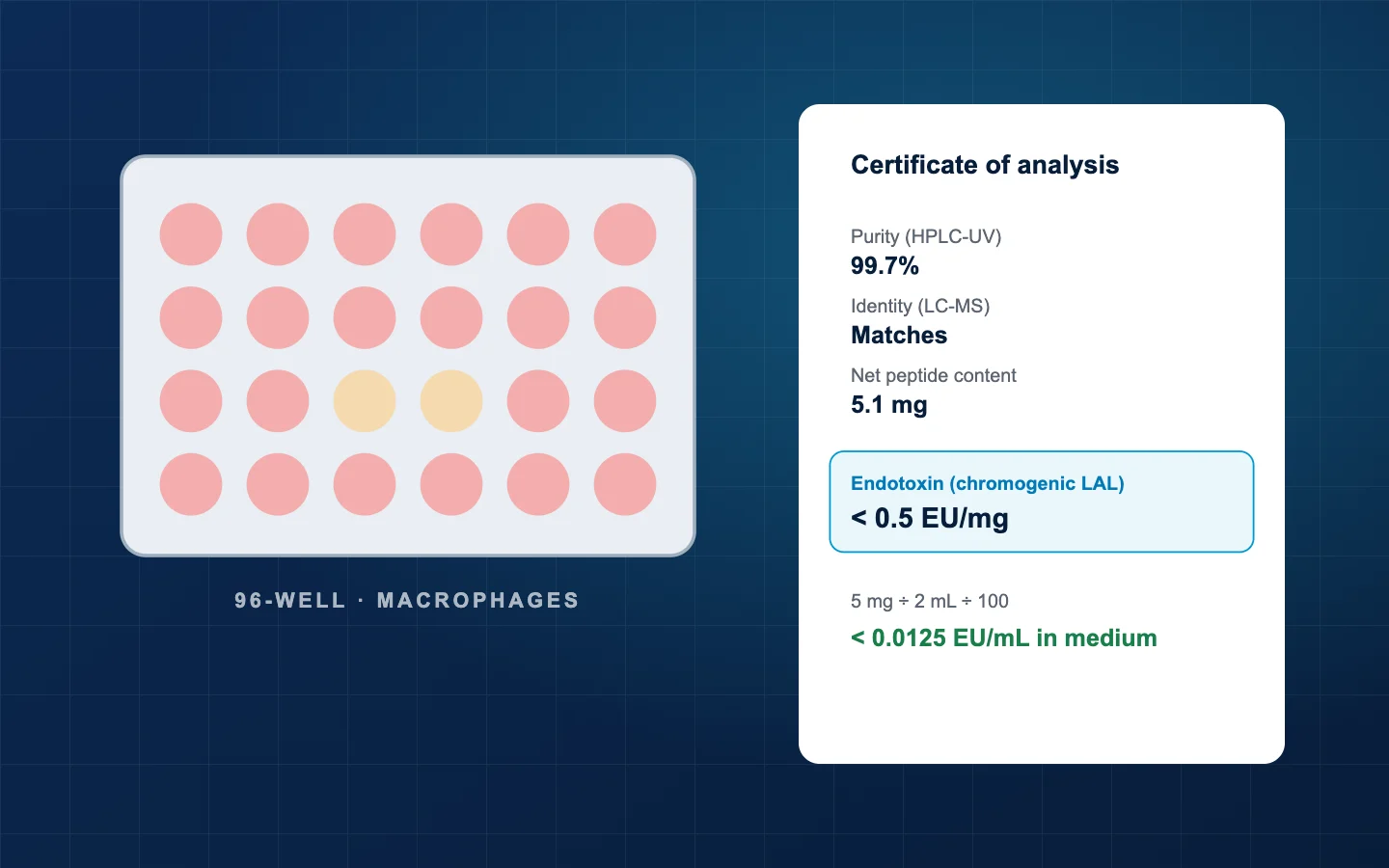
Endotoxin is the one contaminant a research peptide can carry that affects cells without the peptide doing anything at all. It is lipopolysaccharide from the outer membrane of Gram-negative bacteria, it survives the sterile filtration and freeze-drying that kill the bacteria themselves, and immune cells respond to it at concentrations far below anything visible. The endotoxin line on a certificate is the only way to know how much is in the vial.
This post explains the test, gives a dilution table for every vial in the catalog, says which cell types care and which do not, and covers what to do when a certificate has no endotoxin line at all.
What is endotoxin and why does it survive?
Lipopolysaccharide is a structural component of the bacterial outer membrane, released when bacteria die and shed continuously while they live. It is heat-stable enough to survive autoclaving, small enough to pass a 0.22 micron sterile filter, and sticky enough to adsorb onto glass and plastic.
A process can be sterile, with no living organisms at all, and still carry endotoxin from water, reagents or equipment that once had bacteria in them. Sterility and endotoxin are therefore two separate tests, and a certificate that reports one is not reporting the other.
How is endotoxin measured?
The standard method is the Limulus amebocyte lysate assay, described in United States Pharmacopeia chapter 85. The lysate, derived from horseshoe crab blood cells, clots or changes colour in the presence of endotoxin. Three formats are recognised:
| Format | What it reads | What it reports |
|---|---|---|
| Gel-clot | Whether a clot forms at a fixed dilution | Pass or fail against a limit |
| Turbidimetric | Rate of clouding | A quantitative value |
| Chromogenic | Rate of colour change | A quantitative value |
A recombinant Factor C assay, which uses a synthetic version of the lysate's active protein, is an accepted alternative. A certificate should say which format was used and the limit tested against, for example "chromogenic LAL, below 0.5 EU/mg". The FDA's inspection guide on bacterial endotoxins describes the same methods and the controls a valid run needs.
Results are given in endotoxin units, a measure of biological activity against a reference standard rather than a mass. One endotoxin unit corresponds to roughly a tenth of a nanogram of the reference lipopolysaccharide, though the mass equivalent varies with the bacterial source.
How do you convert the certificate figure to your assay?
The certificate reports EU per milligram of peptide. Your cells see EU per millilitre of medium. Three multiplications connect them:
| Step | Calculation | Example |
|---|---|---|
| Total in the vial | EU/mg × net mg in the vial | 0.5 EU/mg × 5 mg = 2.5 EU |
| Stock concentration | total EU ÷ reconstitution volume | 2.5 EU ÷ 2 mL = 1.25 EU/mL |
| Working concentration | stock ÷ dilution factor into medium | 1.25 EU/mL ÷ 100 = 0.0125 EU/mL |
At a 1:100 dilution, a vial at the 0.5 EU/mg limit contributes about 0.0125 EU/mL to the culture, roughly a picogram of lipopolysaccharide per millilitre. At a 1:10 dilution the figure is ten times higher.
What does each catalog vial contribute at the limit?
Every lot is tested against a limit of 0.5 EU/mg. The table below assumes a lot exactly at that limit, which is the worst case a passing certificate allows, reconstituted in 2 mL:
| Vial | Worst-case EU in vial | Stock, 2 mL | Medium at 1:10 | Medium at 1:100 | Medium at 1:1000 |
|---|---|---|---|---|---|
| BPC-157 5 mg | 2.5 | 1.25 EU/mL | 0.125 | 0.0125 | 0.00125 |
| TB-500 5 mg | 2.5 | 1.25 EU/mL | 0.125 | 0.0125 | 0.00125 |
| GHK-Cu 50 mg | 25 | 12.5 EU/mL | 1.25 | 0.125 | 0.0125 |
| MOTS-c 10 mg | 5 | 2.5 EU/mL | 0.25 | 0.025 | 0.0025 |
| NAD+ 500 mg | 250 | 125 EU/mL | 12.5 | 1.25 | 0.125 |
The pattern is the point. A 5 mg vial at the limit is comfortably low for most cell work at any normal dilution. A 500 mg vial at the same per-milligram limit is not, because the mass is a hundred times larger; at a 1:10 dilution it is in the range where sensitive cells respond. For large-mass vials used with immune cells, ask for the numeric result rather than the pass or fail, and run the arithmetic with the actual figure.
Which cells care?
Cell sensitivity to endotoxin varies by orders of magnitude. Vendor technical notes on cell culture report that some lines show altered behaviour below a nanogram per millilitre, which is about 10 EU/mL, while others tolerate far more.
| Cell type | Sensitivity | Typical artefact |
|---|---|---|
| Macrophages, monocytes, dendritic cells | High | Cytokine release, activation markers |
| Primary immune cells, T cells | High | Proliferation, cytokine changes |
| Endothelial cells | Moderate to high | Adhesion molecule expression, permeability |
| Stem cells and differentiating cultures | Moderate | Altered differentiation, growth |
| Established epithelial and fibroblast lines | Low to moderate | Usually none at trace levels |
| Biochemical assays with no cells | None | Not applicable |
Uehara and colleagues reported in 2024 a case where endotoxin arriving with a medium supplement changed experimental outcomes before it was traced, which is the practical risk: the peptide gets blamed for an effect the contaminant caused. Compounds studied in inflammatory and repair models, such as BPC-157, TB-500 and GHK-Cu, are exactly the ones where an endotoxin artefact would look like a result.
What should you look for on the certificate?
- A numeric result or a "below" limit, with units of EU/mg or EU/vial.
- The method named: gel-clot, turbidimetric, chromogenic or recombinant Factor C.
- A lot number that matches the vial.
- Sterility reported separately, if it was tested.
A certificate with no endotoxin line has not measured it. That does not prove contamination, but it means the vial is uncharacterised for cell work.
What if the certificate has no endotoxin line?
Three options, in order of cost. Ask the supplier whether the lot was tested and the line omitted; sometimes it was. Send a sealed vial to an independent lab, which offers endotoxin as an add-on to the standard panel, as the independent testing post describes. Or run a commercial LAL kit on your reconstituted stock; chromogenic kits are inexpensive and take about an hour, and the result applies to the exact solution you will use, which is better than any certificate for a sensitive assay.
Frequently asked questions
Can I remove endotoxin from a peptide solution?
Partially, with affinity columns that bind lipopolysaccharide, but peptides with basic residues bind to the same columns and losses can be large. Starting with a certified low-endotoxin lot is far more practical than cleaning up a contaminated one.
Does bacteriostatic water add endotoxin?
Pharmaceutical-grade bacteriostatic water is itself endotoxin-tested to a limit. Water from an uncertified source is one of the most common ways endotoxin enters a preparation, which is why the reconstitution guide specifies the water to use.
Is sterile the same as endotoxin-free?
No. Sterile means no viable organisms. Endotoxin is a molecule left behind by organisms that may be long dead, and it passes the filter that makes a solution sterile.
What limit should I ask a supplier for?
Below 0.5 EU/mg is a reasonable default for research material and is the limit our lots are tested against. For sensitive primary immune cells at low dilution, or for large-mass vials, do the arithmetic above and, if the result is close to your cells' threshold, ask for the numeric result rather than the pass or fail.
References
- United States Pharmacopeia. General Chapter <85> Bacterial Endotoxins Test. www.usp.org/harmonization-standards/pdg/general-methods/bacterial-endotoxins
- US Food and Drug Administration. Inspection Technical Guide: Bacterial Endotoxins/Pyrogens. www.fda.gov/inspections-compliance-enforcement-and-criminal-investigations/inspection-technical-guides/bacterial-endotoxinspyrogens
- Uehara K, Oshiro E, Ochiai A, et al. Lessons learned from contamination with endotoxin originated from the supplement in the cell culture medium. Regenerative Therapy 2024;27:230-233. doi.org/10.1016/j.reth.2024.03.022
- Corning. Endotoxins and Cell Culture. Technical Bulletin TC-305. www.corning.com/catalog/cls/documents/application-notes/TC-305.pdf
Every product mentioned is sold for laboratory research use only and is not for human or animal use. Nothing on this page describes or recommends use of the material sold here in humans or animals.