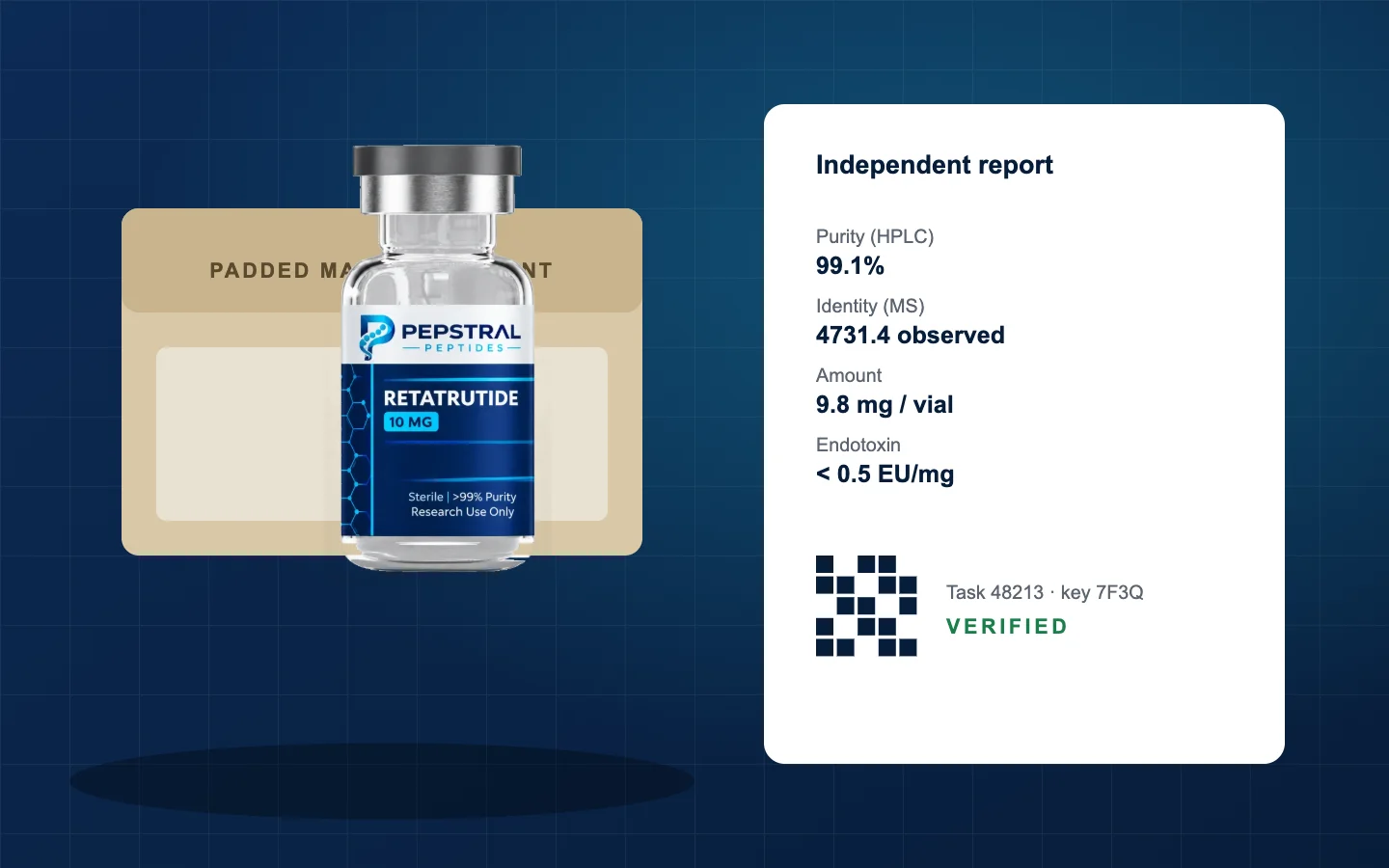
You can verify a vial yourself. Independent analytical labs accept a single sealed vial from anyone, run HPLC for purity and mass spectrometry for identity, weigh how much peptide is actually inside, and return a report that can be checked online. For a common compound the test costs about the price of four vials and takes about a week. If a supplier's certificate and an independent report disagree, the independent report wins.
This post covers when a test is worth running, what to send, what the report shows, how to compare it with the certificate, and what to do about each kind of disagreement.
When is an independent test worth it?
Three situations justify the cost:
- You are qualifying a new supplier and want one data point that does not come from them.
- The peptide is the variable in a study whose result will be published or acted on.
- A lot behaves differently from the last one and you want to rule out the material before you rule out the protocol.
For routine restocking from a supplier whose lot-matched certificates have checked out before, the supplier's certificate is normally enough. Set against the cost of a wasted study, a $215 test on the first vial from a new source is cheap insurance; set against a $60 vial for a pilot experiment, it is not.
Which labs accept single vials?
Janoshik Analytical, based in the Czech Republic, is the lab most researchers use because it accepts samples from anywhere, sells tests per compound through an online shop, and publishes a verification page where any report can be checked by its task number and unique key. Its BPC-157 analysis, as an example of a standard single-compound test, was listed on 11 September 2026 at:
| Item | Detail |
|---|---|
| Test | Identity, amount and purity by HPLC |
| Price | $215 |
| Sample | One whole unopened lyophilized vial |
| Turnaround | About 7 business days |
| Optional add-ons | Endotoxin ($180), TFA analysis, heavy metals, sterility, raw data |
| Result format | mg of peptide per vial and peptide purity |
Prices differ by compound and change over time, so treat the figures as a scale rather than a quote and read the current listing before ordering. Other labs run the same panel for institutional customers and some will take individual orders on request. What matters is the same three lines, purity, identity and amount, on a report you can verify, using the methods Bachem's guide describes: HPLC for purity, mass spectrometry for identity, and a content method for net peptide.
What do you send?
An unopened vial, not a reconstituted one. The lab needs the whole lyophilized content to weigh the peptide, and an opened vial has already started absorbing moisture. A submission checklist:
- Order the test first. The lab sends packing and labelling instructions with the order.
- Keep the label and lot number on the vial. Photograph it before packing.
- Write the lot number and the supplier in the order notes so the report can be matched to the certificate later.
- Pack in a padded envelope or small box. Lyophilized peptide tolerates a week in transit at ambient temperature.
- Note the tracking number and the date sent against the lot in your lab record.
What comes back?
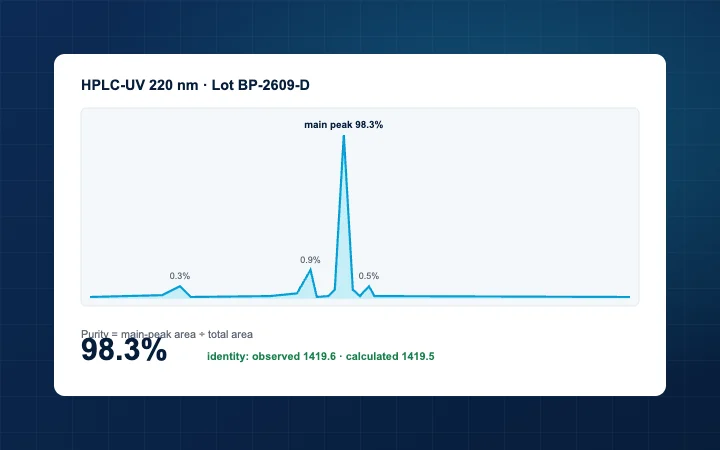
A report with three numbers and a chromatogram. Purity is the main-peak area as a percentage of all peaks. Identity is the observed mass from mass spectrometry compared with the calculated mass of the sequence; the reference table gives the calculated mass for every compound in the catalog. Amount is milligrams of peptide found in the vial, which is the number that tells you whether a 5 mg label meant 5 mg of peptide or 5 mg of powder.
The report carries a task number and a key. Enter them on the lab's verification page and it confirms the report is genuine and unaltered. A report that cannot be verified that way is not independent evidence.
How do you compare it with the supplier's certificate?
Line the two up:
| Line | Supplier certificate | Independent report | Read it as |
|---|---|---|---|
| Purity | 99.7% | 99.1% | Agreement; different columns integrate differently |
| Purity | 99.7% | 92.0% | Disagreement; ask the supplier for the lab name and raw data |
| Identity | Mass matches | Mass matches | Correct compound |
| Identity | Mass matches | Mass does not match | Wrong compound or wrong label; stop using the lot |
| Amount | 5 mg net stated | 4.9 mg | Agreement |
| Amount | 5 mg stated | 3.6 mg | Gross-weight fill or short fill; adjust concentrations and raise it |
A gap of a point or so in purity between labs is normal. A gap in identity is never normal. A gap in amount larger than 10% means the label overstates the peptide, and every concentration calculated from that label is off by the same proportion.
What do you do about each kind of disagreement?
- Purity gap of more than about two points. Ask the supplier which laboratory ran the lot and for the raw chromatogram. If they cannot name the lab, the certificate was not independent. Keep using the vial only for work that tolerates the lower figure.
- Identity mismatch. Quarantine the lot. Report it to the supplier with the independent report attached. Do not use the material for anything, because you do not know what it is.
- Amount short by more than 10%. Recalculate every concentration from the measured milligrams, not the label. Raise it with the supplier; a short fill on one vial is often a short fill on the lot.
- Endotoxin above the certificate limit. Relevant only for cell work; the endotoxin post explains the arithmetic. Ask for the supplier's LAL method and result.
What we do with the result
Send the report to support and we compare it with the lot certificate. If the independent result falls outside the certificate's numbers, the shipping and returns page sets out what happens next, and the lot is pulled from sale while it is re-tested. Independent reports on our lots are welcome; they are the cheapest audit we can get. The lots most often sent for testing are the GLP-1 class, and the retatrutide and semaglutide product pages carry the certificate you would be comparing against.
Frequently asked questions
Can I test a reconstituted vial?
Purity and identity can still be measured from solution, but the amount per vial cannot, and the result will reflect any degradation since reconstitution. Send a sealed vial from the same lot instead.
Does testing use up the vial?
Yes. The lab consumes the sample. Budget one vial per lot you want tested.
How do I know the independent report is real?
Use the lab's verification page with the task number and key printed on the report. A report that cannot be verified that way is not independent evidence.
Is one test per lot enough?
For qualifying a supplier, one vial per lot is the usual practice. For published work, test the vial you actually used, or one from the same lot opened at the same time.
References
- Janoshik Analytical. BPC-157 analysis: ID, amount and purity, price, sample and turnaround. Read 11 September 2026. janoshik.com/pricelist/bpc-157-analysis
- Janoshik Analytical. Report verification by task number and unique key. janoshik.com/verify
- Bachem. Quality Control of Amino Acids and Peptides: A Guide. Methods for purity, identity and net content. www.bachem.com/knowledge-center/quality-control-of-amino-acids-peptides-a-guide
- United States Pharmacopeia. General Chapter <85> Bacterial Endotoxins Test. www.usp.org/harmonization-standards/pdg/general-methods/bacterial-endotoxins
Every product mentioned is sold for laboratory research use only and is not for human or animal use. Nothing on this page describes or recommends use of the material sold here in humans or animals.