
SNAP-8 is acetyl octapeptide-3: the sequence Glu-Glu-Met-Gln-Arg-Arg-Ala-Asp with an acetyl group on the N-terminus and an amide on the C-terminus, a mass of 1075.2, and a design that copies the N-terminal end of the protein SNAP-25. It is the eight-residue successor to argireline, the six-residue peptide Blanes-Mira and colleagues described in 2002, and it exists for one idea: a fragment of SNAP-25 that competes with the real protein for a place in the SNARE complex. This post gives the sequence and its origin, explains what the SNARE complex is and what the peptide is meant to interfere with, sets out honestly what its literature covers, and reads the current certificate for the SNAP-8 in the catalogue.
What is the sequence?
| Sequence | Residues | Mass | |
|---|---|---|---|
| Argireline (acetyl hexapeptide-3) | Ac-Glu-Glu-Met-Gln-Arg-Arg-NH2 | 6 | 888.9 |
| SNAP-8 (acetyl octapeptide-3) | Ac-Glu-Glu-Met-Gln-Arg-Arg-Ala-Asp-NH2 | 8 | 1075.2 |
The mass is worth checking by hand once, because it settles a discrepancy. Summing the residue masses (two glutamates, methionine, glutamine, two arginines, alanine, aspartate) gives 1016.1; adding the terminal water gives 1034.1; the acetyl adds 42.0 and the amide removes 1.0, giving 1075.2. That is what the certificate reports. The catalogue's reference table carried 1073.2 until this post was written and has been corrected. The sequence post covers the one-letter form, EEMQRRAD, and the Semax amidate post what the two caps do to a peptide's charge and stability.
At neutral pH the two glutamates and the aspartate are negative and the two arginines positive, so the capped peptide carries a net charge of about −1 and is freely water-soluble. The methionine at position 3 is the one residue that oxidises, which the glutathione post explains for thiols and which applies to thioethers in the same way: store solutions cold and dark.
What is the SNARE complex, and what does the peptide copy?
Vesicle fusion, the step in which a vesicle's membrane merges with the cell membrane to release its contents, is driven by three proteins that wind together into a four-helix bundle: SNAP-25 (which contributes two helices), syntaxin and VAMP, collectively the SNARE proteins, described by Söllner and colleagues in 1993. Assembly of the bundle pulls the two membranes together.
SNAP-8 copies the sequence at the N-terminal end of SNAP-25's first helix. The design hypothesis, from the argireline work, is that a free fragment of that region can occupy the site the real protein would take, so that fewer complete complexes form and vesicle fusion is reduced in the cells exposed to it. It is a competitive-fragment idea, the same logic as the PE-22-28 fragment or the KPV fragment, applied to a protein-protein assembly rather than a receptor.
What does the literature actually cover?
Topical and in-vitro cosmetic science, almost entirely. Blanes-Mira's 2002 paper on argireline reported reduced SNARE complex formation in an in-vitro assembly assay and reduced neurotransmitter release in a cell model, alongside a small topical study; SNAP-8 was developed as a longer version of the same fragment and its published work follows the same pattern. It is sold and studied as a cosmetic-ingredient peptide, with an INCI name, and that is the context in which its assays make sense: SNARE assembly in vitro, exocytosis readouts in cell lines, and formulation work.
What it is not: a receptor ligand. It binds no receptor, has no systemic pharmacology in the literature, and the receptor table lists it as targeting a protein assembly rather than a receptor. A methods section should describe it as an acetylated SNAP-25 N-terminal mimetic and cite the argireline lineage, and should not borrow language from the peptide hormones it shares a catalogue with.
What does the certificate report?
Lot SN810-0803, certificate COA7620, issued by Bioviridian Inc. on 17 August 2026 against a 10 mg sample of white lyophilized powder, published unaltered on the certificate page.
| Certificate line | Result | What it tells you |
|---|---|---|
| Identity, LC-MS/MS | SNAP-8, observed mass 1075.2 | Matches the capped octapeptide; argireline would read 888.9 and the uncapped peptide 1034 |
| Content, HPLC quantitation | 10.47 mg | Overage against the 10 mg label |
| Purity, RP-HPLC at 214 nm | 99.75% | One main peak; the chromatogram post covers the trace |
| Endotoxin | < 0.05 EU/mL | Suitable for cell work |
| Heavy metals | Conforms | August 2026 layout |
The identity mass does real work here because the two closely related products, argireline and SNAP-8, differ by two residues and 186 mass units, and both are sold under similar names. A certificate reading 1075 is the octapeptide.
How many molecules are in 10 mg?
| Vial | Moles | In 1 mL | In 5 mL |
|---|---|---|---|
| 10 mg | 10 mg ÷ 1075.2 g/mol = 9.30 µmol | 9.30 mM | 1.86 mM |
The in-vitro SNARE assays in the literature use micromolar to low-millimolar concentrations, higher than receptor assays, so a 10 mg vial is a sensible size for that work. The molarity post and the vial-size post cover the arithmetic.
How is it handled?
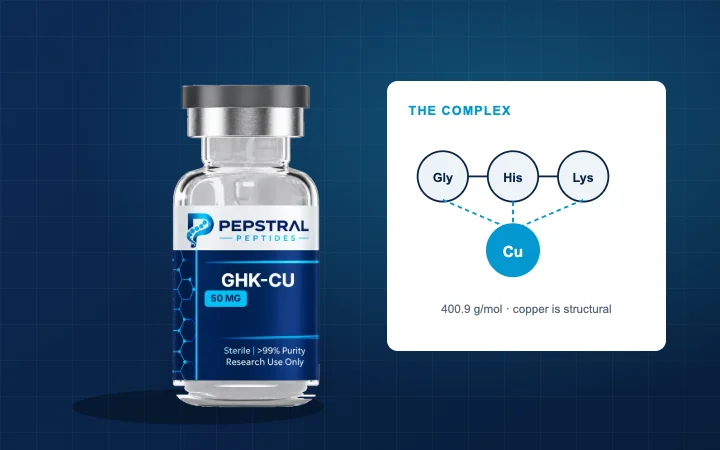
As a water-soluble, capped short peptide with one oxidisable residue. It dissolves immediately in water or reconstitution solution; for topical-formulation work it is also soluble in the aqueous phase of most vehicles. The caps protect both termini from exopeptidases, so it is relatively persistent in cell medium. Keep solutions cold and dark for the methionine's sake, and follow the reconstituted-lifetime post for windows. It is shelved with GHK-Cu and the Glow Mix blend because they share a research context, not a mechanism; GHK-Cu's copper chemistry, covered in the GHK-Cu post, has nothing in common with SNARE mimicry.
Frequently asked questions
Is SNAP-8 the same as argireline?
No. Argireline is the six-residue peptide; SNAP-8 adds alanine and aspartate at the C-terminus. Both are capped. The certificate masses, 888.9 and 1075.2, separate them.
Is SNAP-8 related to SNAP-25?
It copies a short sequence from the N-terminal end of SNAP-25. It is a synthetic fragment mimic, not a piece of the protein, and it is not related to snap-frozen or any other laboratory use of the word.
Why is the mass 1075.2 when some references say 1073.2?
Because 1075.2 is what the sequence weighs and what the certificate measures. The 1073.2 figure appeared in this catalogue's own reference table until 28 September 2026 and was an error; it has been corrected.
Does SNAP-8 act on a receptor?
No. Its target is a protein assembly, the SNARE complex, and its literature is in-vitro assembly and exocytosis work in the cosmetic-science tradition.
What should the methods section record?
"SNAP-8 (acetyl octapeptide-3, Ac-EEMQRRAD-NH2)", the supplier, lot SN810-0803, certificate COA7620, the observed mass, and the stock concentration in molar terms. The methods-section post has the template.
References
- Blanes-Mira C, Clemente J, Jodas G, et al. A synthetic hexapeptide (Argireline) with antiwrinkle activity. International Journal of Cosmetic Science 2002;24(5):303-310. doi.org/10.1046/j.1467-2494.2002.00153.x
- Söllner T, Whiteheart SW, Brunner M, et al. SNAP receptors implicated in vesicle targeting and fusion. Nature 1993;362(6418):318-324. doi.org/10.1038/362318a0
- Bioviridian Inc. Certificate of analysis COA7620, SNAP-8 10 mg, lot SN810-0803, issued 17 August 2026. coa.html
Every product mentioned is sold for laboratory research use only and is not for human or animal use. Nothing on this page describes or recommends use of the material sold here in humans or animals.