
KPV is the tripeptide lysine-proline-valine, the last three residues of the thirteen-residue hormone alpha-MSH. Its CAS number is 67727-97-3, its PubChem CID is 125672, and its mass is 342.43. It is studied because the C-terminal fragment keeps the anti-inflammatory signalling reported for the parent hormone while lacking the melanocortin-receptor activity that drives pigmentation, so the two can be separated experimentally. This post gives the identifiers a methods section needs, summarises the two findings the compound's literature rests on, works the molar arithmetic for the catalogue's 10 mg vial, and reads the current certificate for the KPV in the catalogue.
What are the identifiers?
Short peptides are sold under abbreviations, and an abbreviation is not an identifier. These are.
| Identifier | Value |
|---|---|
| Sequence | Lys-Pro-Val (one-letter: KPV) |
| Position in alpha-MSH | Residues 11 to 13 of the 13-residue hormone |
| CAS registry number | 67727-97-3 |
| PubChem CID | 125672 |
| Formula | C16H30N4O4 |
| Mass | 342.43 g/mol (certificate: 342.4) |
| Termini | Free amine, free acid |
| Charge at pH 7 | About +1 (lysine side chain and N-terminus, minus the C-terminal acid) |
The five-names post explains why the CAS number and the CID are the two identifiers that resolve to one molecule; for a tripeptide, they are also the only way to distinguish it from the many other three-residue compounds in a catalogue, which the Khavinson series comparison makes concrete. The sequence post covers the one-letter code.
Where does KPV come from, and why the last three residues?
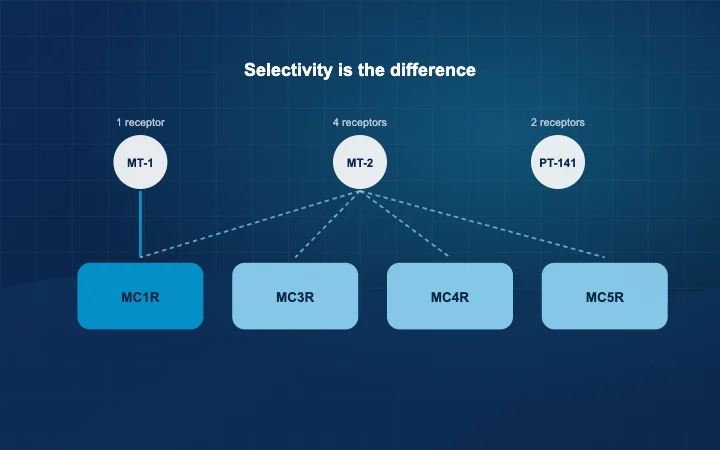
Alpha-melanocyte-stimulating hormone is thirteen residues: Ser-Tyr-Ser-Met-Glu-His-Phe-Arg-Trp-Gly-Lys-Pro-Val, acetylated at one end and amidated at the other. Its pigmentary activity depends on the central His-Phe-Arg-Trp motif, the sequence the melanocortin receptor post describes and the sequence that melanotan-1 and PT-141 are built around.
Hiltz and Lipton reported in 1989 that the C-terminal fragment, Lys-Pro-Val, reproduced the hormone's anti-inflammatory effect in their models without that motif. That separation is the reason KPV exists as a research compound: it lets a study ask whether an effect of alpha-MSH depends on the melanocortin receptors or not, by using a fragment that does not engage them.
Dalmasso and colleagues added the second finding in 2008: intestinal epithelial cells take KPV up through PepT1, the transporter that carries di- and tripeptides across the gut wall, and the uptake was associated with reduced inflammatory signalling in their cell and mouse models. It is the reason KPV appears in epithelial and mucosal model work, and the reason a study in those models should confirm PepT1 expression in the cell line before attributing an effect to uptake.
Why is it not shelved with the melanocortin agonists?
Because it does not act like one. The melanocortin agonists in the catalogue, melanotan-1, melanotan-2 and PT-141, are built around the His-Phe-Arg-Trp motif and are characterised by receptor binding and selectivity. KPV lacks the motif and is characterised by an inflammatory readout, so it sits with the repair-class compounds alongside BPC-157 and GHK-Cu, with which it shares an assay class rather than a mechanism. The receptor table lists the target for each of the melanocortin agonists; KPV is the fragment that was made to lack one.
How many molecules are in a 10 mg vial?
| Vial | Moles | In 1 mL | In 2 mL | In 5 mL |
|---|---|---|---|---|
| 10 mg | 10 mg ÷ 342.43 g/mol = 29.2 µmol | 29.2 mM | 14.6 mM | 5.8 mM |
For a 10 µM working concentration from a 29.2 mM stock, the dilution is about 1 in 2,900. The molarity post explains why this matters: 10 mg of KPV is nearly ten times as many molecules as 10 mg of a 3 kDa peptide, and a study that matches mass concentrations across the two is comparing very different molar amounts.
How does a 342-dalton tripeptide behave in solution?
It dissolves immediately in water or reconstitution solution, gives a clear solution, does not aggregate, and does not need a carrier protein. The tripeptides post explains why compounds this short behave more like small organic molecules than like the longer peptides. Two cautions remain. The free N-terminus and C-terminus are exposed to exopeptidases in serum-containing medium, so lifetime in a culture well is limited, and the reconstituted-lifetime post gives the storage windows for the stock. And a peptide with a lysine and a free amine is hygroscopic as a powder, so keep the vial sealed until it reaches room temperature.
What does the current certificate report?
Lot KPV10-0318, certificate COA7614, issued by Bioviridian Inc. on 17 August 2026 against a 10 mg sample of white lyophilized powder, published unaltered on the certificate page.
| Certificate line | Result | What it tells you |
|---|---|---|
| Identity, LC-MS/MS | KPV, observed mass 342.4 | Matches Lys-Pro-Val; any other three residues would give a different mass |
| Content, HPLC quantitation | 10.20 mg | Overage against the 10 mg label |
| Purity, RP-HPLC at 214 nm | 99.73% | One main peak |
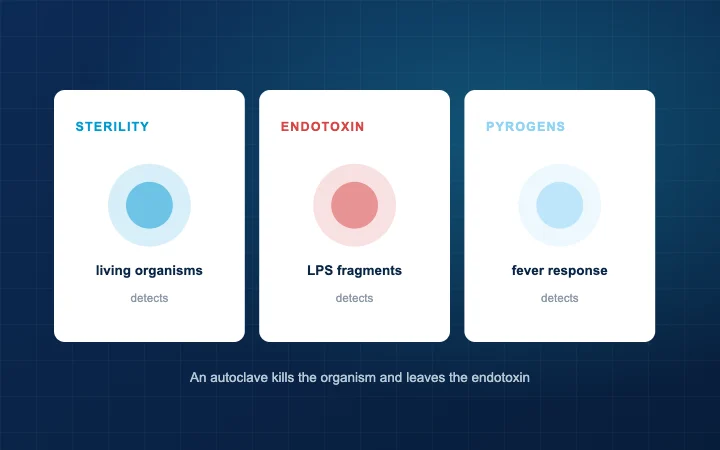
| Endotoxin | < 0.05 EU/mL | Essential for a compound studied in inflammatory models, where endotoxin would produce the signal being measured |
| Heavy metals | Conforms | On the August 2026 layout |
As with thymosin alpha-1, the endotoxin line is the one to read first for this compound. KPV's literature is an inflammatory readout, and endotoxin is a potent inflammatory stimulus; a certificate line below 0.05 EU/mL is what lets a result be attributed to the peptide rather than to a contaminant. The endotoxin post explains the unit and its conversion.
Frequently asked questions
What is the CAS number for KPV?
67727-97-3. The PubChem CID is 125672.
Is KPV a melanotan?
No. The melanotans are alpha-MSH analogues built around the receptor-binding motif. KPV is the C-terminal tripeptide that lacks it, and it is studied for exactly that reason.
Does KPV have pigmentary activity?
Not in the literature that characterises it. Hiltz and Lipton's point was that the anti-inflammatory activity and the pigmentary activity of alpha-MSH reside in different parts of the sequence.
Why is the certificate identity by LC-MS/MS rather than sequencing?
For a tripeptide, the exact mass is nearly as specific as a sequence, because few three-residue combinations share it. The tripeptide certificate post explains the limits of that argument.
How should the methods section name it?
"KPV (Lys-Pro-Val, CAS 67727-97-3)", the supplier, lot KPV10-0318, certificate COA7614, and the stock concentration in molar terms. The methods-section post has the template.
References
- Hiltz ME, Lipton JM. Antiinflammatory activity of a COOH-terminal fragment of the neuropeptide alpha-MSH. FASEB Journal 1989;3(11):2282-2284. pubmed.ncbi.nlm.nih.gov/2550304
- Dalmasso G, Charrier-Hisamuddin L, Nguyen HT, et al. PepT1-mediated tripeptide KPV uptake reduces intestinal inflammation. Gastroenterology 2008;134(1):166-178. doi.org/10.1053/j.gastro.2007.10.026
- PubChem, National Library of Medicine. Lys-Pro-Val, CID 125672, C16H30N4O4, 342.43 g/mol, CAS 67727-97-3. Read 27 September 2026. pubchem.ncbi.nlm.nih.gov/compound/125672
Every product mentioned is sold for laboratory research use only and is not for human or animal use. Nothing on this page describes or recommends use of the material sold here in humans or animals.