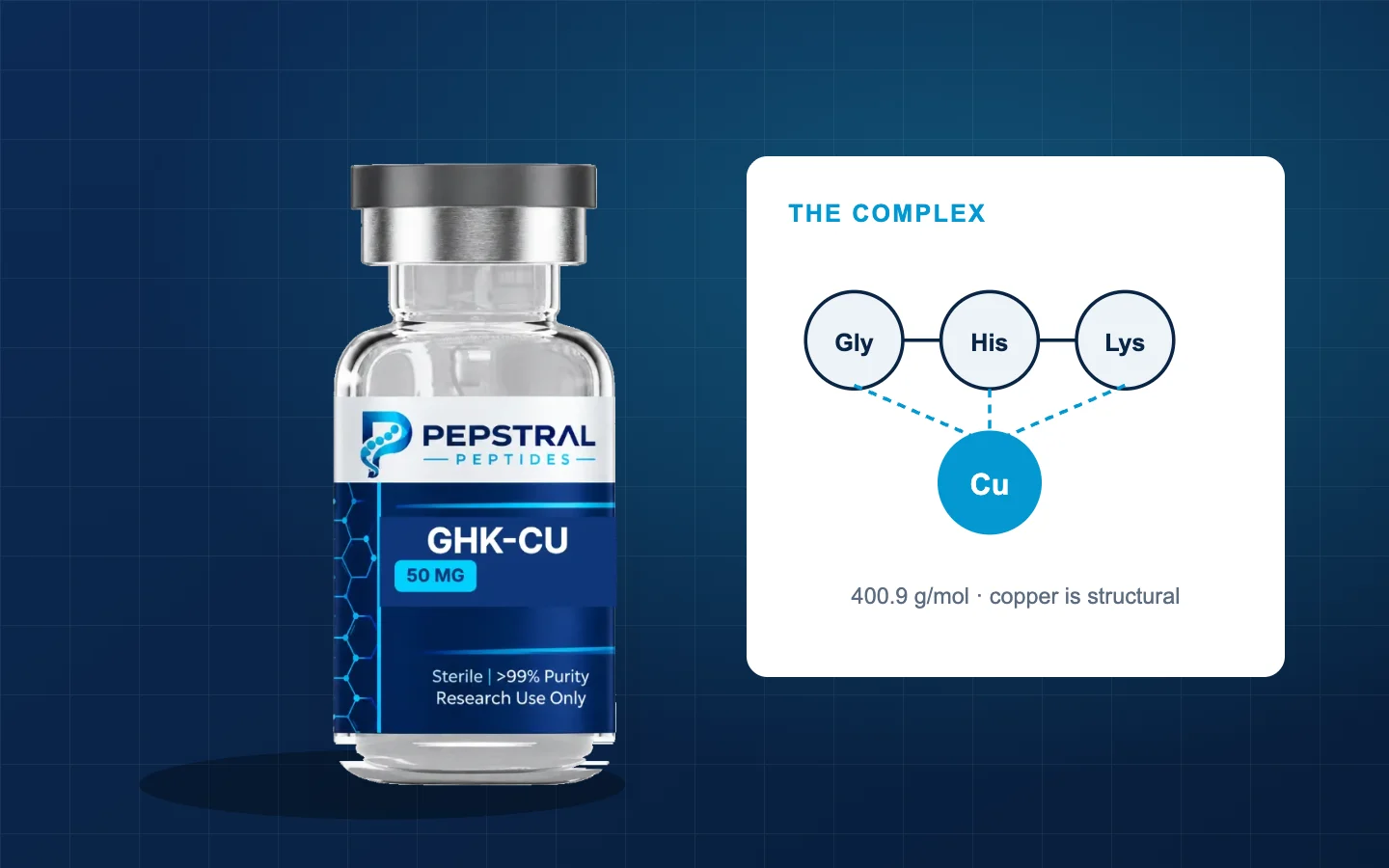
GHK-Cu is catalogued as a peptide, and it is one, but describing it only that way misses the point of the molecule. The full compound is a three-residue peptide — glycine, histidine, lysine — coordinating a copper(II) ion. The copper is part of the structure, not something added to it. That distinction governs how the compound behaves in a vial, how it is studied, and what you have to declare in a methods section.
What is the actual structure?
GHK is Gly-His-Lys, a tripeptide first isolated from human plasma. On its own it is unremarkable in size — three residues, the shortest compounds in this catalogue sit in the same range.
What makes it interesting is that this particular sequence is an excellent copper chelator. The N-terminal amine, the adjacent backbone nitrogen and the imidazole side chain of histidine sit at the right spacing to grip a metal ion between them. Copper(II) slots into that pocket, and the resulting complex is stable enough to be the form that exists in practice.
PubChem lists the complex as C14H21CuN6O4, 400.9 g/mol. The copper contributes about 63.5 of that — roughly a sixth of the molecular weight is the metal.
| GHK | GHK-Cu | |
|---|---|---|
| Composition | Gly-His-Lys | Gly-His-Lys + Cu(II) |
| Molecular weight | ~340 g/mol | 400.9 g/mol |
| Copper present | No | Yes, coordinated |
| What the literature studies | Rarely alone | This is the form in most papers |
| Assay consideration | Standard peptide handling | Redox-active metal in the system |
Why does it matter that the copper is integral?
Because it means GHK and GHK-Cu are not interchangeable in an experiment, and results reported for one should not be quietly attributed to the other.
Copper is biologically active in its own right. It is a cofactor for lysyl oxidase, which cross-links collagen and elastin, and it participates in a range of redox chemistry. When a paper reports an effect for the complex, disentangling "the peptide did this" from "the copper did this" from "the complex did this" is exactly the hard part — and it is why well-designed work includes copper-salt controls alongside the peptide.
If your design does not include that control, the honest description of your result is that you observed an effect of the complex, not of the peptide.
What has actually been published?
Three reference points, all preclinical:
Park and colleagues (2016) reported that the GHK-Cu complex reduced markers of inflammation in a mouse model of lipopolysaccharide-induced acute lung injury — a model far from the dermatological context GHK-Cu is usually associated with, and useful precisely because it broadens the picture.
Fu and colleagues (2015) examined GHK-Cu in a rat model of ACL reconstruction and described a transient improvement in healing outcome. The word "transient" is in their title, and it is the kind of qualification that tends to disappear when findings are summarised by third parties.
Dou and colleagues (2020) reviewed GHK in the context of ageing research, covering the gene-expression work that much of the broader interest rests on.
These are animal and in-vitro studies. They describe neither the material sold here nor any human use of it, and everything in this catalogue is for in-vitro laboratory research only.
What does the copper mean for handling?
Three practical consequences, and they are the reason GHK-Cu gets its own handling note rather than the generic peptide one:
- It is coloured. The complex is blue, and reconstituted solution is visibly so. A blue solution is not a contamination signal here — it is the compound.
- Copper is not inert in your system. Trace-metal-sensitive assays, anything measuring oxidative stress, and media with chelators in them can all interact with it. Declare the copper in your methods.
- It accelerates oxidation of other things. In a blend with oxidation-prone residues — methionine or cysteine in a co-formulated compound — the metal is a catalyst. Our solution-stability post covers why that matters once a vial is reconstituted.
This catalogue sells GHK-Cu alone and in two blends, the GLOW mix and the KLOW blend, and the copper note applies equally in both.
Frequently asked questions
Is the blue colour a sign of degradation?
No — it is the copper complex. A colourless GHK-Cu solution would be the anomaly worth investigating.
Can I make GHK-Cu by adding copper to GHK?
The complex does form spontaneously given a copper source, which is why the affinity matters. But the stoichiometry, the copper salt used and the resulting speciation all become your variables rather than the supplier's, and none of that is captured on a certificate. Buying the complex means the thing in the vial is characterised.
Why is it dosed in much larger amounts than other peptides?
The catalogue lists GHK-Cu at 50 mg and 100 mg where most compounds are 5 or 10 mg. At 400.9 g/mol it is a very small molecule, so a given mass is a very large molar amount — a 50 mg vial holds more than 120,000 nanomoles. Our molarity post works through why equal masses are not equal amounts.
Does GHK-Cu belong in the same category as the mitochondrial peptides?
They sit together under longevity and skin because that is where researchers look for them, not because the chemistry is related. GHK-Cu is a copper complex; MOTS-c and humanin are encoded in the mitochondrial genome. The category page says so explicitly.
References
- Dou Y, Lee A, Zhu L, Morton J, Ladiges W. The potential of GHK as an anti-aging peptide. Aging Pathobiology and Therapeutics 2020;2(1):58-61. doi.org/10.31491/apt.2020.03.014
- Park JR, Lee H, Kim SI, Yang SR. The tri-peptide GHK-Cu complex ameliorates lipopolysaccharide-induced acute lung injury in mice. Oncotarget 2016;7(36):58405-58417. doi.org/10.18632/oncotarget.11168
- Fu SC, Cheuk YC, Hung LK, Chan KM. Tripeptide-copper complex GHK-Cu (II) transiently improved healing outcome in a rat model of ACL reconstruction. Journal of Orthopaedic Research 2015;33(7):1024-1033. doi.org/10.1002/jor.22831
- PubChem CID 139035031 — GHK-Cu: molecular formula C14H21CuN6O4, molecular weight 400.9. pubchem.ncbi.nlm.nih.gov/compound/139035031
Every product mentioned is sold for laboratory research use only and is not for human or animal use. Nothing on this page describes or recommends use of the material sold here in humans or animals.