
N-acetyl Semax amidate is Semax with both ends capped: an acetyl group on the N-terminal amine and an amide in place of the C-terminal carboxylic acid. The heptapeptide in the middle is unchanged. The two modifications add about 41 mass units, remove the two terminal charges, and make the ends harder for exopeptidases to attack. That is all they do, and it is enough to make the capped form a different compound with a different mass, a different charge state and, importantly, a different literature. This post sets the two side by side, explains what each cap changes, and says which format the catalogue supplies each in: Semax as a powder with a certificate, N-acetyl Semax amidate as a spray solution.
What is Semax, before any modification?
Semax is a synthetic heptapeptide: Met-Glu-His-Phe-Pro-Gly-Pro. The first four residues are positions 4 to 7 of adrenocorticotropic hormone, the fragment that carries the hormone's non-endocrine activity without the region responsible for steroid release. The Pro-Gly-Pro tail was added to slow degradation; Zolotarev and colleagues showed the peptide is cleaved from the N-terminus in cell-culture and membrane preparations, with the Pro-Gly-Pro fragment among the products. Dolotov's group reported that Semax raises BDNF and trkB expression in rat hippocampus, which is the finding most often cited for it. The Adamax and Semax post covers the adamantane-conjugated relative.
| Semax | N-acetyl Semax amidate | |
|---|---|---|
| Sequence | H-Met-Glu-His-Phe-Pro-Gly-Pro-OH | Ac-Met-Glu-His-Phe-Pro-Gly-Pro-NH2 |
| Formula | C37H51N9O10S | C39H54N10O10S |
| Mass (g/mol) | 813.9 | about 855.0 (computed) |
| N-terminus | Free amine, protonated at neutral pH | Acetylated, uncharged |
| C-terminus | Free acid, deprotonated at neutral pH | Amide, uncharged |
| Net charge at pH 7 | About 0 (one +, one −, plus the glutamate −) | About −1 (glutamate only) |
| Exopeptidase exposure | Both ends | Both ends blocked |
| Peer-reviewed literature | Substantial, mostly Russian groups | Not located |
| Catalogue format | 10 mg lyophilized powder | 10 mL spray, 1 mg/mL |
| Current certificate | COA7586, lot SEMX10-0803 | None on file |
What does N-terminal acetylation do?
It replaces the N-terminal NH3+ with an acetamide. Three consequences follow.
The charge goes. The free N-terminal amine is protonated at neutral pH. Acetylating it removes that positive charge, which changes the molecule's isoelectric point and, modestly, its solubility and its behaviour on a reversed-phase column.
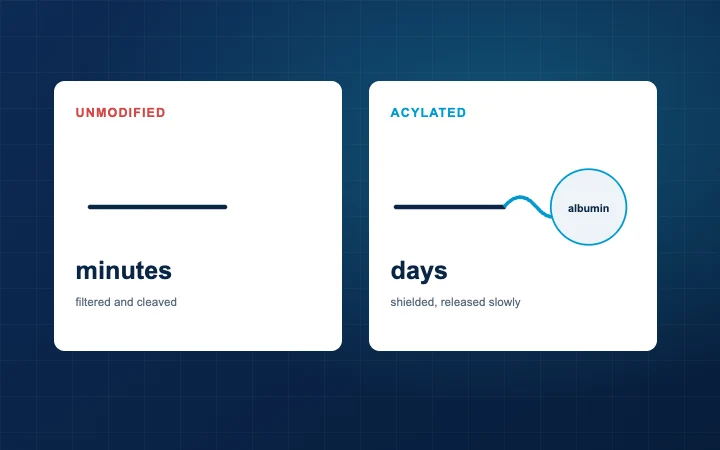
Aminopeptidases lose their handle. Enzymes that trim residues from the N-terminus need a free amine to recognise. Zolotarev's work found Semax degraded from that end; capping it is the obvious counter. The acylated-peptides post explains the general logic of blocking a terminus, and acetylation is the smallest version of it.
The mass goes up by 42.04. That is the whole acetyl group, C2H2O, and it is the first thing to look for on a mass spectrum when checking which form is in the vial.
What does C-terminal amidation do?
It replaces the C-terminal COOH with CONH2.
The negative charge goes. A free C-terminal acid is deprotonated at neutral pH. The amide is neutral. Combined with the acetyl, this leaves the glutamate side chain as the only charge on the molecule.
Carboxypeptidases lose their handle. The mirror of the aminopeptidase point. Many native peptide hormones are amidated for exactly this reason, and the five-names post notes how often the amide is dropped from a product name even though it changes the compound.
The mass goes down by 0.98. An OH becomes an NH2. On its own that is within the tolerance of a low-resolution instrument, which is why the acetyl is the diagnostic change and the amide is confirmed by the exact mass.
Why does it matter that the literature is on the unblocked peptide?
Because the published results, including the BDNF findings, were obtained with Semax as Dolotov and Zolotarev describe it: free at both ends. Capping both termini changes charge, conformation at the ends and degradation rate. Whether it changes receptor interaction or the downstream response is an empirical question, and no peer-reviewed characterisation of the acetyl-amidate form was located while writing this post. A methods section that cites Semax papers for a study run with N-acetyl Semax amidate is citing a different molecule. The trial-data post makes the same argument across a wider gap; here the gap is two small groups, but it is still a gap.
Which format does the catalogue supply each in, and why?
Semax ships as a 10 mg lyophilized powder. The current certificate, COA7586 for lot SEMX10-0803, was issued by Bioviridian Inc. on 17 August 2026 and reports identity by LC-MS/MS at 813.9, content 10.50 mg, purity 99.82% by RP-HPLC at 214 nm, endotoxin below 0.05 EU/mL and heavy metals conforming. It is published unaltered on the certificate page. The Selank and Semax post covers the blend that pairs it with Selank.
N-acetyl Semax amidate ships as a 10 mL metered spray at 1 mg/mL, delivering 100 µg per actuation, for laboratory research use only. The reasons a ready-made solution suits some compounds are set out in the solution-format post. This product currently has no certificate on file, and the product page says so rather than borrowing the powder's; the certificates for the two forms would report different masses, so one cannot stand in for the other.
How do you tell the two apart on a certificate?
| Check | Semax | N-acetyl Semax amidate |
|---|---|---|
| Observed mass | 813.9 | about 855.0 |
| Difference | Reference | +41.1 |
| Reversed-phase retention | Reference | Slightly later, because the capped peptide is a little less polar |
| Name on the identity line | Semax | Should name the acetyl and the amide |
A certificate that says "Semax" and reports 813.9 is for the unblocked peptide, whatever the product label says. The LC-MS post explains why a 41-unit difference is unambiguous on any instrument.
Frequently asked questions
Is N-acetyl Semax amidate stronger than Semax?
There is no peer-reviewed comparison to answer that. The caps change degradation and charge; whether they change activity in a given model is something the model has to show.
Can I make the acetyl-amidate form from Semax myself?
Not on a bench. Acetylation and amidation are done during solid-phase synthesis, the amide by choosing the resin and the acetyl as the final coupling step, as the synthesis post describes. They are not post-hoc treatments.
Why is the spray 1 mg/mL?
Because 10 mg in 10 mL gives a round concentration and a 100 µg actuation. A reconstituted Semax powder can be made to any concentration; the concentration table gives the arithmetic for the 10 mg vial.
Does the acetyl group change storage?
Not the dry-powder rules. In solution, a capped peptide is protected against exopeptidases but not against oxidation, and Semax carries a methionine at position 1 that oxidises in the same way the glutathione post describes for thiols. Store solutions cold and dark either way.
Which one should a methods section name?
Whichever was used, in full, with the certificate code. "Semax" for a study run with the capped form is a misidentification, and the mass on the certificate is the evidence either way.
References
- Dolotov OV, Karpenko EA, Inozemtseva LS, et al. Semax, an analog of ACTH(4-10) with cognitive effects, regulates BDNF and trkB expression in the rat hippocampus. Brain Research 2006;1117(1):54-60. doi.org/10.1016/j.brainres.2006.07.108
- Zolotarev YA, Dolotov OV, Inozemtseva LS, et al. Degradation of the ACTH(4-10) analog Semax in the presence of rat basal forebrain cell cultures and plasma membranes. Amino Acids 2006;30(4):403-408. doi.org/10.1007/s00726-006-0328-8
- PubChem, National Library of Medicine. Semax, CID 9811102, C37H51N9O10S, 813.9 g/mol. Read 27 September 2026. pubchem.ncbi.nlm.nih.gov/compound/9811102
Every product mentioned is sold for laboratory research use only and is not for human or animal use. Nothing on this page describes or recommends use of the material sold here in humans or animals.