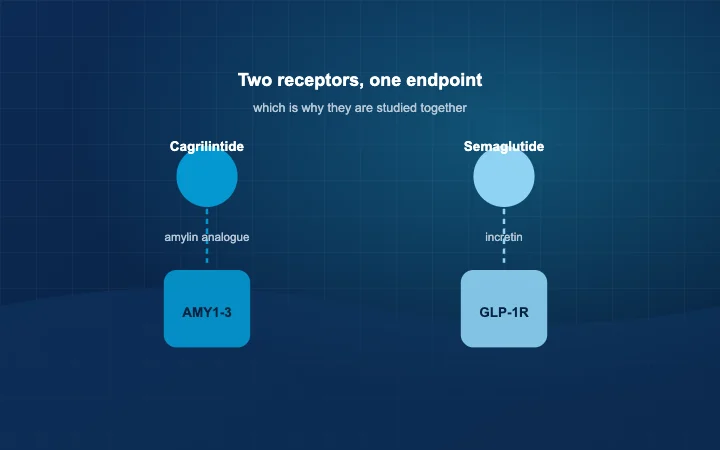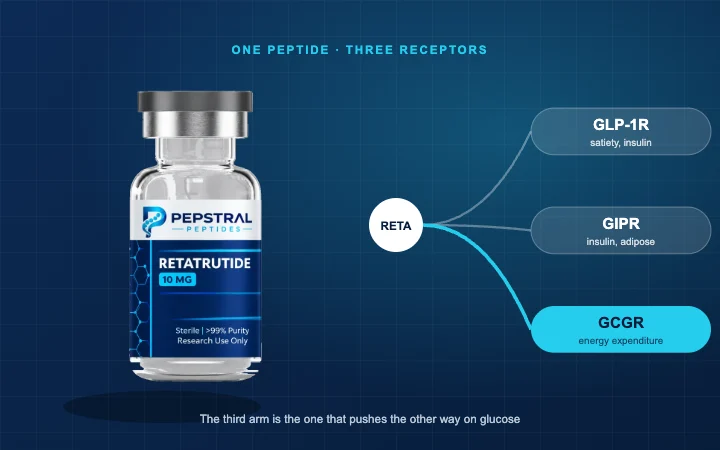

The retatrutide and cagrilintide blend is one vial holding 12.5 mg of retatrutide and 2.5 mg of cagrilintide, co-lyophilized from a single lot. Retatrutide is a 39-residue acylated peptide that acts at the GIP, GLP-1 and glucagon receptors; cagrilintide is a 37-residue acylated analogue of amylin that acts at the amylin and calcitonin receptor family. Together that is four receptor systems from one reconstitution, which is the reason the blend exists and the reason it has to be designed around carefully. This post gives the contents, converts the mass ratio to a molar ratio, reads the current certificate for the blend in the catalogue component by component, and says plainly what the published literature does and does not cover. The amylin post and the glucagon receptor post cover the pharmacology of each half; this one covers the vial.
What is in the vial?
| Component | What it is | Residues | Formula | Mass | Label | Certificate content |
|---|---|---|---|---|---|---|
| Retatrutide | GIP, GLP-1 and glucagon receptor triple agonist, acylated | 39 | C221H342N46O68 | 4731.2 | 12.5 mg | 12.59 mg |
| Cagrilintide | Long-acting amylin analogue, acylated | 37 | C194H312N54O59S2 | 4409.1 | 2.5 mg | 2.61 mg |
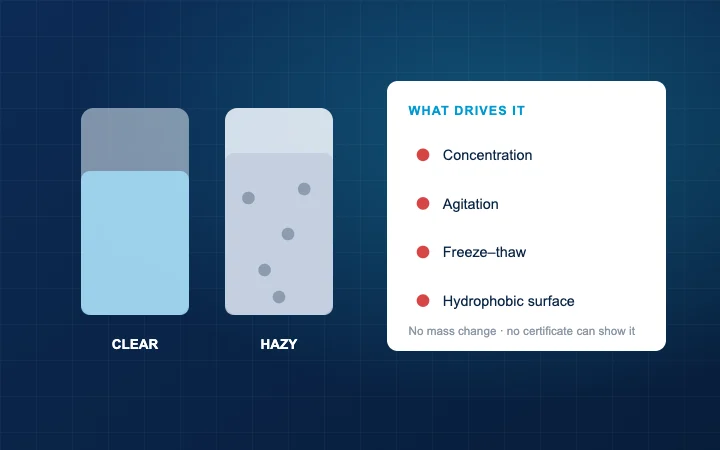
Both carry a fatty-acid side chain that binds albumin, the design the acylated-peptides post explains, and both are among the peptides the slow-dissolving post describes: they take minutes to go into solution and should be swirled, never shaken. Reconstituting the blend is reconstituting two of them at once, which the blends post covers.
Why is 5 to 1 by mass not 5 to 1 by moles?
Because the two molecules weigh different amounts.
| Component | Mass in vial (certificate) | Molar mass | Amount |
|---|---|---|---|
| Retatrutide | 12.59 mg | 4731.2 g/mol | 2.66 µmol |
| Cagrilintide | 2.61 mg | 4409.1 g/mol | 0.59 µmol |
| Ratio | 4.8 : 1 by mass | 4.5 : 1 by moles |
Reconstituted in 2 mL, the stock is 1.33 mM retatrutide and 0.30 mM cagrilintide, and every dilution from it keeps that 4.5-to-1 molar ratio. A design that wants a different ratio, equimolar for instance, needs the single compounds rather than the blend. The molarity post covers the general arithmetic, and the retatrutide table the fill volumes for the retatrutide vials on their own.
What does the certificate report?
Lot RTCAG15-0803, certificate COA7594, issued by Bioviridian Inc. on 17 August 2026 against a 15 mg sample, published unaltered on the certificate page. A blend certificate has to identify and quantify each component separately, and this one does.
| Certificate line | Result | What it tells you |
|---|---|---|
| Identity, LC-MS/MS | Two masses, 4731.2 and 4409.1 | Both peptides present and neither confused with a near relative: semaglutide is 4113.6, tirzepatide 4813.5 |
| Content, HPLC quantitation | 12.59 mg and 2.61 mg | Each component against its own label figure; both slightly over |
| Purity, RP-HPLC at 214 nm | 99.70% | One figure for the mixture's chromatogram, see below |
| Endotoxin | < 0.05 EU/mL | Suitable for cell work |
| Heavy metals | Conforms | August 2026 layout |
The single purity figure describes the chromatogram: 99.70% of the absorbing material is one of the two expected peaks. It cannot say how pure each component was before they were mixed, and it cannot assign an impurity to one peptide or the other. The blend certificate post explains this limit; the identity masses and the two content figures are the component-specific evidence. Note also that cagrilintide on its own currently has no certificate on file, which its product page states. The blend is the only certified form of cagrilintide in the catalogue today.
Which receptors are involved?
Four systems, which is the point and the complication.
| Receptor | Ligand in the vial | Notes |
|---|---|---|
| GLP-1 receptor | Retatrutide | Shared with semaglutide and tirzepatide |
| GIP receptor | Retatrutide | Shared with tirzepatide |
| Glucagon receptor | Retatrutide | The third arm; the glucagon post explains why it is the unusual one |
| Amylin receptors (calcitonin receptor with RAMP1 to 3) | Cagrilintide | Also active at the calcitonin receptor itself; the amylin post covers the family |
An effect measured with the blend is an effect of four receptor systems at a fixed ratio. Attributing any part of it to one receptor needs the single-compound arms, and for the glucagon and GIP arms, selective agonists that the blend does not contain. The receptor table lists each, and the concentration-response post covers a design with fixed-ratio mixtures.
What has the literature actually tested?
Not this pair. Retatrutide's published work, Coskun's discovery paper and the clinical trials that followed, studied retatrutide alone. Cagrilintide's published work, Lau's phase 2 and the CagriSema programme, studied cagrilintide alone or with semaglutide. Neither has been combined with the other in a published study as of the date on this post. The blend is a research reagent for a question the literature has not yet asked; it is not a reproduction of a clinical combination, and a methods section should not imply otherwise. The trial-data post makes the wider point.
How is the blend handled?
As two acylated GLP-1-class peptides, which means slowly and gently. Add reconstitution solution down the side of the vial, wait, swirl, wait again; the slow-dissolving post explains why the acyl chains make the powder wet slowly. Both peptides adsorb to plastic in dilute solution, so working dilutions go into medium with albumin, which is also what the acyl chain is designed to bind. Aliquot once and freeze; the reconstituted-lifetime post gives the windows and the storage guide the dry-vial rules.
Frequently asked questions
Is this the same as CagriSema?
No. CagriSema is cagrilintide with semaglutide. This blend is cagrilintide with retatrutide, a different GLP-1-class peptide with two extra receptor activities. The pair has no published trial.
Can I get cagrilintide with a certificate on its own?
Not at present; the cagrilintide page says the single-compound vial has no certificate on file. The blend's certificate covers cagrilintide only as a component of this lot.
Why 12.5 mg to 2.5 mg?
That is the ratio the supplier fills. It is not derived from any published study, since none exists for this pair. Treat it as a fixed-ratio reagent and record the molar ratio, 4.5 to 1, in the methods.
Does the blend dissolve faster or slower than retatrutide alone?
About the same: both components are acylated and both wet slowly. Expect several minutes with gentle swirling and do not shake.
What should the methods section record?
Both components by name, formula and mass, the molar ratio, the supplier, lot RTCAG15-0803, certificate COA7594, and the stock concentration of each. The methods-section post has the template.
References
- Coskun T, Urva S, Roell WC, et al. LY3437943, a novel triple glucagon, GIP, and GLP-1 receptor agonist for glycemic control and weight loss: from discovery to clinical proof of concept. Cell Metabolism 2022;34(9):1234-1247.e9. doi.org/10.1016/j.cmet.2022.07.013
- Lau DCW, Erichsen L, Francisco AM, et al. Once-weekly cagrilintide for weight management in people with overweight and obesity: a multicentre, randomised, double-blind, placebo-controlled and active-controlled, dose-finding phase 2 trial. The Lancet 2021;398(10317):2160-2172. doi.org/10.1016/S0140-6736(21)01751-7
- PubChem, National Library of Medicine. Retatrutide CID 171390338, C221H342N46O68, 4731; cagrilintide CID 171397054, C194H312N54O59S2, 4409. Read 28 September 2026. pubchem.ncbi.nlm.nih.gov/compound/171397054
- Bioviridian Inc. Certificate of analysis COA7594, Reta/Cagri 15 mg, lot RTCAG15-0803, issued 17 August 2026. coa.html
Every product mentioned is sold for laboratory research use only and is not for human or animal use. Nothing on this page describes or recommends use of the material sold here in humans or animals.